
Medi-Cal residential rehab San Diego: county-listed and DHCS-certified programs, population served, phones, and how prior authorization works.
Jump to a section
Medi-Cal residential rehab in San Diego is arranged by County Behavioral Health Services, not your health plan, and every placement requires prior authorization. The programs below are the residential substance use treatment sites on the county's own residential treatment listing or in the state Department of Health Care Services certification dataset, with the population each is certified to serve. One number starts the process: the San Diego Access and Crisis Line, 1-888-724-7240, free and open 24 hours a day.
Golden Coast Rehab publishes this page and is not on the list. Golden Coast Rehab does not provide residential, inpatient, or overnight care. Our part comes later, when someone leaves a residential program and needs a place to keep going.
If you are in danger right now, call 911. In a mental health or overdose crisis, call or text 988 or call 1-888-724-7240. A blog page is not crisis care.
Key Takeaways on Medi-Cal residential rehab in San Diego
- Residential substance use treatment for adults on Medi-Cal in San Diego runs through the Drug Medi-Cal Organized Delivery System, carved out of the four managed care plans and administered by County Behavioral Health Services with Optum as its administrative services organization.
- Residential care always requires prior authorization. IOP, outpatient, ambulatory detox, and medication-assisted treatment do not, and you can call those programs yourself.
- Start at the Access and Crisis Line, 1-888-724-7240, TTY 711, 24 hours a day. You may also be given an Optum authorization number for the residential placement.
- Population matters more than location. Many sites are certified for men only, women only, or women and children, so the nearest program is often not the one you can enter.
- For most Medi-Cal members, county substance use services carry no copay and no deductible.
- There is no published length of stay. Level and duration are determined clinically through an ASAM assessment.
How did we rank San Diego's Medi-Cal residential rehab programs?
- The program is a residential substance use treatment site in San Diego County at ASAM level 3.1 or 3.5, not residential detox and not mental health crisis residential.
- The program appears on the County of San Diego Behavioral Health Services residential treatment listing or in the state DHCS facility certification dataset with a residential program code.
- The DHCS certification is current with an expiration after 12/31/2026, so the credential is unlikely to lapse inside this page's useful life.
- Order is not a quality judgment. Programs on the county's own residential listing come first, then programs whose public credential is a current DHCS residential certification, alphabetical within each tier.
- Every entry states the population code DHCS records for that site, because that decides whether you can be admitted at all.
- Golden Coast Rehab publishes this list and is not in it. We hold no residential certification, have no financial relationship with any program named here, and did not rate or score any facility by quality.
Several entries were exceptions. A county-listed substance use residential teen program matched no DHCS certification row and, being a youth program outside this page's adult scope, was dropped. Three DHCS-certified residential sites that do not appear on the county residential listing, and that the allowed sources could not confirm as open-access residential rehab, were left out; if one is suggested to you, the Access and Crisis Line can confirm it by name. A county Pathfinders address on Cedar Street sits one digit from the address DHCS records for a Pathfinders detox site, so it is carried inside the Pathfinders entry with that caveat rather than listed twice. One Vista program was excluded because its certification expires 12/31/2026. Last verified 2026-08-30 against the County of San Diego Behavioral Health Services residential treatment listing and the DHCS licensed and certified facilities dataset for San Diego County.
This article is part of a series built from the same county and DHCS listings. If withdrawal management comes first, see the best Medi-Cal detox options in San Diego; for the outpatient levels that follow, compare Medi-Cal addiction treatment programs ranked for San Diego; and where a mental health condition is also present, see ranked Medi-Cal dual diagnosis programs in San Diego.
Best Medi-Cal residential rehab programs in San Diego
- Alpha Project for the Homeless, Casa Raphael (Vista). Population: men only. Casa Raphael is a residential substance use treatment program in Vista, in the North Coastal region, and the largest county-listed site on this page at a DHCS-recorded capacity of 132 beds. Residential care sits at ASAM levels 3.1 and 3.5, and an assessment decides which fits. Start at the Access and Crisis Line, 1-888-724-7240. Direct line: (760) 630-9922. DHCS certification 370073AN, expiration 6/30/2027.
- CRASH, Inc., Golden Hill House (San Diego). Population: men only. Golden Hill House is a CRASH, Inc. residential program on E Street, county-listed, with a DHCS-recorded capacity of 36. CRASH operates several county-listed sites, so confirm which address the Access and Crisis Line is authorizing. Direct line: (619) 234-3346. DHCS certification 370024LN, expiration 4/30/2027.
- CRASH, Inc., Golden Hill House II (San Diego). Population: co-ed. Golden Hill House II is CRASH, Inc.'s co-ed site, near Golden Hill House but a separate certification and population, with a DHCS-recorded capacity of 45. If you are not a man and you are looking at CRASH, this is the site to ask for by name. Direct line: (619) 239-9691. DHCS certification 370024KN, expiration 5/31/2028.
- CRASH, Inc., Short Term I (Marlborough) (San Diego). Population: men only. Short Term I is CRASH, Inc.'s county-listed Marlborough Avenue program, with a DHCS-recorded capacity of 50. The name refers to the county's short-term residential category, not a published length of stay. Entry runs through 1-888-724-7240. Direct line: (619) 282-7274. DHCS certification 370024IN, expiration 3/31/2027.
- House of Metamorphosis (San Diego). Population: co-ed. House of Metamorphosis is a co-ed residential program on 42nd Street, with a DHCS-recorded capacity of 64. The county listing and the DHCS dataset give different phone numbers, so confirm before relying on either: DHCS records (619) 236-9217 and the county records (619) 236-9492. Admission requires prior authorization through 1-888-724-7240. DHCS certification 370021AN, expiration 11/30/2027.
- MAAC, Casa de Milagros (San Diego). Population: women and children. Casa de Milagros is MAAC's county-listed residential program for women and children on South 38th Street, with a DHCS-recorded capacity of 18. This is the population code to ask about if you are pregnant or parenting and cannot enter treatment without your children. Placement still runs through assessment and prior authorization. Direct line: (619) 262-4002. DHCS certification 370014AN, expiration 9/30/2027.
- MAAC, Nosotros (Chula Vista). Population: men only. Nosotros is MAAC's men's residential program in Chula Vista, serving the South region, with a DHCS-recorded capacity of 17. South Bay residents often commute north for residential care, so this is the closest county-listed option for much of the region. Direct line: (619) 426-4801. DHCS certification 370014BN, expiration 9/30/2027.
- New Entra Casa (San Diego). Population: women only. New Entra Casa is a county-listed women's residential program on Pershing Avenue, with a DHCS-recorded capacity of 6. At a DHCS-recorded capacity of 6 it is one of the smallest county-listed sites, so ask about it by name rather than assuming it is on the list you are read. Direct line: (619) 294-4526. DHCS certification 370083AN, expiration 4/30/2028.
- Pathfinders of San Diego (San Diego). Population: men only. Pathfinders of San Diego runs a men's residential program on Dale Street, with a DHCS-recorded capacity of 16. Pathfinders also holds a separate residential detox certification at a Cedar Street address, so be specific about which service you want; county and DHCS records differ on that house number and on the phone, where DHCS gives (619) 239-7370 and the county gives (619) 260-1605. DHCS certification 370006AN, expiration 7/31/2028.
- The Stepping Stone of San Diego (San Diego). Population: co-ed. The Stepping Stone of San Diego is a county-listed co-ed residential program on Central Avenue, with a DHCS-recorded capacity of 31. Here too the phone numbers differ: DHCS records (619) 584-4010 and the county records (619) 278-0777. Admission requires prior authorization, so begin at 1-888-724-7240. DHCS certification 370008DN, expiration 5/31/2028.
- The Turning Point Home of San Diego (San Diego). Population: women only. The Turning Point Home is a women's residential program on 25th Street, county-listed as "Turning Point," with a DHCS-recorded capacity of 20. It is one of a handful of county-listed sites serving women without children, a narrow category countywide. Ask the Access and Crisis Line to check it, New Entra Casa, and the co-ed sites in one call. Direct line: (619) 233-0067. DHCS certification 370013AN, expiration 7/31/2027.
- The Twelfth Step House of San Diego, Heartland House (San Diego). Population: men only. Heartland House is The Twelfth Step House of San Diego's residential program on Streamview Drive, with a DHCS-recorded capacity of 32. The county lists it as "Heartland House," the name to use on the phone. Direct line: (619) 287-5460. DHCS certification 370003AN, expiration 9/30/2027.
- Tradition One, Tradition One-Men (San Diego). Population: men only. Tradition One-Men is a residential program on Delta Street, capacity 43. It is the one entry the county's residential listing does not name, which is why it sits in the second tier: its public credential is the DHCS certification alone. Confirm with the Access and Crisis Line that it is an authorized placement before counting on it. Direct line: (619) 264-0141. DHCS certification 370012AN, expiration 2/29/2028.
Do you actually need residential, or structured outpatient?
Most people searching for residential rehab have not had an assessment yet, and a meaningful share of them are assessed into intensive outpatient care instead. The honest fork looks like this: residential fits when withdrawal risk is high, the home environment actively undermines recovery, or previous outpatient attempts have not held. Structured outpatient, monitored detox where needed, then IOP with medication support, fits when housing is stable and work or family cannot pause. You do not have to decide this yourself; the ASAM assessment below decides it, and either answer is covered the same way.
Who qualifies for residential treatment under Drug Medi-Cal?
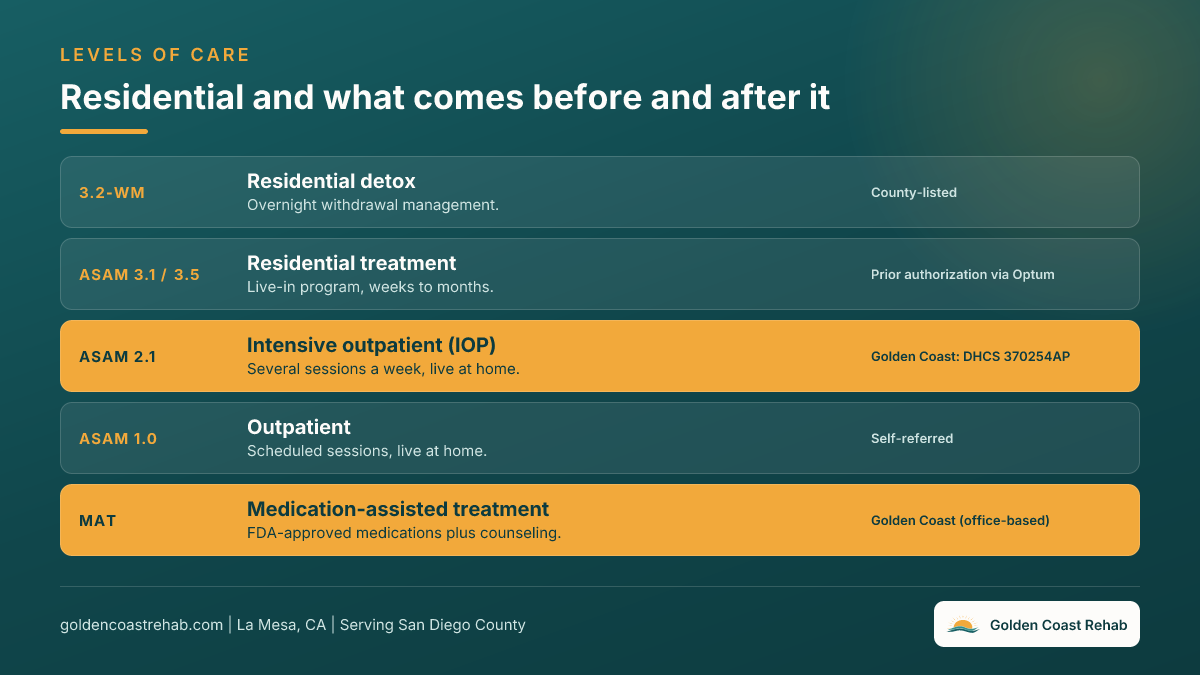
You qualify for residential treatment when a clinical assessment places you at ASAM level 3.1 or 3.5, and not before. The American Society of Addiction Medicine criteria weigh withdrawal risk, medical and psychiatric conditions, readiness to change, relapse risk, and whether your living situation supports recovery. Level 3.1 is clinically managed low-intensity care and 3.5 is clinically managed high-intensity care. Someone with stable housing and moderate use is usually assessed into outpatient or intensive outpatient care instead.
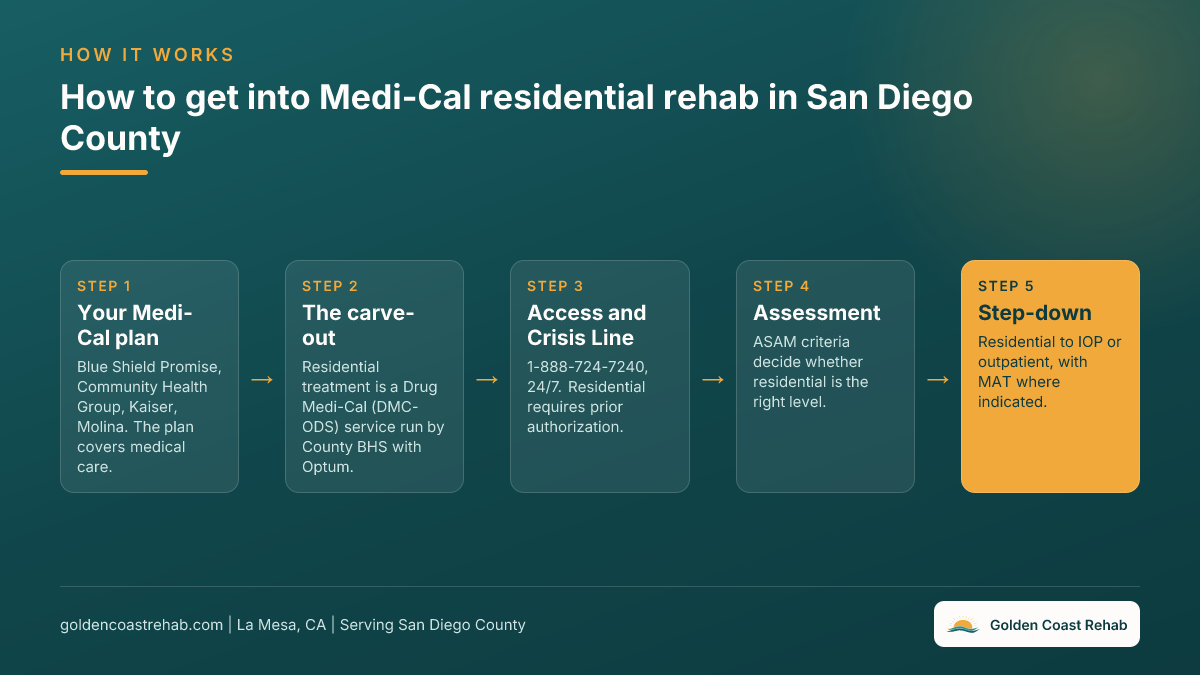
You also have to be a San Diego County Medi-Cal member with a Drug Medi-Cal qualifying substance use disorder diagnosis. Medi-Cal is California's Medicaid program, and this residential lane is the county-run part of it, not anything your plan card decides. Blue Shield of California Promise Health Plan, Community Health Group, Kaiser Permanente, and Molina Healthcare members all enter through the same county system, because substance use treatment is carved out of all four plans.
How does prior authorization for residential rehab work?
Prior authorization means the county approves the placement before a program can admit you. Call the Access and Crisis Line at 1-888-724-7240 and say you want residential substance use treatment. The line is operated by Optum for the county, is staffed 24 hours a day, and handles detox and outpatient referrals through the same system. You may also be given an Optum authorization number, 1-800-798-2254, option 3 then option 2, for the residential authorization itself; both numbers appear in county material, so use whichever the person on the phone says is current.
Have ready your Medi-Cal number, date of birth, where you are staying, what you are using and how recently, and any medications or medical conditions. County standards call for urgent needs to be seen within 48 hours and routine non-urgent appointments within 10 business days. If the assessment places you below residential level, that is a level-of-care finding rather than a rejection, and the same call should produce an outpatient or IOP referral.
What does Medi-Cal residential rehab cost?
For most Medi-Cal members, county-delivered substance use treatment carries no cost: no deductible and no per-session copay across outpatient treatment, intensive outpatient, withdrawal management, and medication-assisted treatment. The county publishes no cost statement specific to residential care, so ask the Access and Crisis Line what your share of cost is, if any, before admission. If a program quotes you a daily rate, the placement is probably not going through the county system, and 1-888-724-7240 can point you to one that is. Housing and transportation are separate questions; the county behavioral health resources page covers what exists locally.
How long does residential treatment last?
There is no fixed length. The county categorizes this lane as short-term residential treatment, but neither the county listing nor the DHCS dataset publishes a number of days: length of stay is determined clinically and reauthorized as care continues. A guaranteed 30, 60, or 90 days quoted before an assessment describes a marketing package, not a Drug Medi-Cal authorization. What ends a stay is a clinical judgment that you can hold your recovery at a lower level, which is why discharge planning starts early.
What comes after residential treatment?
What comes after residential treatment is a step down, usually to intensive outpatient then outpatient, with medication-assisted treatment continuing across both when it applies. This is where the county stops arranging things for you: outpatient levels are self-referred, so you call the provider directly. The gap between leaving a bed and starting the next thing is where most people lose ground, so make that call before discharge.
Golden Coast Rehab is an outpatient provider in La Mesa, in East County, serving adults 18 and older. Golden Coast Rehab does not provide residential, inpatient, or overnight care. We hold DHCS substance use certification 370254AP, covering intensive outpatient treatment, outpatient treatment, medication-assisted treatment, and outpatient detoxification. We separately hold County Contract 575462 as a contracted provider of Specialty Mental Health Services for adults whose primary condition is a mental health condition, which matters when a substance use problem and a psychiatric condition are both in play. Reach admissions at (858) 925-8589. If residential is not where the assessment lands you, our companion pages on Medi-Cal addiction treatment in San Diego and what Medi-Cal covers for rehab walk through the rest of the system.
FAQ: Medi-Cal residential rehab in San Diego
Does Medi-Cal cover residential rehab in San Diego?
Can I just call a residential program and admit myself?
How do I get into Medi-Cal residential rehab in San Diego?
Why are so many San Diego residential programs men only?
What is the difference between residential rehab and residential detox?
Does Medi-Cal residential rehab cost anything?
How long will I stay in residential treatment?
Does Golden Coast Rehab offer residential rehab?
Bottom Line
Medi-Cal residential rehab in San Diego is gated by one phone call, and for most members the county's substance use services carry no copay. The county residential listing and the state certification dataset are where a program's credential is publicly verifiable, and the population each site serves will narrow your options faster than distance will. Call the Access and Crisis Line at 1-888-724-7240, ask for a substance use assessment, and name the programs above that match your population. When the stay ends, have the next level lined up before discharge day.
Sources
- County of San Diego Behavioral Health Services: Residential Treatment (substance use residential programs)https://www.sandiegocounty.gov/content/sdc/bhs/long-term_and_residential_services/residential_treatment.html
- California Department of Health Care Services: Licensed and Certified Substance Use Disorder Recovery and Treatment Facilities datasethttps://data.chhs.ca.gov/dataset/sud-recovery-treatment-facilities
- County of San Diego Behavioral Health Services: Substance Use Outpatient Services and the Access and Crisis Linehttps://www.sandiegocounty.gov/content/sdc/bhs/substance_use_outpatient_services.html
- Golden Coast Rehab: Medi-Cal coverage and credentialshttps://goldencoastrehab.com/medi-cal/

Reviewed by
Matthew Beck, LMFTProgram Director & Clinical Director
Matthew Beck, LMFT, is Program Director and Clinical Director at Golden Coast Rehab. A licensed Marriage and Family Therapist with more than a decade in substance use and mental health treatment, he oversees clinical delivery, supports staff, and holds the standard of care across programs. He has spent over ten years working directly with individuals and families affected by addiction and co-occurring mental health conditions. His therapeutic approach draws on person-centered, cognitive behavioral, and solution-focused work, meeting clients where they are while building practical tools for the long term. Matthew is open about his own recovery, and that experience informs how he runs a program: accountable, unsentimental about what the work requires, and unwilling to treat people as cases.
Written by the Golden Coast Rehab Editorial Team and reviewed for clinical accuracy before publication.