
Medi-Cal inpatient mental health San Diego: call 988 or 1-888-724-7240. The county list of crisis stabilization units, psychiatric hospitals, crisis beds.
Jump to a section
If you or someone you love is in a mental health emergency right now, call 988 or the San Diego Access and Crisis Line at 1-888-724-7240, or go to the nearest crisis stabilization unit or emergency room. If there is immediate danger, call 911. This page is a directory, not crisis care; for the wider picture across every level, see our guide to mental health facilities in San Diego. Medi-Cal inpatient mental health in San Diego is covered through Specialty Mental Health Services administered by County Behavioral Health Services. San Diego County Psychiatric Hospital is the county-operated acute psychiatric facility, at 3853 Rosecrans St., open 24/7 to adults 18 and older regardless of insurance status.
Golden Coast Rehab does not provide inpatient, crisis, or overnight care, so you will not find us on the lists below. Our role is what comes after a hospital or crisis stay: we are an outpatient provider of Specialty Mental Health Services (PHP and IOP) for the County of San Diego, Behavioral Health Services, under County Contract 575462. We will also help a family navigate the Access and Crisis Line. Call (858) 925-8589.
Everything below comes from County of San Diego Behavioral Health Services listings, in the county's own order. We did not rank anything.
Key Takeaways on Medi-Cal inpatient mental health care in San Diego
- The 24/7 entry points are 988, the Access and Crisis Line at 1-888-724-7240, a crisis stabilization unit, or an ER.
- Inpatient care is carved out of the four Medi-Cal managed care plans and run by County Behavioral Health Services, so your plan does not decide where you go.
- San Diego County Psychiatric Hospital is the county's own acute facility, and its listing says it serves adults regardless of insurance.
- Crisis stabilization units are walk-in and stabilize people for up to 24 hours, often avoiding an admission.
- Crisis residential is a short-term, home-like alternative to a hospital bed for adults with serious mental illness.
- These services cost most members nothing, and discharge should include a step-down plan, usually PHP or IOP.
How did we choose these programs?
- The facility appears on a County of San Diego Behavioral Health Services listing for the level of care described.
- The facility is in San Diego County and part of the county Specialty Mental Health Services system.
- Address, phone, hours, and population are exactly as the county states them.
- Order within each list is the county's. We did not rank, score, or rate any facility.
- Golden Coast Rehab publishes this list, appears nowhere in it, and has no financial relationship with any facility named.
Last verified 2026-08-29 against the county crisis stabilization unit, San Diego County Psychiatric Hospital, Tri-City PHF, hospital-level care, residential treatment, and Medi-Cal access pages.
This article is one of four in a series built from the same county and DHCS listings. For the step-down levels that follow a hospital stay, compare ranked Medi-Cal mental health PHP programs in San Diego and the best Medi-Cal mental health IOP options in San Diego; if substance use is the primary condition, see Medi-Cal addiction treatment programs ranked for San Diego. Newer entries cover severe mental health treatment options between the ER and weekly therapy and where a parent can send an adult son in San Diego.
Crisis stabilization units in San Diego County (walk-in, up to 24 hours)
A crisis stabilization unit provides walk-in psychiatric crisis care for up to 24 hours. No appointment, no referral. Staff assess, stabilize, and connect the person to whatever comes next, and for many people no hospital admission follows. All eight units below are open 24 hours a day, seven days a week, and all but the first serve adults 18 and older.
- Children and Youth Crisis Stabilization Unit (CYCSU) (San Diego). The county unit for children and adolescents, providing emergency psychiatric evaluations, crisis intervention and stabilization, brief outpatient counseling, case management, emergency medication management, and referrals. Young people may come on their own or be brought by parents, guardians, social workers, law enforcement, or ambulance. Phone: 619-876-4502. Address: 4309 Third Avenue, San Diego, CA 92103.
- North Coastal Crisis Stabilization Unit (Vista). Serving the North Coastal region. Phone: (760) 305-4900. Address: 524 W. Vista Way, Vista, CA 92083.
- North Coastal Live Well Health Center Crisis Stabilization Unit (Oceanside). Serving the North Coastal region. Phone: (760) 305-4848. Address: 1701 Mission Avenue Suite 130, Oceanside, CA 92058.
- Palomar Crisis Stabilization Unit (Escondido). Serving the North Inland region. Phone: (760) 739-3012. Address: 2185 Citracado Parkway, Escondido, CA 92029.
- San Diego County Psychiatric Hospital Emergency Psychiatric Unit (San Diego). Serving the North Central and Midway region, inside the county psychiatric hospital, so a person needing admission after stabilization is already on site. Phone: (619) 692-8222. Address: 3853 Rosecrans Street, San Diego, CA 92110.
- Paradise Valley Bayview Crisis Stabilization Unit (Chula Vista). Serving the South and West Chula Vista region. Phone: (619) 585-4221. Address: 330 Moss Street, Chula Vista, CA 91911.
- Sharp Crisis Stabilization Unit (Chula Vista). Serving the South and East Chula Vista region. Phone: (619) 502-5800. Address: 751 Medical Center Court, Chula Vista, CA 91911.
- East Region Crisis Stabilization Unit (El Cajon). Serving the East region, the closest unit to La Mesa, Santee, Lakeside, and Spring Valley. Phone: (619) 924-4205. Address: 200 S. Magnolia Avenue, El Cajon, CA 92020.
If you are not sure a crisis stabilization unit is the right call, the Access and Crisis Line will tell you. An assessment is not the same thing as an admission, and here is what happens during a crisis assessment, if that is the part you dread.
Inpatient psychiatric hospitals and psychiatric health facilities that serve Medi-Cal members
These are the county's hospital-level care listings. You do not pick a psychiatric hospital the way you pick a clinic: a crisis stabilization unit, an emergency room, or a mobile crisis team decides a bed is needed. Except where noted, each listing describes psychiatric acute inpatient care for adults.
- San Diego County Psychiatric Hospital (SDCPH) (San Diego). A standalone acute psychiatric facility providing 24/7 care for adults: assessment, intervention, and stabilization in the Emergency Psychiatric Unit, inpatient care, supportive services in the Crisis Recovery Unit, and care coordination after discharge. Patients may arrive on their own or be brought by a loved one, a Mobile Crisis Response Team, PERT, or law enforcement. The county listing states it serves adults 18 and older regardless of insurance status. Phone: (619) 692-8232. Address: 3853 Rosecrans St., San Diego, CA 92110.
- Psychiatric Health Facility (Tri-City PHF) (Oceanside). A 24-hour facility on the Tri-City Medical Center campus providing short-term inpatient psychiatric care for adults 18 and older, beyond the level offered in outpatient, emergency, or other crisis settings. Average stay is five to seven days, after which clients are connected to community-based care. Patients are admitted directly from crisis stabilization units and emergency rooms. It opened to clients in December 2025. Address: 3996 Vista Way, Oceanside, CA 92056.
- Alvarado Parkway Institute (La Mesa). Address: 7050 Parkway Drive, La Mesa, CA 91942.
- Aurora Behavioral Healthcare San Diego Hospital (San Diego). Also serves children and youth. Address: 11878 Avenue of Industry, San Diego, CA 92128.
- Bayview Hospital (Chula Vista). Address: 330 Moss St, Chula Vista, CA 91911. This is the same Moss Street campus as the Paradise Valley Bayview crisis stabilization unit listed above.
- East Campus Medical Center at UC San Diego Health (San Diego). Address: 6655 Alvarado Rd, San Diego, CA 92120.
- Edgemoor Acute Inpatient Unit. Listed by the county as coming in 2027, so it cannot take an admission today.
- Paradise Valley Hospital (National City). Address: 2400 E 4th St, National City, CA 91950.
- Scripps Mercy Hospital (San Diego). Address: 4077 Fifth Ave, San Diego, CA 92103.
- Sharp Grossmont Hospital (La Mesa). Address: 5555 Grossmont Center Dr, La Mesa, CA 91942.
- Sharp Mesa Vista Hospital (San Diego). Also serves children and youth. Address: 7850 Vista Hill Ave, San Diego, CA 92123.
- UCSD Hillcrest Medical Center (San Diego). Address: 200 W. Arbor Dr, San Diego, CA 92103.
- Child and Adolescent Psychiatry Services (CAPS) (San Diego). Acute inpatient care for children and youth. Address: 3020 Children's Way, San Diego, CA 92123.
Only the San Diego County Psychiatric Hospital listing says explicitly that it serves adults regardless of insurance status. For the others, confirm Medi-Cal acceptance and bed availability through the Access and Crisis Line.
Crisis residential programs (a short-term alternative to a hospital bed)
Crisis residential is the level most families have never heard of and most need: a short-term program staffed around the clock, in a house rather than a locked unit. It is voluntary, and for someone struggling badly but not in immediate danger it can do what a hospital admission would do without the hospital. Referrals come through the county system rather than walk-ins, so the Access and Crisis Line is the way in. Every program below provides Mental Health Crisis Residential Services for adults with serious mental illness.
- Vista Balboa Crisis Center (San Diego). Phone: 619-233-4399. Address: 545 Laurel St, San Diego, CA 92101.
- New Vistas Crisis Center (San Diego). Phone: 619-239-4663. Address: 734 10th Avenue, San Diego, CA 92101.
- Jary Barreto Crisis Center (San Diego). Phone: 619-232-4357. Address: 2865 Logan Ave, San Diego, CA 92113.
- Halcyon Crisis Center (El Cajon), the East region program. Phone: 619-579-8685. Address: 1664 Broadway, El Cajon, CA 92021.
- Turning Point Crisis Center (Oceanside). Phone: 760-439-2800. Address: 1738 S. Tremont St, Oceanside, CA 92054.
- Esperanza Crisis Center (Escondido). Phone: 760-975-9939. Address: 490 N. Grape St, Escondido, CA 92025.
- Del Sur Crisis Center (San Diego). Phone: 619-575-4687. Address: 892 27th St, San Diego, CA 92154.
The same county page also lists two transitional residential programs, for adults with serious mental illness who are building skills for independent living or supportive housing. Those are longer-stay programs, not crisis beds: Casa Pacifica, 321 Cassidy St., Oceanside, CA 92054, 760-721-2171, and Changing Options SD, Inc., 500 Third Street, Ramona, CA 92065, 760-789-7299.
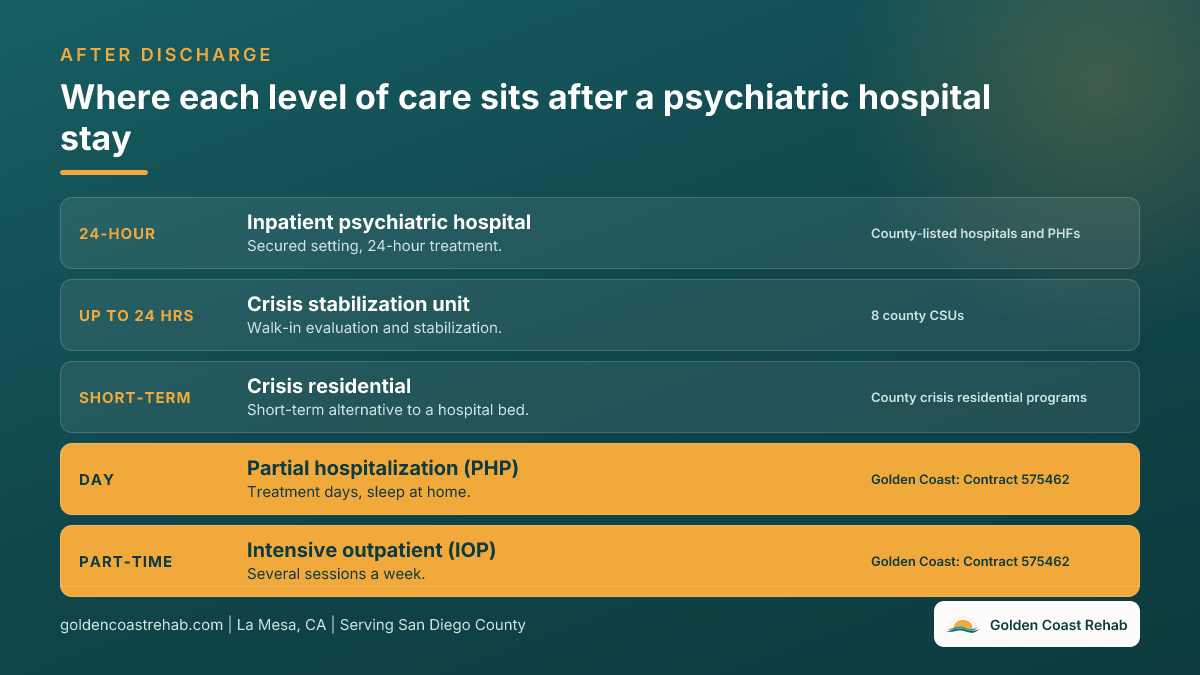
Four levels get confused constantly. The difference:
| Level of care | How long | Setting | Who it fits | How you get in |
|---|---|---|---|---|
| Crisis stabilization unit | Up to 24 hours, in the county's words | Walk-in clinic, 24/7 | Acute crisis, needs help now | Walk in, or be brought by family, a mobile crisis team, or law enforcement |
| Inpatient psychiatric hospital or psychiatric health facility | Tri-City PHF states five to seven days on average; the county states no length for the others | Hospital unit, overnight | Needs 24-hour hospital-level care | Admitted from a crisis stabilization unit, an ER, or a mobile crisis team, not by walking in |
| Crisis residential | Short-term; the county states no length | Staffed house, not locked | Serious mental illness, needs more than outpatient care, not in immediate danger | County referral, starting with the Access and Crisis Line |
| Partial Hospitalization Program (PHP) | Part of a course of care that runs up to twelve weeks, determined clinically | Outpatient, you sleep at home | Stabilized, still needs daily structure | Hospital or clinic referral, or call a contracted program |
How does Medi-Cal inpatient psychiatric care work in San Diego?
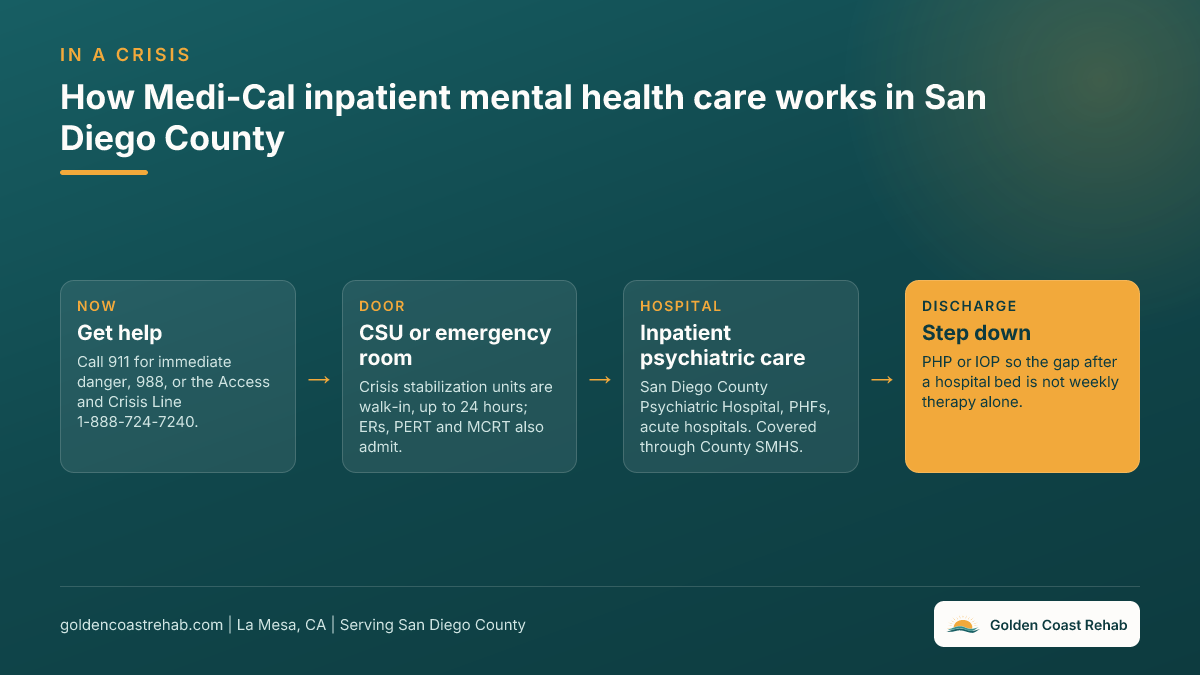
San Diego County has four Medi-Cal managed care plans: Blue Shield of California Promise Health Plan, Community Health Group, Kaiser Permanente, and Molina Healthcare. Medi-Cal is California's Medicaid program, so if you have been searching for a Medicaid psychiatric hospital, this is the same coverage. Specialty Mental Health Services, where inpatient care, crisis stabilization, crisis residential, PHP, and IOP all live, is carved out of those four plans and run by County Behavioral Health Services. Optum administers Medi-Cal behavioral health services on behalf of San Diego County; Optum is not an insurer, and you do not need to change plans to use any facility here. Your plan card does not decide which psychiatric hospital you can use. The San Diego Access and Crisis Line operates 24 hours a day at 1-888-724-7240, in over 200 languages, TTY 711, at no cost to most members.
Admission almost never starts with calling a hospital. It happens three ways: a crisis stabilization unit arranges a bed when 24 hours is not enough; an emergency room evaluates and admits; or a mobile crisis team responds in the community, either PERT, which pairs a clinician with law enforcement, or the Mobile Crisis Response Team, which responds without law enforcement. Any of the three can end in an inpatient admission, a crisis residential referral, or a plan to go home with outpatient care.
You will hear the term 5150. California law allows a designated professional to hold a person up to 72 hours for psychiatric evaluation when they are judged a danger to themselves, a danger to others, or gravely disabled because of a mental health condition. That is a description, not legal advice; questions about a specific hold go to the facility's patient rights advocate.
What should you bring, and what can a family expect?
Bring the Medi-Cal or benefits identification card, a photo ID, and a written list of current medications with doses. Missing paperwork will not stop a crisis evaluation, so do not delay looking for it. Leave valuables at home. Inpatient units restrict cords, belts, glass, and sharps, so a phone charger and a razor will most likely be held for you.
Expect the first hours to be slow, mostly waiting and assessment, and expect limited phone access. Ask early who the social worker or discharge planner is and leave a phone number, because that is who builds the aftercare plan. Ask the unit directly about visiting hours rather than assuming. Sign a release of information if your person consents; without it the team may not be able to talk to you at all. Stays are short: Tri-City PHF states an average of five to seven days. Inpatient care is built to stabilize an acute crisis, not to complete treatment, which is exactly why the discharge plan matters more than most families expect.
What happens after discharge, and what gap did the county contract fill?
The riskiest stretch is the weeks right after discharge, and the gap is always the same: a person leaves stabilized, and the only appointment waiting is a therapy slot a month out. PHP and IOP sit in that gap. PHP is the higher of the two, structured treatment most of the day several days a week. IOP is a few hours a day, a few days a week, enough to hold a person steady at work, school, or home.
The county created that contract to make those levels available to adult Medi-Cal members whose primary condition is a mental health condition. Golden Coast Rehab holds County Contract 575462 for Specialty Mental Health Services, and states it is one of four award recipients of that first contract and the first mental-health-primary PHP/IOP facility for adult Medi-Cal members in the county to begin operating under the new program. We serve adults 18 and older in La Mesa.
A hospital social worker can refer directly; here is how referrals from hospitals to PHP work. To compare step-down levels, read our lists of PHP programs and IOP programs, and see what happens after PHP. To decide which call to make, start at admissions, our San Diego County behavioral health resources page, or 988 versus the Access and Crisis Line.
FAQ: psychiatric hospital stays with Medi-Cal in San Diego
Does Medi-Cal cover inpatient mental health care in San Diego?
Which psychiatric hospital in San Diego takes Medi-Cal?
Can I just show up at a psychiatric hospital?
What is a crisis stabilization unit?
Should I call 988 or the San Diego Access and Crisis Line?
Does Golden Coast Rehab provide inpatient or crisis care?
What is crisis residential and how is it different from a hospital?
What does a 5150 hold mean?
What happens after an inpatient psychiatric discharge?
Bottom Line
In a mental health emergency in San Diego, call 988 or the Access and Crisis Line at 1-888-724-7240, or walk into the nearest crisis stabilization unit. Medi-Cal covers what comes next through County Behavioral Health Services: a night at San Diego County Psychiatric Hospital, a crisis residential stay, or a stabilization visit and an aftercare plan. What decides whether the crisis repeats is the step-down, and that is what Golden Coast was contracted to provide. Call (858) 925-8589 or visit our Medi-Cal page.
Sources
- County of San Diego Behavioral Health Services: Crisis Stabilization Unitshttps://www.sandiegocounty.gov/content/sdc/bhs/csu.html
- County of San Diego Behavioral Health Services: San Diego County Psychiatric Hospitalhttps://www.sandiegocounty.gov/content/sdc/bhs/SDCPH.html
- County of San Diego Behavioral Health Services: Psychiatric Health Facility (Tri-City PHF)https://www.sandiegocounty.gov/content/sdc/bhs/Tri-City_PHF.html
- County of San Diego Behavioral Health Services: Hospital-Level Carehttps://www.sandiegocounty.gov/content/sdc/bhs/hospital-level_care.html
- County of San Diego Behavioral Health Services: Residential Treatment (crisis residential and transitional residential)https://www.sandiegocounty.gov/content/sdc/bhs/long-term_and_residential_services/residential_treatment.html
- County of San Diego Behavioral Health Services: All Services, including the Access and Crisis Linehttps://www.sandiegocounty.gov/content/sdc/bhs/all_services.html

Reviewed by
Matthew Beck, LMFTProgram Director & Clinical Director
Matthew Beck, LMFT, is Program Director and Clinical Director at Golden Coast Rehab. A licensed Marriage and Family Therapist with more than a decade in substance use and mental health treatment, he oversees clinical delivery, supports staff, and holds the standard of care across programs. He has spent over ten years working directly with individuals and families affected by addiction and co-occurring mental health conditions. His therapeutic approach draws on person-centered, cognitive behavioral, and solution-focused work, meeting clients where they are while building practical tools for the long term. Matthew is open about his own recovery, and that experience informs how he runs a program: accountable, unsentimental about what the work requires, and unwilling to treat people as cases.
Written by the Golden Coast Rehab Editorial Team and reviewed for clinical accuracy before publication.