
Ranked Medi-Cal dual diagnosis treatment in San Diego: programs credentialed in both the mental health and substance use lanes, verified 2026.
Jump to a section
The best Medi-Cal dual diagnosis treatment in San Diego comes from a program that holds a public credential in both behavioral health lanes at once, because a co-occurring mental health condition and substance use disorder are paid for by two separate Medi-Cal systems. By that criterion Golden Coast Rehab in La Mesa ranks first: it holds County Contract 575462 for Specialty Mental Health Services and California Department of Health Care Services certification 370254AP for substance use treatment, at one address.
This is a publisher list. Golden Coast Rehab writes it and appears in it, so the criteria are stated in the open and every other program is drawn from County of San Diego Behavioral Health Services listings or the DHCS substance use facility dataset, quoted with its certification number.
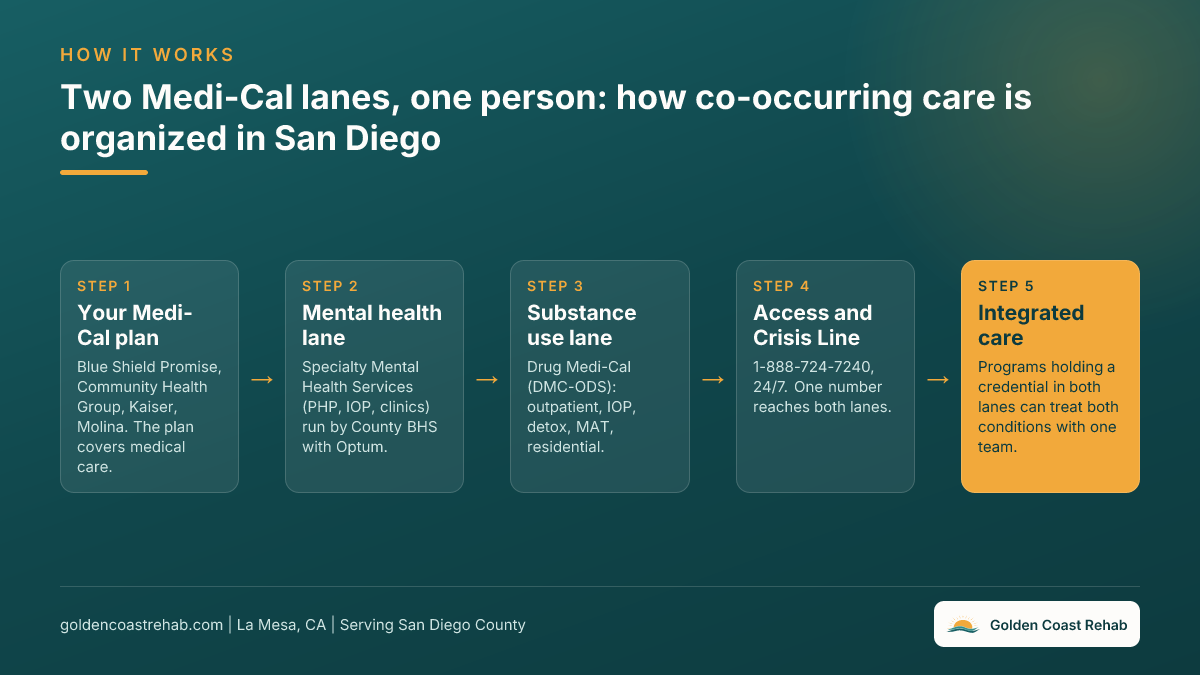
Medi-Cal is California's Medicaid program, and in San Diego County the behavioral health part of it is carved out of your health plan and run by the county. That single fact decides who you call, and it is the piece most articles on co-occurring care leave out.
If someone is in immediate danger, call 911. In a mental health or substance use crisis, call or text 988, or call the San Diego Access and Crisis Line at 1-888-724-7240, which answers 24 hours a day. This page is information, not crisis care.
Key Takeaways on Medi-Cal dual diagnosis treatment in San Diego
- Two lanes pay for co-occurring care: Specialty Mental Health Services (SMHS) and the Drug Medi-Cal Organized Delivery System (DMC-ODS), both administered by County of San Diego Behavioral Health Services through Optum.
- Which lane leads depends on which condition is primary at the moment you seek care, not on which diagnosis came first.
- The San Diego Access and Crisis Line, 1-888-724-7240, is the single entry point to both lanes.
- Optum administers these services for the county. Optum is not an insurer, and you do not switch health plans to get treated.
- For most Medi-Cal members these services carry no cost.
- The question to ask any program: which lane is your credential in, mental health, substance use, or both?
How did we rank the best dual diagnosis treatment programs in San Diego?
- The program holds a public credential you can look up: a County of San Diego Behavioral Health Services listing, or a DHCS certification number.
- The source itself says the program serves co-occurring conditions. That means either the county's own program description uses co-occurring language, or the DHCS row carries the target population code "1.8 --- DUAL DIAGNOSIS".
- The program serves adults and sits in San Diego County.
- Ranking basis, stated so you can check it: county-contracted programs first, then DHCS dual diagnosis rows alphabetically. This is not a quality ranking and nobody paid for a position.
- Golden Coast Rehab publishes this list and is ranked first as the one entry holding a public credential in both lanes at a single location, and is not ranked for levels of care it does not provide.
Last verified 2026-08-30 against County of San Diego Behavioral Health Services program listings and the DHCS SUD Recovery Treatment Facilities dataset (San Diego County rows). County Contract 575462 is a county contracting document, so it does not appear as a row in the state facility dataset. Programs whose dual diagnosis claim rests on their own marketing or a third party directory, including Volunteers of America Southwest and the Paradise Valley Hospital Bayview campus, were left out.
This article is part of a series built from the same county and DHCS listings. If substance use is clearly the primary problem, start with Medi-Cal addiction treatment programs ranked for San Diego or the best Medi-Cal detox options in San Diego; if a mental health condition leads, compare ranked Medi-Cal mental health PHP programs in San Diego and the best Medi-Cal mental health IOP options in San Diego; and if someone needs a hospital bed first, see where Medi-Cal psychiatric hospital care happens in San Diego.
Best Medi-Cal dual diagnosis treatment programs in San Diego
Read these as starting points for a phone call. A certification tells you what a program is allowed to treat; an assessment tells you what you need.
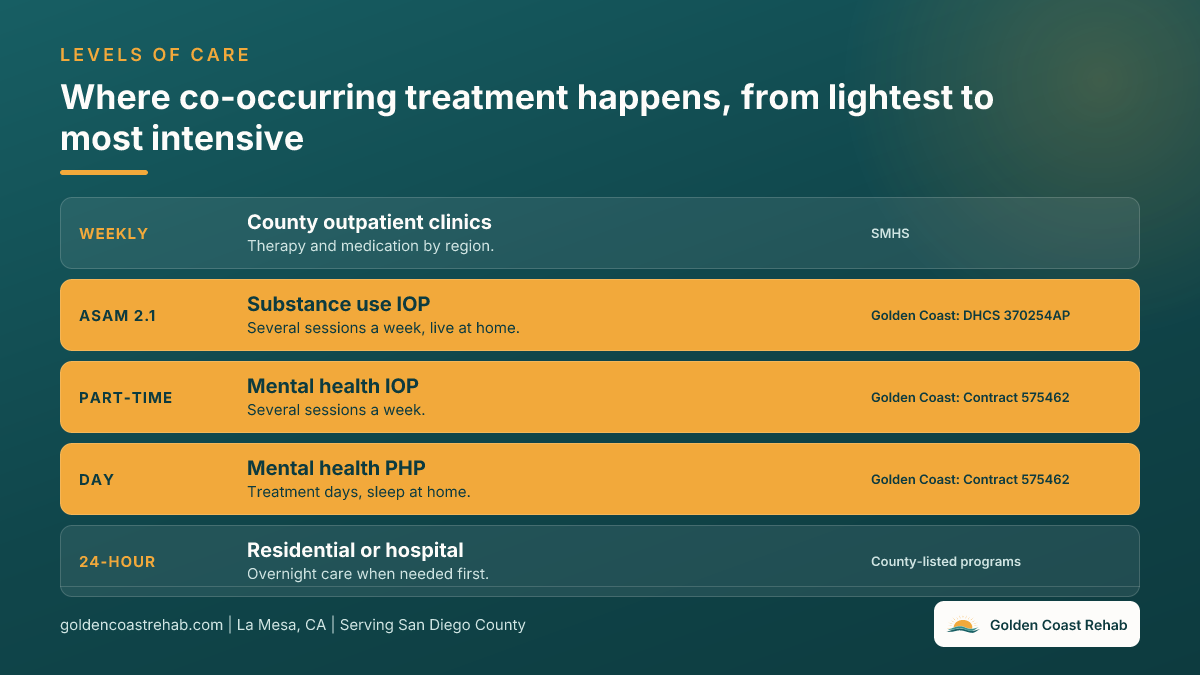
- Golden Coast Rehab (La Mesa). An adult outpatient behavioral health program in East County at 8809 La Mesa Blvd., Suite 102, holding two separate public credentials. On the mental health side it is a contracted provider of Specialty Mental Health Services for County of San Diego Behavioral Health Services under County Contract 575462, covering partial hospitalization and intensive outpatient care for adults whose primary condition is a mental health condition. On the substance use side it holds DHCS certification 370254AP, program code NON-DETOX, adults co-ed, expiring 2/29/2028, covering outpatient treatment, intensive outpatient treatment, outpatient (ambulatory) detoxification, and medication-assisted treatment. Both credentials at one location is what puts it first here: the two lanes that usually sit at two different organizations are held by one provider at one address. Golden Coast Rehab describes its own dual diagnosis program as treating both conditions together, coordinated by one team. Golden Coast Rehab does not provide residential, inpatient, or overnight care. Call (858) 925-8589 or start at admissions.
- NHA Healing Oaks Clinic, Bio-Psychosocial Rehabilitation program (San Diego). The county's own listing describes this as a "Program for mental health and substance use co-occurring conditions: Bio-Psychosocial Rehabilitation (BPSR) program," which is the clearest integrated adult program we found in that language on a County of San Diego Behavioral Health Services listing. The county's full provider directory is not publicly searchable in bulk, so treat this list as what we could verify, not as everything that exists. It sits in the Central region, Lincoln Park, at 286 Euclid Ave, San Diego, CA 92114. Because it is county listed rather than a state dataset row, its credential is the county contract behind that listing, not a DHCS number. Call (619) 859-6270 about intake.
- 516 Recovery Center (Carlsbad). Licensed and certified under DHCS 370258AP with the target population code "1.8 --- DUAL DIAGNOSIS," program code RES-DETOX, 6 beds, certification expiring 12/31/2027. It is the one dual diagnosis flagged program in the San Diego DHCS rows with residential and withdrawal management capacity, at 2537 Davis Ave, Carlsbad, CA 92008. Residential substance use care paid by Medi-Cal requires prior authorization through the county, so start with the Access and Crisis Line rather than the front desk. Call (516) 776-2595.
- Latitude Recovery Center (Carlsbad). DHCS certification 370199AP, program code NON (outpatient), population code "1.8 --- DUAL DIAGNOSIS," certification expiring 11/30/2027, at 560 Carlsbad Village Dr, Suites 200 and 201, Carlsbad, CA 92008. An outpatient program in the North Coastal area with no beds listed. Call (760) 808-2504.
- Mental Health Center of San Diego (San Diego). DHCS certification 370196AP, program code NON, population code "1.8 --- DUAL DIAGNOSIS," expiring 12/31/2027, at 960 Grand Ave, San Diego, CA 92109. Outpatient, in the Central region. Call (619) 450-1874.
- Mission Prep Healthcare (Fallbrook). DHCS certification 370243AP, program code DSS, certification expiring 4/30/2027, at 4045 Limber Pine Rd, Fallbrook, CA 92028, in North Inland. Its target population code reads "1.13 --- CO-ED/CHILD/DUAL," so the dual diagnosis flag comes bundled with a population that includes minors. Ask what the adult track looks like. Call (760) 783-5405.
- Pacific Bay Recovery (Jamul). DHCS certification 370136AP, program code NON-DETOX, population code "1.8 --- DUAL DIAGNOSIS," expiring 5/31/2028, at 13967 Campo Rd, Suite 202B, Jamul, CA 91935. A non-residential East County program with detoxification on the certification. Call (619) 461-3717.
- Pacific Beach Health (San Diego, two sites). Two outpatient certifications under the same operator, both population code "1.8 --- DUAL DIAGNOSIS": 370202AP at 2108 Garnet Ave, Unit A, expiring 11/30/2027, and 370202BP at 4425 Bayard St, Suite 200, expiring 12/31/2026, both San Diego, CA 92109. Confirm the second is current when you call. One number for both: (858) 922-9359.
- Park Mental Health Treatment of San Diego (San Diego). Operated by Shoreline Recovery Center, LLC under DHCS certification 370017BP, program code NON (outpatient), population code "1.8 --- DUAL DIAGNOSIS," expiring 10/31/2027, at 2859 El Cajon Blvd, San Diego, CA 92104, in the Central region. Call (866) 420-2524.
Two entries sit just outside this list. Crownview Co-Occurring Institute in Oceanside holds two DHCS certifications, 370151CP at 315 North Clementine St and 370151DP at 212 North Clementine St, both outpatient, reachable at (760) 231-1170. The words "co-occurring" appear in the business name, but DHCS classifies those sites under the population codes "1.12 --- WOMEN/YOUTH" and "1.1 --- CO-ED," not the dual diagnosis code, so the evidence is a name rather than a state classification of clinical scope. Families of a minor should know the county contracts six Teen Recovery Centers, one per region, for youth ages 12 to 17 with a substance use condition including co-occurring mental health needs.
One limitation worth stating: the DHCS dataset records that a facility is certified for substance use treatment, not whether it holds a county Drug Medi-Cal contract, and it says nothing about mental health contracts. Ask any program here directly whether it takes Medi-Cal through the county for the level of care you want.
Why are there two Medi-Cal lanes for one person?
San Diego County has four Medi-Cal managed care plans: Blue Shield of California Promise Health Plan, Community Health Group, Kaiser Permanente, and Molina Healthcare. Specialty mental health care and substance use treatment are carved out of all four and delivered by County of San Diego Behavioral Health Services, with Optum administering.
Those two carve-outs are separate systems with separate rules.
| Specialty Mental Health Services | Drug Medi-Cal Organized Delivery System | |
|---|---|---|
| Levels of care | Outpatient clinics, partial hospitalization (county term: Day Treatment Intensive), intensive outpatient, crisis stabilization units, crisis residential, inpatient psychiatric care | Outpatient (ASAM 1.0), intensive outpatient (ASAM 2.1), residential (ASAM 3.1 and 3.5), withdrawal management, medication-assisted treatment, opioid treatment programs |
| Public credential | County of San Diego Behavioral Health Services contract | DHCS certification number |
| How you enter | Assessment arranged through the Access and Crisis Line | Outpatient and IOP self-referred; residential needs prior authorization |
A person with depression and an alcohol use disorder qualifies under both, and the two lanes carry different credentials, providers, and authorization rules. That is why a program credentialed in both is worth ranking first.
For how the two intensive outpatient programs differ in practice, see mental health IOP versus substance use IOP.
Which condition gets treated first in dual diagnosis care?
Neither lane asks you to pick a favorite diagnosis. The system asks which condition is primary right now, meaning which one is driving the risk and the need for this level of care today. If a psychiatric condition is primary, the mental health lane leads and the substance use work happens alongside it. If withdrawal or active use is the immediate danger, the substance use lane leads and psychiatric care runs in parallel or follows quickly.
This is a clinical judgment made at assessment, and it can change: someone entering through outpatient detox may step into intensive outpatient care weeks later. More on sequencing sits in co-occurring disorders: which gets treated first, and the clinical background sits on the co-occurring disorders page.
How do you start Medi-Cal dual diagnosis treatment, and what does it cost?
Call the San Diego Access and Crisis Line at 1-888-724-7240. It is county operated, answers 24 hours a day, is part of the 988 network, and is the single entry point into both lanes, which is what you want when you do not know which lane you belong in. TTY users dial 711. The line routes you to an assessment rather than diagnosing on the phone.
You can also call an outpatient substance use program directly, because outpatient and intensive outpatient substance use treatment are self-referred. Residential substance use treatment requires prior authorization through Optum. Optum administers these services for the county, does not insure you, and nobody changes managed care plans to be seen.
For most Medi-Cal members, county behavioral health services carry no cost. More on how coverage works sits on the Medi-Cal page. Related lists in this series cover Medi-Cal addiction treatment and Medi-Cal mental health IOP in San Diego.
What should you ask a dual diagnosis program before you commit?
Ask which lane the credential is in. The exact sentence works: "Is your program certified for substance use, contracted for specialty mental health, or both?" A program that genuinely treats co-occurring conditions answers in one breath.
Then ask three more. Do you take Medi-Cal through the county for this level of care? Who prescribes and manages psychiatric medication here, and is that person on site? If my other condition needs a higher level of care than you provide, who do you hand me to and how fast?
FAQ: Medi-Cal dual diagnosis treatment in San Diego
What is the best Medi-Cal dual diagnosis treatment in San Diego?
Does Medi-Cal cover dual diagnosis treatment in San Diego?
Where do I call first for co-occurring mental health and substance use treatment?
Which condition does a dual diagnosis program treat first?
Is dual diagnosis treatment free with Medi-Cal?
Do I need a referral for dual diagnosis outpatient or IOP care?
Is Optum my insurance for behavioral health?
Does Golden Coast Rehab offer residential dual diagnosis treatment?
Bottom Line
Dual diagnosis care on Medi-Cal in San Diego is a question of credentials before it is a question of philosophy, because two separate county systems pay for the two halves of a co-occurring condition. Golden Coast Rehab ranks first for holding a public credential in both lanes at one location, with the Healing Oaks BPSR program and the DHCS dual diagnosis certified programs above as the other places to call. Start with the Access and Crisis Line at 1-888-724-7240, ask each program which lane its credential is in, and if there is any danger right now call 911 or 988 instead.
Sources
- County of San Diego Behavioral Health Services, mental health serviceshttps://www.sandiegocounty.gov/content/sdc/hhsa/programs/bhs/mental_health_services.html
- County of San Diego Behavioral Health Services, substance use outpatient serviceshttps://www.sandiegocounty.gov/content/sdc/bhs/substance_use_outpatient_services.html
- California DHCS, SUD Recovery Treatment Facilities datasethttps://data.chhs.ca.gov/dataset/sud-recovery-treatment-facilities
- California DHCS, Drug Medi-Cal Organized Delivery System (DMC-ODS)https://www.dhcs.ca.gov/provgovpart/Pages/Drug-Medi-Cal-Organized-Delivery-System.aspx
- Optum San Diego, Access and Crisis Linehttps://www.optumsandiego.com/content/SanDiego/sandiego/en/access---crisis-line.html
- Golden Coast Rehab, Medi-Cal coveragehttps://goldencoastrehab.com/medi-cal/
Reviewed by
Matthew Beck, LMFTProgram Director & Clinical Director
Matthew Beck, LMFT, is Program Director and Clinical Director at Golden Coast Rehab. A licensed Marriage and Family Therapist with more than a decade in substance use and mental health treatment, he oversees clinical delivery, supports staff, and holds the standard of care across programs. He has spent over ten years working directly with individuals and families affected by addiction and co-occurring mental health conditions. His therapeutic approach draws on person-centered, cognitive behavioral, and solution-focused work, meeting clients where they are while building practical tools for the long term. Matthew is open about his own recovery, and that experience informs how he runs a program: accountable, unsentimental about what the work requires, and unwilling to treat people as cases.
Written by the Golden Coast Rehab Editorial Team and reviewed for clinical accuracy before publication.