
Where can I send my son for mental health treatment in San Diego? Call 1-888-724-7240, 911, or 988. His Medi-Cal covers the ladder from crisis care to IOP.
Jump to a section
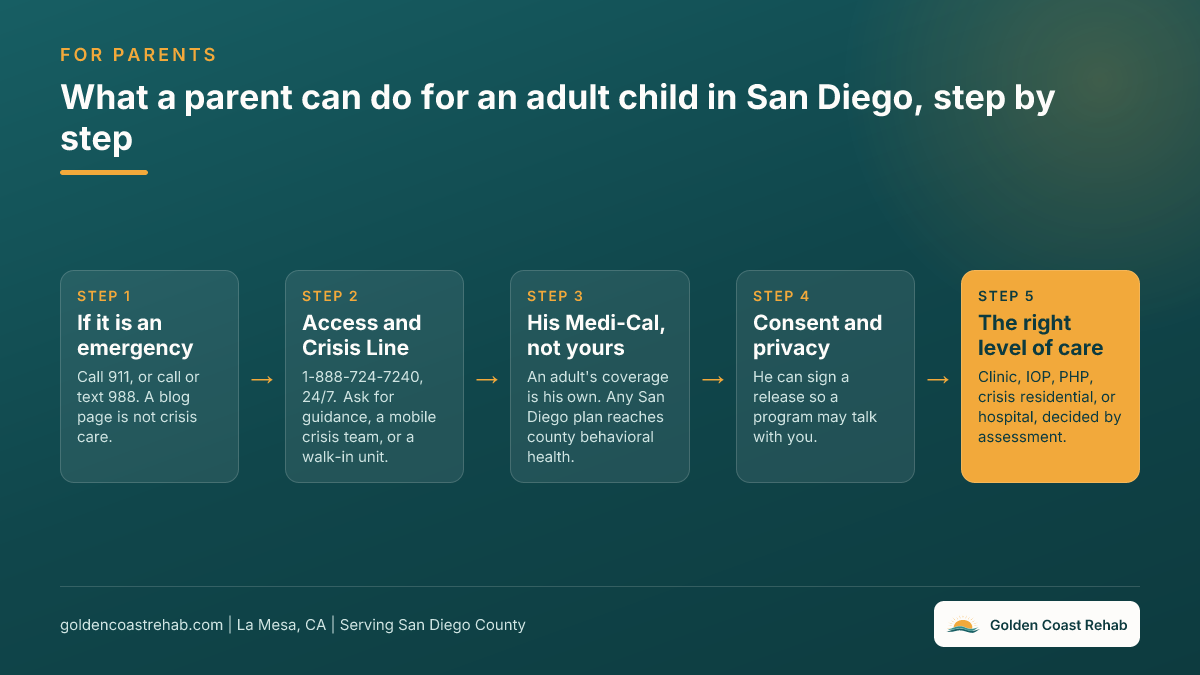
If your adult son is struggling with his mental health in San Diego, the care he needs exists as a ladder, and one number reaches most of it: the San Diego Access and Crisis Line at 1-888-724-7240, answered 24 hours a day. If he is in immediate danger, call 911. If you are unsure how urgent it is, call or text 988. His own Medi-Cal, whichever San Diego plan he carries, covers specialty mental health care at no cost to most members. This page is a guide, not crisis care.
The part that catches parents off guard is legal, not clinical. Once he turned 18 he became the person who consents to his own treatment and controls his own records. That changes what you can do, but it does not leave you without moves. You can call the crisis line and describe what you see, drive him to a walk-in crisis stabilization unit, ask him to sign a release so his team can talk with you, and learn which rung of the ladder fits, so that when he says yes you are not starting from zero.
Key Takeaways
- One number reaches the county system: the Access and Crisis Line, 1-888-724-7240, 24/7, TTY 711. Call 911 for immediate danger, 988 for anything in between.
- He consents to his own care. California allows an involuntary 72-hour hold under Welfare and Institutions Code section 5150, but a parent cannot place one.
- Coverage follows him, not you. Specialty mental health services are carved out of the four Medi-Cal plans and run by County Behavioral Health Services.
- Staff can speak with you if he does not object, and a signed release makes that reliable.
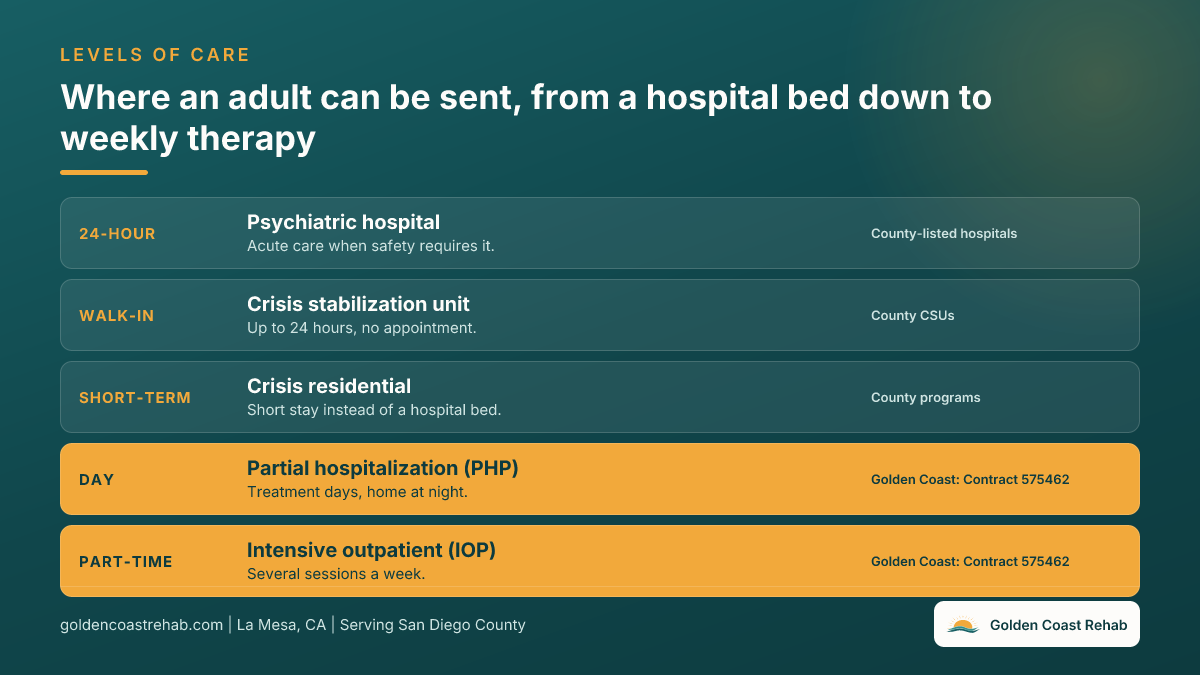
- The ladder runs from a county clinic and IOP up through PHP, crisis residential, crisis stabilization, and psychiatric hospitals. Assessment decides the rung.
- After a hospital stay, ask the discharge social worker for a PHP or IOP referral before discharge day.
How this guide was put together
- Every program named appears on a County of San Diego Behavioral Health Services listing for the level of care described, with the county's own address, phone, and population.
- Legal statements quote Welfare and Institutions Code sections 5150 and 5250 as published by the state legislature, describing the statute rather than giving advice.
- Golden Coast Rehab publishes this guide and appears at two rungs, PHP and IOP, the levels our County contract covers, with no financial relationship to any other program named. What a treatment team may share with a parent comes from federal Health and Human Services guidance and 42 CFR Part 2.
Last verified 2026-08-30 against the county crisis stabilization unit, hospital-level care, residential treatment, outpatient clinic, and Access and Crisis Line pages, the text of both statutes, and federal privacy guidance.
This article is part of a series built from the same county and DHCS listings. For the full ladder of care for serious mental illness, read severe mental health treatment options between the ER and weekly therapy; for hospital-level options, see where Medi-Cal psychiatric hospital care happens in San Diego; and for the day-treatment rung, compare ranked Medi-Cal mental health PHP programs in San Diego.
Is this an emergency, or can it wait?
Three tiers, and the difference decides who shows up. Call 911 when there is immediate danger: a suicide attempt in progress, a weapon, an overdose, violence. Say plainly that this is a mental health emergency and ask for a crisis clinician, since San Diego law enforcement pairs officers with clinicians on Psychiatric Emergency Response Teams.
Call or text 988 when he is in distress and you need a counselor now but nobody is in danger this minute. Call the Access and Crisis Line at 1-888-724-7240 when you want a San Diego answer: which clinic, which program, how to get an assessment. It is county-run, part of the 988 network, and supports over 200 languages.
Either line can dispatch the county's Mobile Crisis Response Team, which sends licensed clinicians, case managers, and peer support specialists as an alternative to a police response.
Can I make my adult son get treatment in California?
Not as a parent, and not for refusing therapy. Welfare and Institutions Code section 5150 applies "when a person, as a result of a mental health disorder, is a danger to others, or to themselves, or gravely disabled." The statute names who may act: "a peace officer, professional person in charge of a facility designated by the county for evaluation and treatment... designated members of a mobile crisis team, or professional person designated by the county may, upon probable cause, take, or cause to be taken, the person into custody."
A parent is not on that list. What you can do is give those people facts: he has not eaten in three days, he said he wants to die, he stopped his medication and is not sleeping, he is talking to people who are not there. Concrete observations are what a clinician measures against the statutory standard.
The 72 hours are for evaluation. If staff find he remains a danger to himself or others, or is gravely disabled, section 5250 allows certification for up to 14 more days of intensive treatment, with a right to a certification review hearing within four days. After 14 days he is released, admitted voluntarily, or held again.
Whose Medi-Cal pays for this, his or mine?
His. Coverage follows the patient, and an adult on Medi-Cal has his own case whether or not he lives with you. Medi-Cal is California's Medicaid program, and San Diego County has four managed care plans: Blue Shield of California Promise Health Plan, Community Health Group, Kaiser Permanente, and Molina.
Here is what most families get wrong: the plan name does not decide where he goes. Specialty Mental Health Services are carved out of all four plans and administered by County of San Diego Behavioral Health Services, with Optum as the administrative services organization. Optum is not an insurer, and he does not need to switch plans. For most Medi-Cal members these services carry no cost. Our guide to using Medi-Cal for mental health treatment and our Medi-Cal page cover the paperwork.
Will his treatment team talk to me?
Sometimes, and you can make it far more likely. Federal guidance is direct: HIPAA "allows the provider to share or discuss a patient's mental health information with the patient's family members so long as the patient does not object." It does not make you his decision maker, and it does not give you a right of access to his records on request.
So ask him, in a calm hour, to sign a release of information naming you. Every program has the form. Ask for two permissions on it: for the team to share updates with you, and for you to share observations with the team. The second matters more than parents expect, because you see warning signs no clinician catches in an appointment.
If substance use is part of the picture, 42 CFR Part 2 applies, protecting those records from disclosure without express patient consent. Ask for that paperwork by name.
What should I say on the first call?
Whether you call 1-888-724-7240 or a program directly, have four things ready.
- His age, and that he is the patient. Adult and youth programs are separate systems in San Diego.
- His coverage. Say "he has Medi-Cal" and name the plan if you know it.
- What you are seeing, with dates. Sleep, eating, medication, work, substance use, anything said about self-harm.
- Your region. The county runs six: North Coastal, North Inland, North Central, Central, East, and South. Region determines which clinic is his.
Then ask the question that gets a real answer: "based on what I described, what level of care should he be assessed for, and what is the fastest way to get that assessment?" If the county system is new to you, what the Access and Crisis Line does explains the other end of that number.
What if he refuses to go?
Refusal is the most common version of this story, and not the end of it. Some people genuinely cannot perceive that they are ill, which is why arguing about whether he is sick rarely moves anything. What moves things is narrowing the ask: not "you need treatment," but "will you come with me to one appointment Thursday." A small, time-limited request gets a yes more often than a diagnosis.
Keep the door open and the paperwork ready. Two guides go deeper: when a family member refuses treatment and signs someone needs a higher level of care.
Get support for yourself meanwhile. NAMI San Diego and Imperial Counties runs a family and peer support helpline at (619) 543-1434, weekdays 9am to 5pm. Our resources for families page covers a family's role once treatment starts.
What happens after a hospital stay?
A psychiatric hospital stabilizes an acute episode. It does not treat the underlying condition to remission, and the weeks right after discharge are the fragile ones. What protects him is the step-down: a structured outpatient program starting within days, not weeks.
PHP is the most structured outpatient level, several hours a day most weekdays, with group therapy, individual therapy, and medication management, while he sleeps at home. IOP is lighter, built so he can hold a job or classes. At Golden Coast both are part of a course of care that runs up to twelve weeks, determined clinically. See how hospital referrals to PHP work and PHP vs IOP vs outpatient.
Where you can send an adult son in San Diego, by level of care
Ordered from the most acute rung down, so you know what exists and what to name on the phone. Assessment decides which one fits.
- San Diego County Psychiatric Hospital (San Diego). The county's standalone acute psychiatric facility at 3853 Rosecrans St., open 24 hours a day, with an Emergency Psychiatric Unit, inpatient care, and a Crisis Recovery Unit. The county states it serves adults 18 and older regardless of insurance status, and a person may arrive on his own, with a loved one, or with MCRT, PERT, or law enforcement. Phone (619) 692-8232.
- Sharp Mesa Vista Hospital (San Diego). Acute inpatient psychiatric care for adults at 7850 Vista Hill Ave. For the hospital-level programs the county describes, patients arrive from an emergency room, a crisis stabilization unit, or a hold, rather than by a family calling for a bed. Ask the Access and Crisis Line about a specific hospital.
- Alvarado Parkway Institute (La Mesa). Acute inpatient psychiatric care for adults at 7050 Parkway Drive in East County.
- East Region Crisis Stabilization Unit (El Cajon). A walk-in unit at 200 S. Magnolia Avenue, open 24/7 to adults 18 and older. The county describes crisis stabilization as up to 24 hours, after which a person is connected to the next level of care, which may or may not be a hospital. Phone (619) 924-4205.
- North Coastal Crisis Stabilization Unit (Vista). The same walk-in model at 524 W. Vista Way, phone (760) 305-4900. The county lists further units in Oceanside, Escondido, Chula Vista, and Midway.
- Halcyon Crisis Center (El Cajon). Listed by the county as Mental Health Crisis Residential Services for adults with serious mental illness, at 1664 Broadway. Crisis residential sits between a hospital and home, and is the rung most families have never heard of. Ask the Access and Crisis Line what a specific program looks like. Phone 619-579-8685.
- Turning Point Crisis Center (Oceanside). The same level for North County at 1738 S. Tremont St, phone 760-439-2800. The county also lists Vista Balboa, New Vistas, Jary Barreto, Esperanza, and Del Sur.
- Golden Coast Rehab, Partial Hospitalization Program (La Mesa). The most structured level he can attend while sleeping at home. Golden Coast is a contracted provider of Specialty Mental Health Services for the County of San Diego, Behavioral Health Services under County Contract 575462, serving adults 18 and older whose primary condition is a mental health condition. Golden Coast Rehab does not provide residential, inpatient, or overnight care. 8809 La Mesa Blvd., Suite 102; (858) 925-8589; see our PHP page and admissions.
- Golden Coast Rehab, Intensive Outpatient Program (La Mesa). Fewer hours per week than PHP, so he can keep a job or classes, under the same County Contract 575462. A common step down from PHP or a hospital stay, and a common step up from weekly therapy that stopped being enough. Same address and phone; see our IOP page.
- East County Behavioral Health Clinic (El Cajon). A county-operated outpatient clinic for adults at 1000 Broadway, Suite 210, weekdays 8am to 5pm. Phone (619) 401-5500.
- North Central Behavioral Health Clinic (San Diego). The county-operated clinic for North Central at 1250 Morena Blvd, weekdays 8am to 5pm. Phone (619) 692-8750. The county lists roughly twenty adult behavioral health clinics across the six regions, several in most of them, on our county resources page.
Every step here applies the same way to a daughter or any adult child. For a fuller directory of the hospital and crisis rungs see our guide to Medi-Cal inpatient mental health in San Diego, and for the PHP rung, Medi-Cal mental health PHP in San Diego.
FAQ
Can I force my adult son into mental health treatment in California?
What does gravely disabled mean under California law?
What is the difference between a 5150 and a 5250 hold?
Who do I call if my son is in crisis but not in immediate danger?
Does my son need his own insurance, or can Medi-Cal cover treatment?
Will the hospital tell me anything about my son's condition?
What happens after my son is released from a 72-hour hold?
Where do I start if he has never been treated for anything?
Bottom Line
You cannot make an adult son accept help, but you are not powerless. Learn the three numbers: 911 for immediate danger, 988 for crisis support, 1-888-724-7240 for the San Diego system. Describe what you see in specifics rather than diagnoses, get a release signed while things are calm, and know the ladder, so that when he says yes you know which rung to name. Golden Coast Rehab sits at the PHP and IOP rungs in La Mesa under County Contract 575462, and we will help a family navigate the Access and Crisis Line even when the right answer is elsewhere on this list. Call (858) 925-8589 or see our Medi-Cal page.
Sources
- California Welfare and Institutions Code section 5150 (72-hour detention for evaluation and treatment)https://leginfo.legislature.ca.gov/faces/codes_displaySection.xhtml?sectionNum=5150&lawCode=WIC
- California Welfare and Institutions Code section 5250 (certification for up to 14 days of intensive treatment)https://leginfo.legislature.ca.gov/faces/codes_displaySection.xhtml?lawCode=WIC§ionNum=5250
- County of San Diego Behavioral Health Services: Access and Crisis Linehttps://www.sandiegocounty.gov/content/sdc/hhsa/programs/bhs/ACL.html
- County of San Diego Behavioral Health Services: Mobile Crisis Response Teamhttps://www.sandiegocounty.gov/content/sdc/hhsa/programs/bhs/BHS_MCRT.html
- City of San Diego Police Department: Mental Health Resources and the Psychiatric Emergency Response Teamhttps://www.sandiego.gov/police/community/mental-health
- County of San Diego Behavioral Health Services: San Diego County Psychiatric Hospitalhttps://www.sandiegocounty.gov/content/sdc/bhs/SDCPH.html
- County of San Diego Behavioral Health Services: Hospital-Level Carehttps://www.sandiegocounty.gov/content/sdc/bhs/hospital-level_care.html
- County of San Diego Behavioral Health Services: Crisis Stabilization Unitshttps://www.sandiegocounty.gov/content/sdc/bhs/csu.html
- County of San Diego Behavioral Health Services: Residential Treatment (crisis residential and transitional residential)https://www.sandiegocounty.gov/content/sdc/bhs/long-term_and_residential_services/residential_treatment.html
- County of San Diego Behavioral Health Services: Outpatient Behavioral Health Centershttps://www.sandiegocounty.gov/content/sdc/bhs/Outpatient_behavioral_health_centers.html
- U.S. Department of Health and Human Services: HIPAA Privacy Rule and Sharing Information Related to Mental Healthhttps://www.hhs.gov/hipaa/for-professionals/faq/mental-health/index.html
- Code of Federal Regulations, Title 42 Part 2: Confidentiality of Substance Use Disorder Patient Recordshttps://www.ecfr.gov/current/title-42/chapter-I/subchapter-A/part-2
- NAMI San Diego and Imperial Counties: Contact and Family and Peer Support Helplinehttps://namisandiego.org/contact/
- 988 Suicide and Crisis Lifelinehttps://988lifeline.org/

Reviewed by
Matthew Beck, LMFTProgram Director & Clinical Director
Matthew Beck, LMFT, is Program Director and Clinical Director at Golden Coast Rehab. A licensed Marriage and Family Therapist with more than a decade in substance use and mental health treatment, he oversees clinical delivery, supports staff, and holds the standard of care across programs. He has spent over ten years working directly with individuals and families affected by addiction and co-occurring mental health conditions. His therapeutic approach draws on person-centered, cognitive behavioral, and solution-focused work, meeting clients where they are while building practical tools for the long term. Matthew is open about his own recovery, and that experience informs how he runs a program: accountable, unsentimental about what the work requires, and unwilling to treat people as cases.
Written by the Golden Coast Rehab Editorial Team and reviewed for clinical accuracy before publication.