
Severe mental health treatment San Diego: the levels between the ER and weekly therapy, who to call, and how Medi-Cal covers PHP, IOP, and crisis care.
Jump to a section
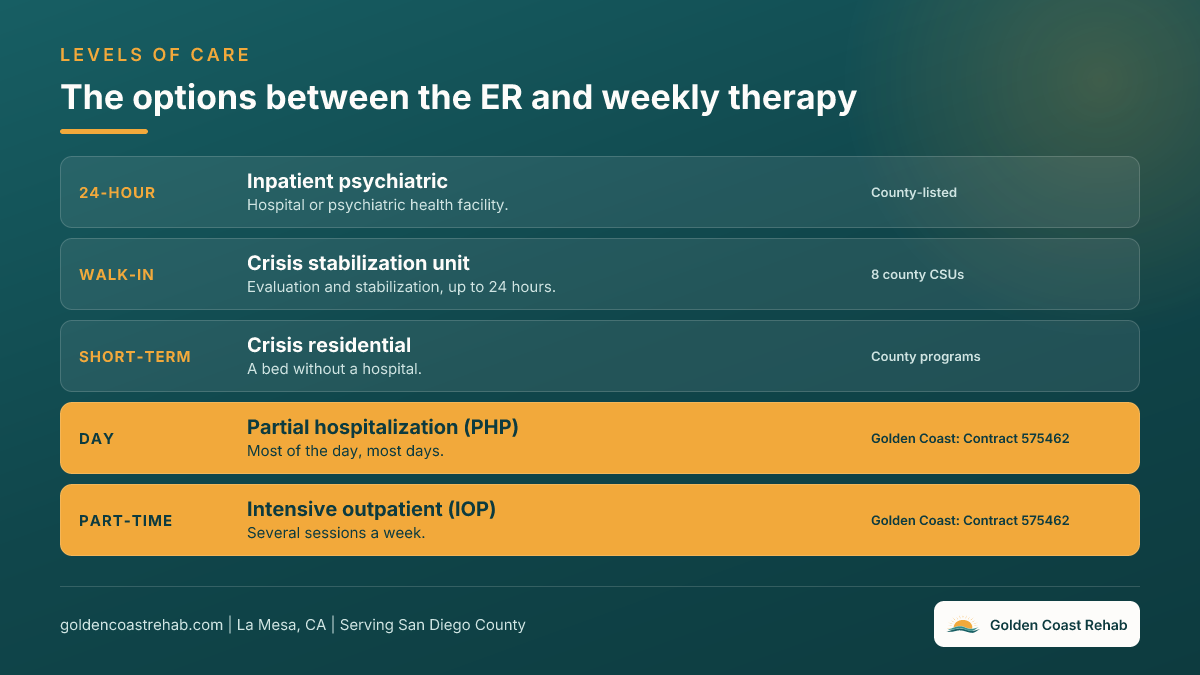
Severe mental health treatment in San Diego is not a choice between an emergency room and a weekly therapy hour. Between those extremes the county runs a ladder: crisis stabilization units you can walk into, crisis residential houses, inpatient psychiatric hospitals, partial hospitalization, intensive outpatient, and regional clinics. Adults living with psychosis, schizophrenia, schizoaffective disorder, bipolar mania, or severe depression with suicidal thinking enter at whichever rung matches the moment.
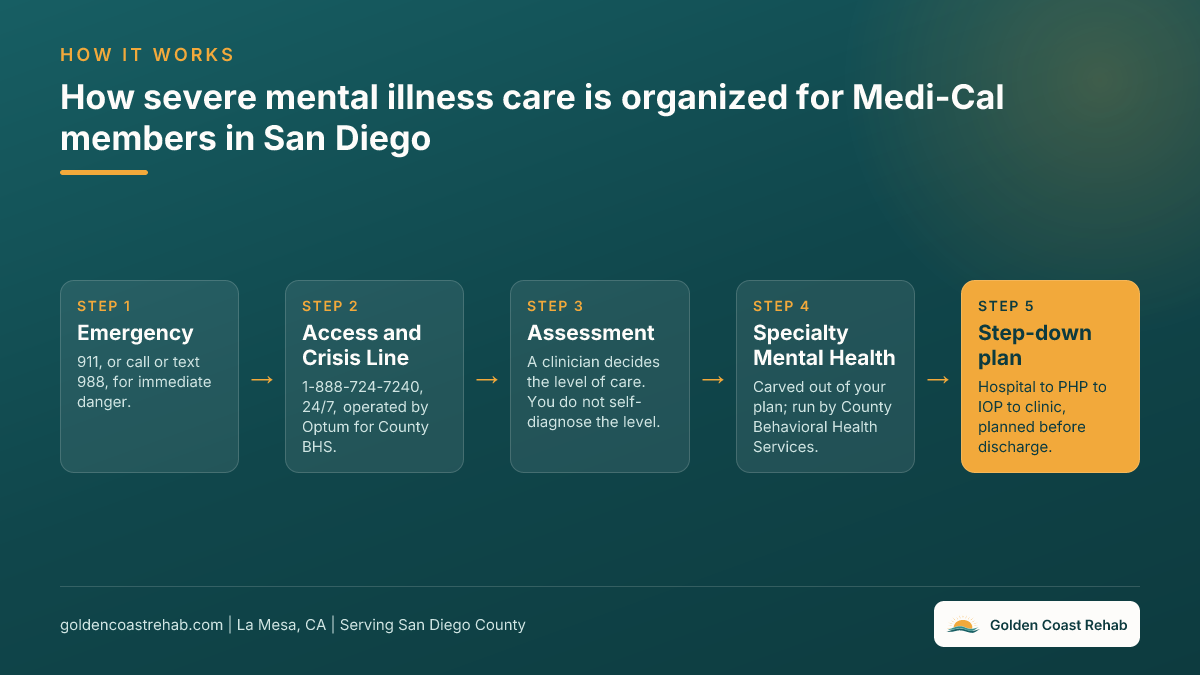
There are two doors. If someone is in immediate danger, call 911, or call or text 988. For everything else, a first assessment, a referral, or a plan after a hospital stay, call the San Diego Access and Crisis Line at 1-888-724-7240, operated by the county 24 hours a day, 7 days a week. A blog page is not crisis care.
Medi-Cal pays for this care. Specialty Mental Health Services are carved out of the four Medi-Cal managed care plans and run by County of San Diego Behavioral Health Services, so all four plans use one county system and your plan name does not decide which program you enter.
Key Takeaways on serious mental illness care in San Diego
- Five levels sit between the emergency room and weekly therapy: inpatient care, crisis stabilization, crisis residential, PHP, and IOP.
- The Access and Crisis Line at 1-888-724-7240 is the county's front door for assessment and referral; 911 and 988 handle emergencies.
- Medi-Cal covers this care through County Behavioral Health Services, not through the managed care plan on the card.
- A 5150 hold is a legal mechanism, not a treatment plan: it allows up to 72 hours of evaluation, and a separate certification is required to go further.
- The weeks right after a psychiatric discharge are where plans fall apart, and PHP and IOP exist to cover them.
- Golden Coast Rehab holds County Contract 575462 for mental health PHP and IOP, adults 18 and older. Golden Coast Rehab does not provide residential, inpatient, or overnight care.
How this guide was put together
- Every named program comes from a public source: a County of San Diego Behavioral Health Services listing or the program's own website.
- Levels of care use the county's own categories, including Day Treatment Intensive, its term for partial hospitalization, and legal statements quote the California Welfare and Institutions Code, cited in the Sources list.
- Where a hospital does not state that it accepts adult Medi-Cal for outpatient programs, this guide says so.
- Golden Coast Rehab publishes this guide and appears at the two levels where it holds a public county credential.
Last verified 2026-08-30 against County of San Diego Behavioral Health Services program pages, the California Welfare and Institutions Code, and each named program's website.
This article is part of a series built from the same county and DHCS listings. Parents of an adult child have a companion guide on where a parent can send an adult son in San Diego; the hospital directory is where Medi-Cal psychiatric hospital care happens in San Diego; and the step-down rungs are compared in ranked Medi-Cal mental health PHP programs in San Diego and the best Medi-Cal mental health IOP options in San Diego.
What does inpatient psychiatric care cover, and where is it in San Diego?
Inpatient psychiatric care is a hospital setting with 24-hour nursing and psychiatric coverage, used when someone cannot be kept safe anywhere else. Stays are measured in days, and the work is stabilization: medication, safety, a discharge plan. The county lists twelve adult hospitals and psychiatric health facilities, one of which is not open until 2027; four are below, and our companion guide, Medi-Cal inpatient mental health in San Diego, carries the full directory.
- San Diego County Psychiatric Hospital (San Diego). Standalone acute psychiatric facility at 3853 Rosecrans St., 24 hours, adults 18 and older regardless of insurance status. Phone (619) 692-8232.
- Tri-City Psychiatric Health Facility (Oceanside). A 24-hour facility at 3996 Vista Way that opened to clients in December 2025. The county states the average stay is 5 to 7 days, with admissions from crisis stabilization units and emergency rooms.
- Sharp Mesa Vista Hospital (San Diego). County-listed acute inpatient care for adults and youth, 7850 Vista Hill Ave.
- Alvarado Parkway Institute (La Mesa). County-listed adult acute inpatient care, 7050 Parkway Drive.
What is a crisis stabilization unit, and can you walk in?
A crisis stabilization unit is an around-the-clock site where an adult in psychiatric crisis is assessed, medicated if needed, and connected onward, for a stay of up to 24 hours. You can arrive on your own, with family, or by ambulance, which makes it an alternative to a general emergency room. Our explainer on crisis stabilization units in San Diego covers the visit.
- East Region Crisis Stabilization Unit (El Cajon). 200 S. Magnolia Avenue, adults 18 and older, 24 hours. Phone (619) 924-4205.
- North Coastal Crisis Stabilization Unit (Vista). 524 W. Vista Way, 24 hours. Phone (760) 305-4900.
- North Coastal Live Well Health Center Crisis Stabilization Unit (Oceanside). 1701 Mission Avenue Suite 130. Phone (760) 305-4848.
- Palomar Crisis Stabilization Unit (Escondido). 2185 Citracado Parkway, North Inland. Phone (760) 739-3012.
- San Diego County Psychiatric Hospital Emergency Psychiatric Unit (San Diego). 3853 Rosecrans Street, North Central. Phone (619) 692-8222.
- Paradise Valley Bayview Crisis Stabilization Unit (Chula Vista). 330 Moss Street, South. Phone (619) 585-4221.
- Sharp Crisis Stabilization Unit (Chula Vista). 751 Medical Center Court, South. Phone (619) 502-5800.
What is crisis residential care, and who is it for?
Crisis residential programs are short-term, unlocked, home-like settings for adults who need more support than an outpatient visit but not a hospital bed. Referrals run through the Access and Crisis Line.
- Vista Balboa Crisis Center (San Diego). 545 Laurel St. Phone 619-233-4399.
- New Vistas Crisis Center (San Diego). 734 10th Avenue. Phone 619-239-4663.
- Jary Barreto Crisis Center (San Diego). 2865 Logan Ave. Phone 619-232-4357.
- Halcyon Crisis Center (El Cajon), East region. 1664 Broadway. Phone 619-579-8685.
- Turning Point Crisis Center (Oceanside), North Coastal. 1738 S. Tremont St. Phone 760-439-2800.
- Esperanza Crisis Center (Escondido), North Inland. 490 N. Grape St. Phone 760-975-9939.
- Del Sur Crisis Center (San Diego), South region. 892 27th St. Phone 619-575-4687.
What does partial hospitalization look like for serious mental illness?
Partial hospitalization is structured clinical programming most of the day, several days a week, while you sleep at home. San Diego County calls this level Day Treatment Intensive, which is why county pages rarely say PHP. For someone leaving a hospital after a psychotic or manic episode, it keeps care intense while the locked door goes away.
- Golden Coast Rehab (La Mesa). A County of San Diego contracted Specialty Mental Health Services provider under County Contract 575462, delivering mental health PHP to adults 18 and older whose primary condition is a mental health condition, whether they are stepping down from a hospital or up from a clinic. It also holds DHCS substance use certification 370254AP for co-occurring care. Golden Coast states it is one of four award recipients of the county's first contract of this kind, and by its own account the first mental-health-primary PHP and IOP facility for adult Medi-Cal members to begin operating under the new program. Golden Coast Rehab does not provide residential, inpatient, or overnight care. Call (858) 925-8589 or start at admissions.
- Sharp Mesa Vista Hospital (San Diego). A county-listed psychiatric hospital whose site describes adult partial hospitalization and outpatient services. Adult Medi-Cal acceptance is not stated there, so ask about Medi-Cal.
- Alvarado Parkway Institute (La Mesa). Partial hospitalization and intensive outpatient at a county-listed psychiatric hospital. Its 2025 press release frames those services as Medicare and commercial, so ask about Medi-Cal.
- Aurora Behavioral Health Care San Diego (San Diego). Adolescent and adult partial hospitalization and intensive outpatient services. A third-party directory describes Medi-Cal acceptance limited to certain age bands, unconfirmed on Aurora's site, so ask about Medi-Cal.
How is mental health IOP different, and where can adults get it?
Intensive outpatient care is the same clinical model at a lower dose: several hours a day, a few days a week, so work, school, and family life restart around it. It is where PHP graduates usually land, and often the entry point for someone hospitalized before.
- Golden Coast Rehab (La Mesa). Mental health IOP for adults 18 and older under the same County Contract 575462, in East County San Diego. Care is part of a course of treatment that runs up to twelve weeks, determined clinically, and telehealth is generally available. See how the county PHP options compare for the level above.
- Alvarado Parkway Institute (La Mesa). Hospital-based intensive outpatient at 7050 Parkway Drive; confirm Medi-Cal on the first call.
- Aurora Behavioral Health Care San Diego (San Diego). Hospital-based adult intensive outpatient; confirm Medi-Cal on the first call.
Where are the county outpatient mental health clinics?
County behavioral health clinics deliver ongoing psychiatry, medication management, therapy, and case management. Long-term care lives here after the intensive levels end.
- North Central Behavioral Health Clinic (San Diego). 1250 Morena Blvd. Phone (619) 692-8750.
- North Coastal Mental Health Center (Oceanside). 1701 Mission Ave, Suite 230. Phone (760) 712-3535.
- North Inland Mental Health Center (Escondido). 221 W. Crest St., Suite 210. Phone (760) 747-3424.
- Jane Westin Center (San Diego), Central region. 1045 9th Ave. Phone (619) 235-2600.
- East County Behavioral Health Clinic (El Cajon). 1000 Broadway. Phone (619) 401-5500.
- South Bay Guidance Wellness Recovery Center (Chula Vista). 1196 3rd Ave. Phone (619) 427-4661.
When is it an emergency, and when is it a crisis?
It is an emergency when there is immediate danger: a suicide attempt or plan in motion, a threat to someone else, a serious overdose, or an injury. Call 911 and say plainly that this is a psychiatric emergency, so the responders who arrive know what they are coming to.
It is a crisis, not an emergency, when someone is hearing voices, has not slept for days, has stopped medication, or is talking about death without a plan in motion. Call or text 988, or call the Access and Crisis Line at 1-888-724-7240. San Diego County's Mobile Crisis Response Team can be dispatched through those numbers as an alternative to a law enforcement response, staffed 24 hours a day by licensed clinicians, case managers, and peer support specialists.
How does a 5150 hold work in San Diego?
California Welfare and Institutions Code section 5150 allows an involuntary hold of up to 72 hours for psychiatric evaluation when a person, "as a result of a mental health disorder, is a danger to others, or to themselves, or gravely disabled." The statute names who may do so, upon probable cause, and a family member is not on that list: a peace officer, a professional person in charge of a county-designated evaluation and treatment facility, a member of that facility's attending staff, designated members of a mobile crisis team, or a professional person designated by the county.
In practice that means law enforcement, a clinician on the county's Psychiatric Emergency Response Team, or other county-designated personnel. Where a hold is placed, the person is taken to a facility designated by the county for evaluation and treatment rather than left at the scene.
If a person still meets criteria at 72 hours, section 5250 allows certification for up to 14 more days of intensive treatment when professional staff find the person remains a danger to others or to themselves, or gravely disabled. That carries a right to a certification review hearing within four days. At the end of the 14 days the person is released, admits voluntarily, or is placed under another hold.
What happens after discharge, and why does the step-down matter?
A hospital stay ends when someone is safe, not when they are well. Medication has usually been started or changed and acute risk has come down, but the condition still needs weekly clinical contact and a schedule. Dropping from 24-hour care to a therapy appointment three weeks out is where plans fail.
The ladder closes that gap: hospital, then crisis residential or PHP, then IOP, then a clinic and medication management. Each rung keeps clinical eyes on the person while handing back a little more ordinary life. What happens after PHP covers the handoff, families can start at resources for families, and parents of an adult child have a companion guide on where to send an adult son in San Diego.
How does Medi-Cal cover severe mental illness care in San Diego?
Medi-Cal is California's Medicaid program, and in San Diego the benefit for more serious conditions runs on a separate track. Specialty Mental Health Services are carved out of the four managed care plans and administered by County Behavioral Health Services, with Optum as the administrative services organization. Optum acts on behalf of the county and is not your insurer, so no one needs to switch plans to reach a county-contracted program.
For most Medi-Cal members these services carry no cost. Eligibility is decided by clinical assessment rather than diagnosis alone, which is why the first step is a call, not a form. Our Medi-Cal page lays out the entry points.
What should you ask a program before you start?
Ask which level of care the program delivers and under what public credential: a county contract number, or a state certification. Ask whether adults 18 and older with Medi-Cal are accepted for that specific level, since a hospital that takes Medi-Cal for a bed does not necessarily take it for an outpatient program. Ask who prescribes and how often medication is reviewed, since medication is central for schizophrenia, schizoaffective disorder, and bipolar disorder. Ask what happens when the level ends, whether family can be involved with a signed release, and how missed days are handled, because that answer shows how the program treats relapse.
FAQ: severe mental health treatment in San Diego
What counts as severe or serious mental illness?
What is between the emergency room and weekly therapy in San Diego?
What number do I call if it is not an emergency?
Can someone be treated for psychosis or mania without being hospitalized?
Does Medi-Cal cover PHP and IOP for serious mental illness in San Diego?
Does Golden Coast Rehab admit people overnight?
What happens after a 5150 hold ends?
How soon after a psychiatric discharge should the next level of care start?
Bottom Line
Serious mental illness in San Diego does not have to be managed in the emergency room or abandoned to one therapy hour a week. The county runs a real ladder, Medi-Cal pays for it, and one number reaches all of it: 1-888-724-7240, with 911 and 988 for emergencies. If the person you are worried about is leaving a hospital and needs the next rung, Golden Coast Rehab delivers mental health PHP and IOP in La Mesa under County Contract 575462, and can help you navigate the Access and Crisis Line for the levels it does not provide.
Sources
- California Welfare and Institutions Code section 5150 (72-hour hold)https://leginfo.legislature.ca.gov/faces/codes_displaySection.xhtml?sectionNum=5150&lawCode=WIC
- California Welfare and Institutions Code section 5250 (14-day certification)https://leginfo.legislature.ca.gov/faces/codes_displaySection.xhtml?lawCode=WIC§ionNum=5250
- County of San Diego Behavioral Health Services: San Diego Access and Crisis Linehttps://www.sandiegocounty.gov/content/sdc/hhsa/programs/bhs/ACL.html
- County of San Diego Behavioral Health Services: Mobile Crisis Response Teamhttps://www.sandiegocounty.gov/content/sdc/hhsa/programs/bhs/BHS_MCRT.html
- City of San Diego Police Department: Psychiatric Emergency Response Team (PERT)https://www.sandiego.gov/police/community/mental-health
- County of San Diego Behavioral Health Services: Crisis Stabilization Unitshttps://www.sandiegocounty.gov/content/sdc/bhs/csu.html
- County of San Diego Behavioral Health Services: Hospital-Level Carehttps://www.sandiegocounty.gov/content/sdc/bhs/hospital-level_care.html
- County of San Diego Behavioral Health Services: San Diego County Psychiatric Hospitalhttps://www.sandiegocounty.gov/content/sdc/bhs/SDCPH.html
- County of San Diego Behavioral Health Services: Psychiatric Health Facility (Tri-City PHF)https://www.sandiegocounty.gov/content/sdc/bhs/Tri-City_PHF.html
- County of San Diego Behavioral Health Services: Residential Treatment (crisis residential)https://www.sandiegocounty.gov/content/sdc/bhs/long-term_and_residential_services/residential_treatment.html
- County of San Diego Behavioral Health Services: Outpatient Behavioral Health Centershttps://www.sandiegocounty.gov/content/sdc/bhs/Outpatient_behavioral_health_centers.html
- Sharp Mesa Vista Hospital: Adult Partial Hospitalization and Outpatient Programshttps://www.sharp.com/hospitals/mesa-vista/programs/adult-partial-hospitalization-outpatient.cfm
- Alvarado Parkway Institute: Intensive Outpatient Programshttps://apibhs.com/intensive-outpatient-programs
- Aurora Behavioral Health Care San Diego: Outpatient Serviceshttps://www.aurorasandiego.com/programs/san-diego-outpatient-services
- Disability Rights California: Medi-Cal Specialty Mental Health Services Covered by County Mental Health Planshttps://www.disabilityrightsca.org/publications/medi-cal-specialty-mental-health-services-covered-by-county-mental-health-plans-adults
- Golden Coast Rehab: Medi-Calhttps://goldencoastrehab.com/medi-cal/

Reviewed by
Matthew Beck, LMFTProgram Director & Clinical Director
Matthew Beck, LMFT, is Program Director and Clinical Director at Golden Coast Rehab. A licensed Marriage and Family Therapist with more than a decade in substance use and mental health treatment, he oversees clinical delivery, supports staff, and holds the standard of care across programs. He has spent over ten years working directly with individuals and families affected by addiction and co-occurring mental health conditions. His therapeutic approach draws on person-centered, cognitive behavioral, and solution-focused work, meeting clients where they are while building practical tools for the long term. Matthew is open about his own recovery, and that experience informs how he runs a program: accountable, unsentimental about what the work requires, and unwilling to treat people as cases.
Written by the Golden Coast Rehab Editorial Team and reviewed for clinical accuracy before publication.