
ADHD Treatment Program in San Diego for Medi-Cal Adults
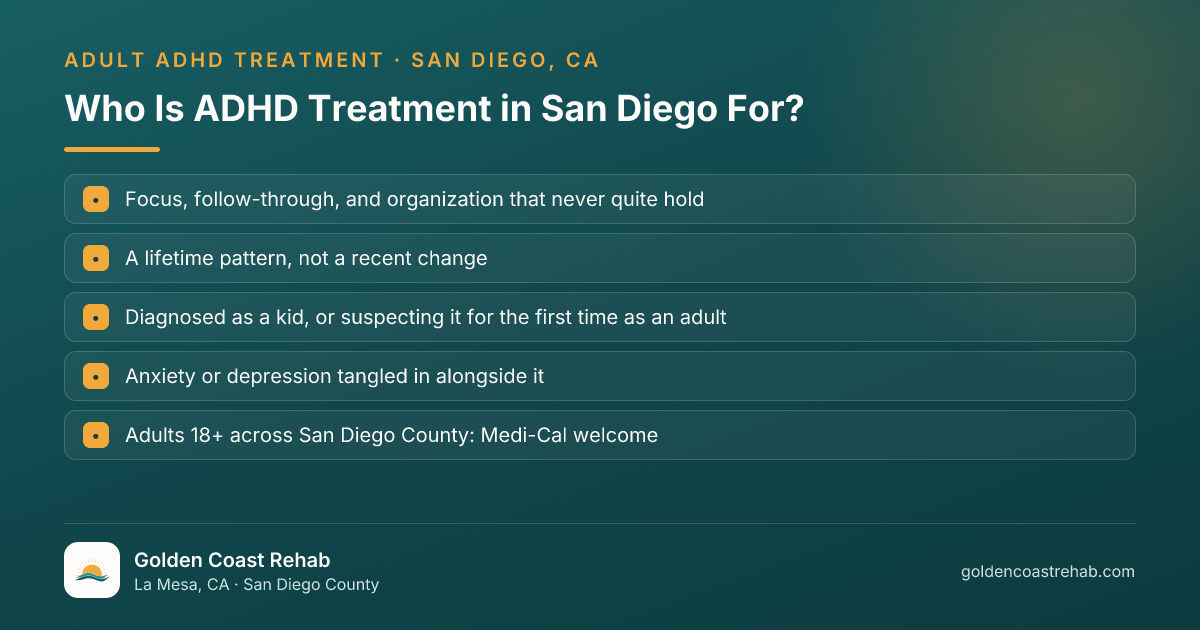
Adult ADHD treatment in San Diego at Golden Coast Rehab is structured outpatient care for adults whose attention, follow-through, and organization have been a lifelong tax, and whose anxiety or depression is often tangled in alongside. We are a contracted Specialty Mental Health Services provider for the County of San Diego, and Medi-Cal covers care here at no cost when criteria are met.
- Screens for sleep disorders, anxiety, depression, and trauma that mimic or accompany ADHD
- Skills-based therapy targets planning, task initiation, time perception, and emotional regulation
- First two weeks focus on sleep and external structure before deeper skills work begins
- Psychiatric provider manages medication with substance use history factored in
- Reframes adult ADHD as a logistics problem instead of a character flaw
- Every day, 8am – 8pm
- 100% confidential (HIPAA & 42 CFR Part 2)
- Adults 18+ · dual-diagnosis welcome
Book an assessment
Takes about 60 seconds. Eligible Medi-Cal members can pick an assessment time right away; everyone else hears from our admissions team, usually within the hour.
Key Takeaways for ADHD Treatment
- Structured outpatient ADHD care for adults 18+, at our one La Mesa facility
- Provided as Specialty Mental Health Services under County of San Diego Contract 575462
- Assessment screens what travels with ADHD, anxiety, depression, substance use, because it rarely arrives alone
- Therapy is built around structure and follow-through; medication is managed alongside it where it fits
- Medi-Cal covers treatment at no cost on any of the county's four plans when clinical criteria are met
- We do not operate inpatient or hospital beds; in a crisis, call 988, or the San Diego Access and Crisis Line at 1-888-724-7240
Attention-deficit/hyperactivity disorder is a difference in how the brain handles attention, working memory, impulse control, and motivation. In adults it usually looks less like restlessness and more like a life spent working twice as hard for the same result, plus the accumulated demoralization that comes with that.
Golden Coast Rehab supports adults with ADHD across San Diego County, most often where it appears alongside depression, anxiety, trauma, or substance use, which is the way it usually presents in adulthood.
Adults who were never identified as children often arrive convinced the problem is character. It is not, and the reframe alone tends to matter.
Programs Available for ADHD Treatment in San Diego
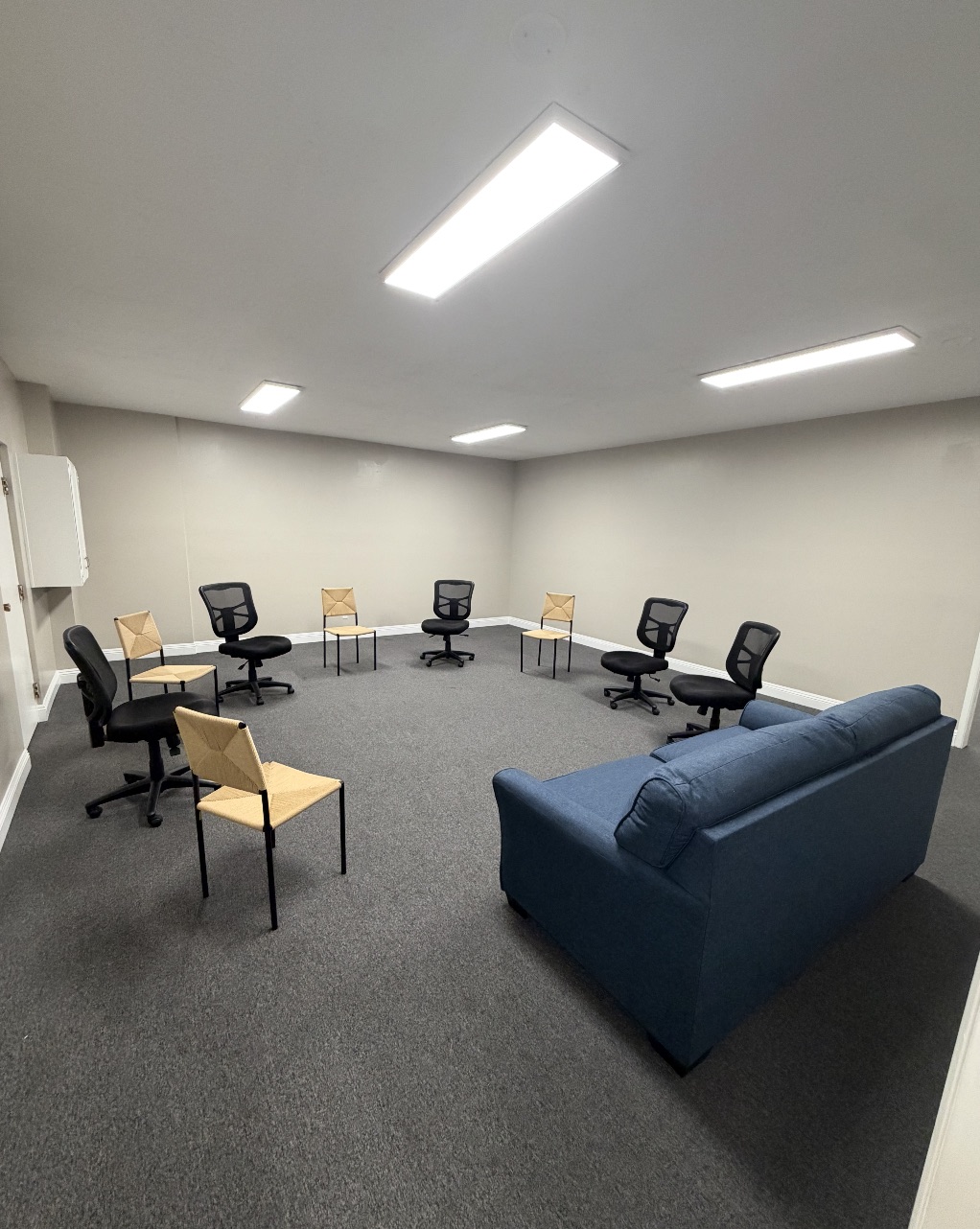
Golden Coast Rehab is a contracted provider of Specialty Mental Health Services (Partial Hospitalization Program and Intensive Outpatient Program) for the County of San Diego, Behavioral Health Services, under County Contract 575462. Both programs serve adults 18 and older whose primary condition is a mental health condition, and both are delivered at our La Mesa facility. Living nearby? Start with ADHD care in La Mesa.
Partial Hospitalization Program (PHP)
Day treatment is appropriate when ADHD sits alongside a mental health condition severe enough to warrant that level of care; the ADHD work is integrated into that treatment. PHP runs during the day, several days a week, and you go home each evening. It is the most structured level of care we offer.
Intensive Outpatient Program (IOP)
IOP allows skills work on structure, routine, and follow-through while you keep the job or the classes that are currently the source of pressure. IOP is several sessions a week rather than full days, so it fits around work, school, and family. Many people step down into IOP from PHP; others start here.
We do not provide residential or inpatient treatment. If your assessment shows you need a higher level of care than we offer, we will tell you plainly and help you find it.
What Does ADHD Treatment Involve at Golden Coast?
ADHD treatment at Golden Coast follows a defined sequence. Intake and assessment, the first two weeks, active treatment, and step-down. Nobody walks in already knowing how this works, so here it is in full, start to finish.
Intake and assessment
We take a developmental history alongside current symptoms, and we screen for the conditions that mimic or accompany ADHD: sleep disorders, anxiety, depression, trauma, and substance use. Getting that ordering right matters, because untreated depression and chronic sleep deprivation both look a great deal like ADHD. Symptoms are tracked with standardized measures, including the PHQ-9 and the GAD-7 where clinically indicated, completed at intake and repeated during treatment so that change is measured rather than assumed.
The first two weeks
The first work is practical: sleep, external structure, and systems that do not depend on remembering. Alongside it, education on how ADHD actually functions, which for many adults reframes twenty years of self-blame.
Active treatment
Skills-based therapy on planning, task initiation, time perception, and emotional regulation, plus treatment for whichever co-occurring condition is currently loudest. Where medication is part of the plan, our psychiatric provider manages it, taking any history of substance use into account.
Stepping down and aftercare
Step-down focuses on which systems you will actually keep using, and on continued care for co-occurring conditions. ADHD does not resolve; the support structures and the self-understanding are what carry forward. A full course of care runs up to twelve weeks across PHP and IOP, but length is a clinical decision made by your treatment team based on how you are actually doing, not a fixed schedule.
How Does ADHD Treatment at Golden Coast Work?
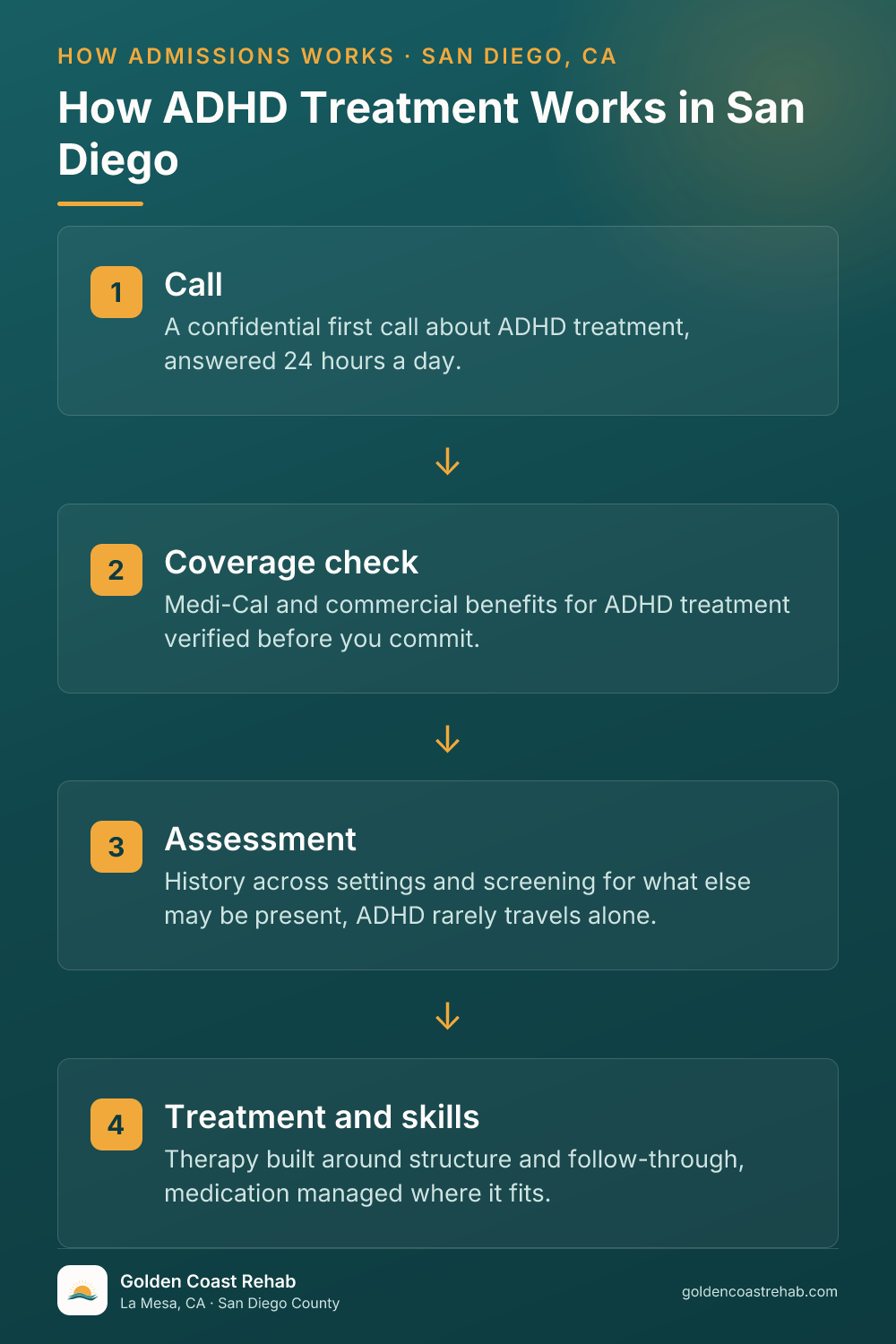
ADHD treatment at Golden Coast works in four phases, paced by your progress rather than a fixed calendar.
1. Assessment across settings and decades
Adult ADHD is diagnosed on a lifelong pattern, so history spans childhood, school, work, and home, plus screening for the conditions that ride along.
2. Sorting ADHD from what it caused
Years of missed deadlines and self-blame generate anxiety and low mood of their own; early treatment separates the driver from the passengers.
3. Skills and structure that fit an ADHD brain
External structure, broken-down tasks, and follow-through systems built in therapy and practiced between sessions. Designed around how ADHD attention actually works, not how it should.
4. Ongoing care that keeps appointments keepable
Medication management where indicated, and a schedule engineered for the condition being treated. Reminders, consistency, one location.
Ready to take the first step?
Speak with our admissions team: free, confidential, and no obligation.
Common Signs of Adult ADHD
What Are the Common Signs of Adult ADHD?
The common signs of adult ADHD rarely look like a restless child; here is what they usually look like instead.
01.moderateChronic lateness and lost time
Consistently underestimating how long things take, losing hours to a task that was meant to take twenty minutes.
Health Risks: Repeated lateness damages jobs and relationships and is read by others as not caring.
02.moderateStarting far more than you finish
Multiple projects begun with real enthusiasm and abandoned once the novelty passes, in a pattern that repeats for years.
Health Risks: The accumulation of unfinished things feeds shame and, commonly, depression.
03.moderateOverwhelm at ordinary admin
Bills, forms, and email piling up not from lack of care but because starting them feels genuinely impossible.
Health Risks: Avoided paperwork turns into financial and legal consequences that then increase anxiety.
04.moderateEmotional reactions that arrive fast and hard
Frustration, hurt, or anger that hits at full volume before you can catch it, then passes quickly.
Health Risks: Emotional dysregulation is a core and underrecognized feature of adult ADHD and strains close relationships.
05.lowSelf-medicating for focus
Heavy caffeine, nicotine, or stimulant use to get functional, sometimes long before any diagnosis.
Health Risks: Self-medication can develop into a substance use disorder needing its own treatment.
Why Golden Coast for ADHD Treatment in San Diego
1. One facility, all of San Diego County
We are a single facility in La Mesa serving the whole county, so your ADHD treatment team stays consistent from intake through step-down instead of handing you between locations.
2. County-contracted specialty mental health care
Golden Coast Rehab is a contracted provider of Specialty Mental Health Services for the County of San Diego, which is why ADHD treatment here can be covered at no cost on any Medi-Cal plan in the county.
3. Progress you can see, not just feel
ADHD symptoms are tracked with standardized tools like the GAD-7 and PHQ-9 at intake and throughout ADHD treatment, so your care team adjusts the plan based on evidence rather than impression.
4. Psychiatric care from a board-certified physician
Where medication is part of ADHD treatment, it is managed by our Medical Director, Dr. Sanjai Mathew Thankachen, MD, a board-certified psychiatrist.
5. Small enough to notice a bad week
As of July 2026 our programs are staffed at two clinicians for every five clients, which keeps ADHD treatment groups small enough that a clinician notices when you are struggling.
6. Reachable when it matters
Our phones are answered 24 hours a day, and our offices are open 8am to 8pm, so starting ADHD treatment does not depend on catching us during a narrow window.
Check your coverage
Medi-Cal welcome. Find out what your coverage includes.
How Does Golden Coast Support Family During ADHD Treatment?
Golden Coast supports family during ADHD treatment by helping them understand the mechanism behind the behavior, since partners and family often read it as indifference instead. The forgotten thing, the unfinished task, the reaction that seemed out of nowhere. Understanding the mechanism changes the conversation from a character argument into a logistics problem, which is far more solvable.
With your consent, family members can be included in treatment planning and family sessions. Without your consent, they cannot. Your privacy is protected by law, and we will explain to your family what we can and cannot share. More for the people who love you: For Families.
Does Medi-Cal Cover ADHD Treatment in San Diego?
Yes. ADHD treatment at Golden Coast is covered by Medi-Cal in San Diego County, including any of the four managed care plans, at no cost to you, because specialty mental health services are administered by San Diego County Behavioral Health Services rather than by your plan. Full detail on how Medi-Cal works here.
Call (858) 925-8589 to check your eligibility. Our line is answered 24 hours a day. If you are in crisis, the San Diego County Access and Crisis Line is available around the clock at 1-888-724-7240.
Understanding ADHD
Understanding ADHD, what it is clinically, how common it is, and what it responds to, puts the treatment decisions on this page in context.
What is adult ADHD?
Adult ADHD is a lifelong difference in attention regulation and executive function, starting, sustaining, organizing, finishing, present since childhood even when it was never named. It is not laziness with a diagnosis; it is measurable brain-based variation with effective treatment.
How common is ADHD in adults?
ADHD affects an estimated 4.4% of U.S. adults aged 18-44, according to NIMH's ADHD statistics page. Many were never diagnosed as children, particularly women and quieter, inattentive-type kids, and first recognize it in adulthood, often when structure falls away.
Can ADHD be diagnosed for the first time in adulthood?
Yes. ADHD can be diagnosed for the first time in adulthood, but the condition itself must trace back: assessment looks for a lifelong pattern across settings, not a recent change. A recent change points somewhere else, and we screen for that too.
Is medication required for ADHD treatment?
No. Medication is not required for ADHD treatment, though it is well-evidenced and many adults benefit. Skills-based therapy stands on its own or alongside it; the combination is decided with our prescriber at evaluation, not assumed.
What happens if adult ADHD goes untreated?
Untreated adult ADHD compounds quietly: jobs shortened, finances frayed, relationships strained by unreliability nobody intends, and self-esteem eroded by decades of trying harder at the wrong lever. Treatment replaces effort with design, which is why it works.
Next Steps
Related Care for ADHD
Levels of care for ADHD step up and down around your progress. Start where you are, and we'll adjust together.
Partial Hospitalization Program (PHP)
Our most structured outpatient level of care, offered as a specialty mental health service.
Learn moreIntensive Outpatient Program (IOP)
Evidence-based group and individual therapy with the flexibility to keep working, studying, and living at home.
Learn moreMedication-Assisted Treatment (MAT)
FDA-approved medication for opioid and alcohol use disorder, managed by our medical team.
Learn moreDual Diagnosis Treatment
Integrated care for substance use and co-occurring mental health conditions, treated together, not separately.
Learn moreVerify Your Insurance
Check your coverage in minutes: free, confidential, and with no obligation to enroll.
Learn moreAdmissions Process
See exactly what happens from your first call to your start date, step by step.
Learn moreServing members of every San Diego Medi-Cal plan
Credentialed through Optum, administrator of behavioral health services for the County of San Diego.




 Optum, a UnitedHealth Group companyAdministrative Services Organization for County of San Diego behavioral health. We are credentialed with Optum.
 County of San Diego Behavioral Health ServicesContracted provider of Specialty Mental Health Services under County Contract 575462.
Not sure if you're covered? Verify your benefits in minutes, free & confidential.
Admissions
Our ADHD Admission Process
Starting treatment at Golden Coast Rehab takes one phone call. Here's exactly what happens from your first call.
Call or Reach Out
Speak with an admissions specialist: no pressure, completely confidential.
Verify Your Coverage
We confirm what your plan covers, Medi-Cal welcome, usually the same day.
Phone Assessment
A 10–15 minute ASAM-based assessment helps us understand your history and recommend the right level of care.
Clinical Review & Intake
Our team reviews your assessment, builds an individualized plan, and schedules your start date.
Questions, Answered
ADHD Treatment FAQs
Do you diagnose ADHD in adults?
Can you prescribe stimulant medication?
I have ADHD and I drink or use. Does that rule out treatment?
Is therapy useful for ADHD, or is it just medication?
How is adult ADHD diagnosed?
Can ADHD be mistaken for anxiety or depression?
What non-medication strategies help with ADHD?
Do you treat ADHD alongside a substance use disorder?
Can undiagnosed ADHD in adulthood look different from childhood ADHD?
What if I was already diagnosed with ADHD elsewhere?
How do I know if I need an ADHD treatment program instead of weekly therapy?
How is progress measured in ADHD treatment?
Does Golden Coast Rehab take Medi-Cal for ADHD treatment?
What does a day in the ADHD treatment program look like?
Can adults self-refer for ADHD treatment in San Diego County?
Sources
- NIMH: current adult ADHD prevalence, ages 18-44 (4.4%)https://www.nimh.nih.gov/health/statistics/attention-deficit-hyperactivity-disorder-adhd
About this page
Prepared by the Golden Coast Rehab team. Everything described here is delivered under two public, verifiable authorities: specialty mental health services (PHP and IOP) contracted by the County of San Diego, and substance use treatment certified by DHCS. We do not operate residential or inpatient beds; partner housing and coordinated referrals cover what we do not deliver on site, and we say so plainly when an assessment points that way.
This content is general educational information, not medical advice. Decisions about your care belong in a conversation with a clinician, which is what the first phone call starts.
Chat with us.
We're here to help you or your loved one, whether the need is mental health, sobriety, or both. Free, confidential.
Structure, support, and a team that knows your name, starting this week.
One call, answered by a person, 24 hours a day. We will tell you plainly whether this is the right fit, and where to go if it is not.
Every day, 8am – 8pm · Free & confidential · HIPAA & 42 CFR Part 2 protected