
OCD Treatment Program in San Diego for Medi-Cal Adults
OCD treatment in San Diego at Golden Coast Rehab is structured outpatient care, PHP and IOP levels, built around exposure and response prevention, for adults whose obsessions and rituals are consuming hours of the day. We are a contracted Specialty Mental Health Services provider for the County of San Diego, and Medi-Cal covers care here at no cost when criteria are met.
- Maps obsessions, compulsions including mental rituals, and family accommodation patterns
- Builds a hierarchy of feared situations from tolerable to hardest before exposure begins
- Exposure and response prevention: facing triggers without performing the ritual
- Works with families to reduce accommodation gradually alongside the exposure plan
- Relapse plan names specific early behaviors like extra checking or reassurance-seeking
- Every day, 8am – 8pm
- 100% confidential (HIPAA & 42 CFR Part 2)
- Adults 18+ · dual-diagnosis welcome
Book an assessment
Takes about 60 seconds. Eligible Medi-Cal members can pick an assessment time right away; everyone else hears from our admissions team, usually within the hour.
Key Takeaways for OCD Treatment
- PHP and IOP levels of care for OCD in adults 18+, at our one La Mesa facility
- Provided as Specialty Mental Health Services under County of San Diego Contract 575462
- Exposure and response prevention (ERP), the first-line OCD treatment, is the core of the work, with most practice assigned to daily life
- Medication support is managed alongside therapy by the same team where it fits
- Medi-Cal covers treatment at no cost on any of the county's four plans when clinical criteria are met
- We do not operate inpatient or hospital beds; in a crisis, call 988, or the San Diego Access and Crisis Line at 1-888-724-7240
Obsessive-compulsive disorder is a loop. An unwanted thought arrives and produces intense distress; a behavior or mental ritual makes the distress drop; the relief teaches the brain that the thought was dangerous and the ritual necessary. Run that thousands of times and it takes over a life.
Golden Coast Rehab treats OCD in adults across San Diego County, including contamination fears, checking, symmetry and ordering, intrusive harm or sexual thoughts, and religious or moral scrupulosity.
People with OCD frequently know their fears are irrational and are ashamed of the content of their thoughts. That shame keeps many from ever describing them to anyone. Clinicians who treat OCD have heard these themes many times and are not shocked by them.
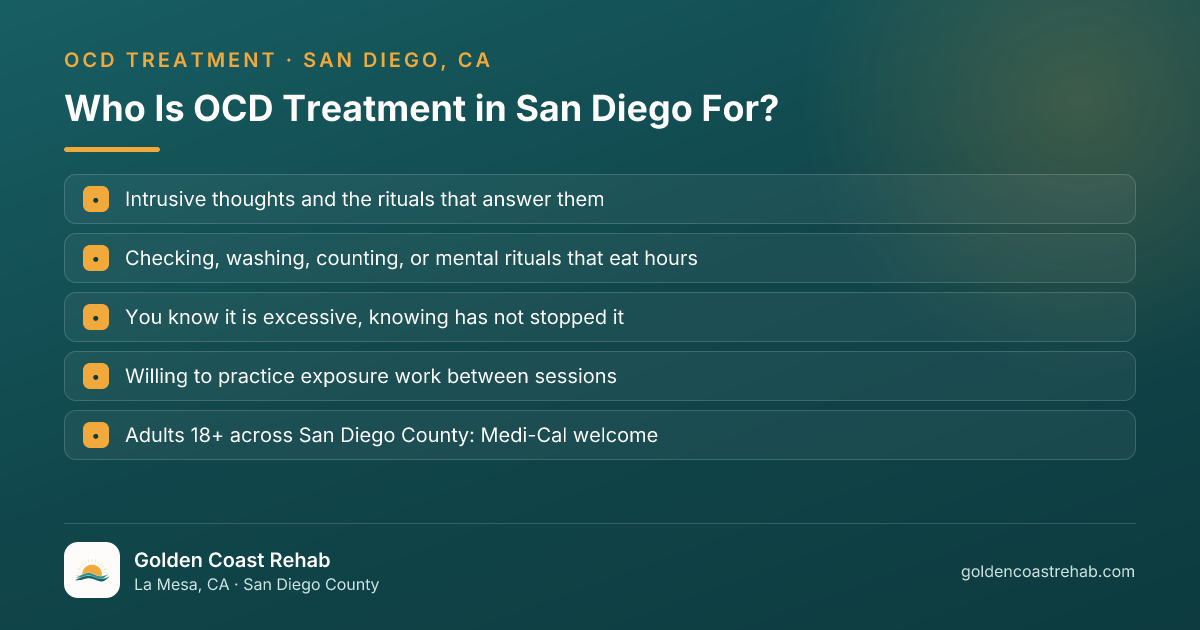
Programs Available for OCD Treatment in San Diego
Golden Coast Rehab is a contracted provider of Specialty Mental Health Services (Partial Hospitalization Program and Intensive Outpatient Program) for the County of San Diego, Behavioral Health Services, under County Contract 575462. Both programs serve adults 18 and older whose primary condition is a mental health condition, and both are delivered at our La Mesa facility. Living nearby? Start with OCD care in La Mesa.
Partial Hospitalization Program (PHP)
Day treatment fits OCD where rituals consume hours daily, where avoidance has shut down work or home life, or where outpatient therapy has not been intensive enough to break the cycle. PHP runs during the day, several days a week, and you go home each evening. It is the most structured level of care we offer.
Intensive Outpatient Program (IOP)
IOP delivers several structured exposure sessions a week while you keep working or studying. IOP is several sessions a week rather than full days, so it fits around work, school, and family. Many people step down into IOP from PHP; others start here.
We do not provide residential or inpatient treatment. If your assessment shows you need a higher level of care than we offer, we will tell you plainly and help you find it.
What Does OCD Treatment Involve at Golden Coast?
OCD treatment at Golden Coast follows a defined sequence. Intake and assessment, the first two weeks, active treatment, and step-down. Nobody walks in already knowing how this works, so here it is in full, start to finish.
Intake and assessment
We map the actual obsessions, the compulsions (including the mental ones people rarely mention), how much time they take, what you avoid, and how family members have been drawn into accommodating the rituals. Symptoms are tracked with standardized measures, including the PHQ-9 and the GAD-7 where clinically indicated, completed at intake and repeated during treatment so that change is measured rather than assumed.
The first two weeks
Education first. How the OCD loop works, and why reassurance and ritual are what maintains it rather than what solves it. Then you and your therapist build a hierarchy of feared situations, ordered from tolerable to hardest.
Active treatment
Exposure and response prevention: approaching the trigger deliberately and not performing the ritual, so the anxiety rises and then falls on its own. This is the treatment with the strongest evidence for OCD. It is demanding and it works, and the discomfort is planned rather than sprung on you. Medication is available where indicated.
Stepping down and aftercare
As rituals shrink and time is reclaimed, care steps down to weekly therapy with continued self-directed exposure. Your relapse plan names your themes and the specific early behaviors, extra checking, a return to reassurance-seeking, that signal it is creeping back. A full course of care runs up to twelve weeks across PHP and IOP, but length is a clinical decision made by your treatment team based on how you are actually doing, not a fixed schedule.
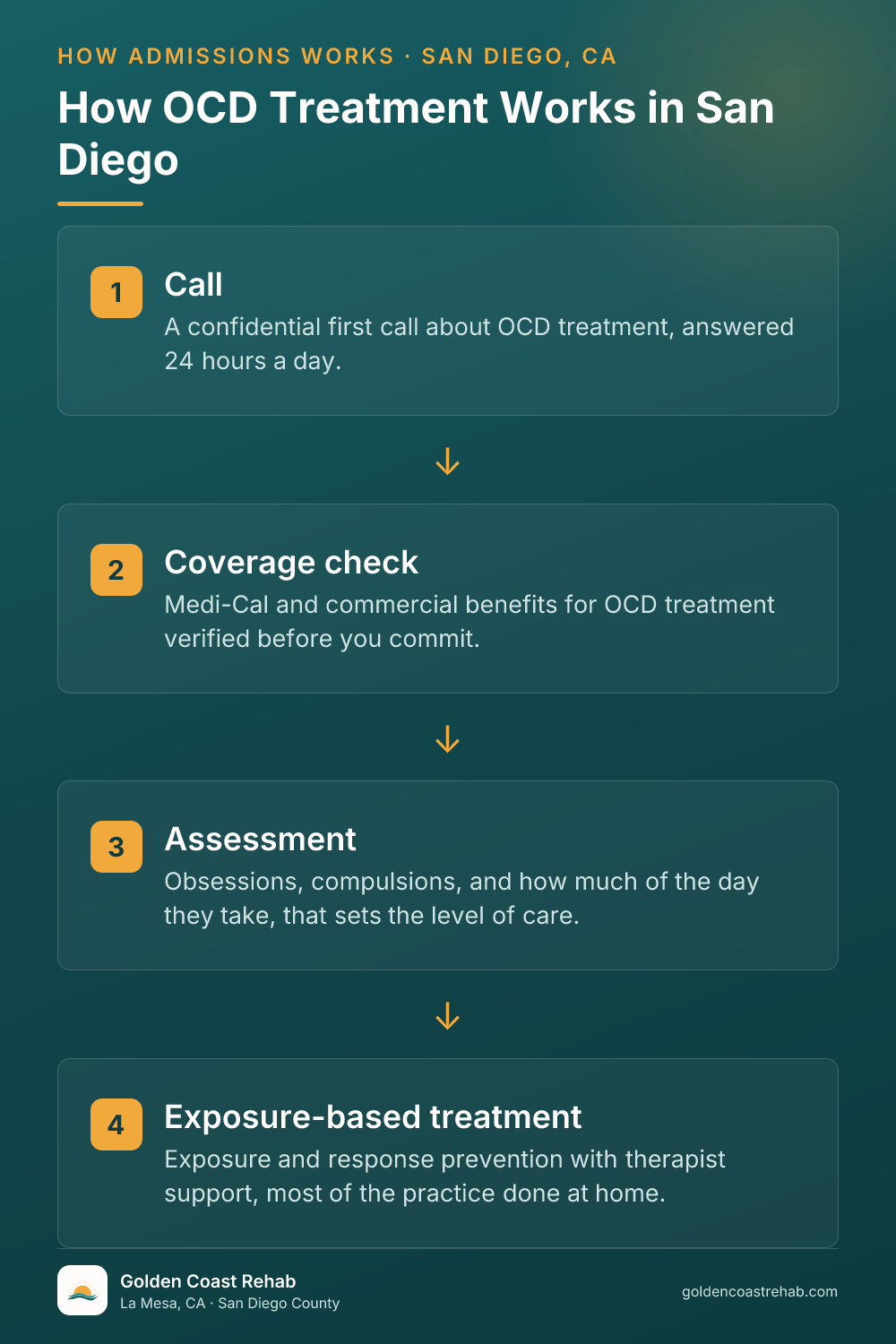
How Does OCD Treatment at Golden Coast Work?
OCD treatment at Golden Coast works in four phases, paced by your progress rather than a fixed calendar.
1. Assessment maps the obsessions and the rituals
A clinician charts what the intrusive thoughts demand and what the compulsions cost, hours, relationships, work, and sets the level of care.
2. Building the ERP foundation
Early weeks teach how OCD's loop works and build the tolerance skills exposure depends on, so the first exposures are wins rather than white-knuckling.
3. Exposure and response prevention
Planned, graded exposures with the response, the ritual, deliberately withheld, coached in session and practiced at home, where OCD actually lives.
4. Step-down and relapse prevention
The same team lightens the schedule as symptoms recede, with a written plan for catching new obsessional themes early. OCD shifts targets, and the skills transfer.

Ready to take the first step?
Speak with our admissions team: free, confidential, and no obligation.
Common Signs of OCD
What Are the Common Signs of OCD?
The common signs of OCD go well beyond tidiness. These are the patterns that mark the obsession-compulsion loop.
01.highRituals that consume hours a day
Washing, checking, counting, arranging, praying, or mentally reviewing, repeated until it feels right, often to a strict rule.
Health Risks: At this level OCD routinely costs people jobs, relationships, and sleep.
02.highIntrusive thoughts that horrify you
Unwanted violent, sexual, or blasphemous thoughts that run against everything you value. Their content is the opposite of your intentions, which is precisely why they are so distressing.
Health Risks: Fear of the thoughts themselves keeps people silent for years, and silence prevents treatment.
03.moderateConstant need for reassurance
Repeatedly asking whether something is safe, whether you locked it, whether you are a good person: with relief that never lasts.
Health Risks: Reassurance from family functions exactly like a compulsion and strengthens the loop.
04.moderateAvoiding whatever triggers the thoughts
Not touching doorknobs, not driving certain routes, not being alone with children, not cooking with knives.
Health Risks: Avoidance shrinks life steadily and prevents the brain from learning the feared outcome does not occur.
05.moderateFamily rearranged around the rituals
Household members checking on your behalf, providing reassurance, or complying with rules about what may be touched or where things go.
Health Risks: Family accommodation is one of the strongest predictors of OCD persisting; changing it is part of treatment.
Why Golden Coast for OCD Treatment in San Diego
1. One facility, all of San Diego County
We are a single facility in La Mesa serving the whole county, so your OCD treatment team stays consistent from intake through step-down instead of handing you between locations.
2. County-contracted specialty mental health care
Golden Coast Rehab is a contracted provider of Specialty Mental Health Services for the County of San Diego, which is why OCD treatment here can be covered at no cost on any Medi-Cal plan in the county.
3. Progress you can see, not just feel
OCD symptoms are tracked with standardized tools like the GAD-7 and PHQ-9 at intake and throughout OCD treatment, so your care team adjusts the plan based on evidence rather than impression.
4. Psychiatric care from a board-certified physician
Where medication is part of OCD treatment, it is managed by our Medical Director, Dr. Sanjai Mathew Thankachen, MD, a board-certified psychiatrist.
5. Small enough to notice a bad week
As of July 2026 our programs are staffed at two clinicians for every five clients, which keeps OCD treatment groups small enough that a clinician notices when you are struggling.
6. Reachable when it matters
Our phones are answered 24 hours a day, and our offices are open 8am to 8pm, so starting OCD treatment does not depend on catching us during a narrow window.
Check your coverage
Medi-Cal welcome. Find out what your coverage includes.
How Does Golden Coast Support Family During OCD Treatment?
Golden Coast supports family during OCD treatment by working with them to reduce accommodation gradually, in coordination with the client's exposure plan, so it lands as teamwork rather than punishment. Families accommodate because it stops visible distress in the moment, but over time it becomes the scaffolding that holds OCD up.
With your consent, family members can be included in treatment planning and family sessions. Without your consent, they cannot. Your privacy is protected by law, and we will explain to your family what we can and cannot share. More for the people who love you: For Families.
Does Medi-Cal Cover OCD Treatment in San Diego?
Yes. OCD treatment at Golden Coast is covered by Medi-Cal in San Diego County, including any of the four managed care plans, at no cost to you, because specialty mental health services are administered by San Diego County Behavioral Health Services rather than by your plan. Full detail on how Medi-Cal works here.
Call (858) 925-8589 to check your eligibility. Our line is answered 24 hours a day. If you are in crisis, the San Diego County Access and Crisis Line is available around the clock at 1-888-724-7240.
Understanding OCD
Understanding OCD, what it is clinically, how common it is, and what it responds to, puts the treatment decisions on this page in context.
What is OCD?
OCD is a loop: intrusive thoughts (obsessions) that spike anxiety, and rituals (compulsions) that relieve it briefly and feed it long-term. It is not tidiness or preference. It is a condition that consumes time and narrows life, and it has a well-established first-line treatment.
How common is OCD?
OCD affects an estimated 1.2% of U.S. adults in a given year, according to NIMH's obsessive-compulsive disorder statistics page. Millions of people, most of whom wait years before treatment, usually because the rituals feel too strange to say out loud. Ours is a clinical setting; nothing about OCD is strange here.
What is exposure and response prevention?
Exposure and response prevention is deliberately approaching what triggers the obsession while not performing the ritual, in graded steps, until the brain re-learns that the feared outcome does not depend on the compulsion. It is the best-evidenced OCD treatment there is.
Why doesn't reassurance help OCD?
Reassurance does not help OCD because it works exactly like a compulsion: brief relief, then the doubt returns hungrier. Treatment teaches you, and your family, to respond to the doubt differently instead of feeding it.
What happens if OCD goes untreated?
Untreated OCD tends to expand: rituals lengthen, themes multiply, and accommodation by family grows around it. Because compulsions are learned, they are also unlearnable, which is why treatment works at any stage.
Next Steps
Related Care for OCD
Levels of care for OCD step up and down around your progress. Start where you are, and we'll adjust together.
Partial Hospitalization Program (PHP)
Our most structured outpatient level of care, offered as a specialty mental health service.
Learn moreIntensive Outpatient Program (IOP)
Evidence-based group and individual therapy with the flexibility to keep working, studying, and living at home.
Learn moreMedication-Assisted Treatment (MAT)
FDA-approved medication for opioid and alcohol use disorder, managed by our medical team.
Learn moreDual Diagnosis Treatment
Integrated care for substance use and co-occurring mental health conditions, treated together, not separately.
Learn moreVerify Your Insurance
Check your coverage in minutes: free, confidential, and with no obligation to enroll.
Learn moreAdmissions Process
See exactly what happens from your first call to your start date, step by step.
Learn moreServing members of every San Diego Medi-Cal plan
Credentialed through Optum, administrator of behavioral health services for the County of San Diego.




 Optum, a UnitedHealth Group companyAdministrative Services Organization for County of San Diego behavioral health. We are credentialed with Optum.
 County of San Diego Behavioral Health ServicesContracted provider of Specialty Mental Health Services under County Contract 575462.
Not sure if you're covered? Verify your benefits in minutes, free & confidential.
Admissions
Our OCD Admission Process
Starting treatment at Golden Coast Rehab takes one phone call. Here's exactly what happens from your first call.
Call or Reach Out
Speak with an admissions specialist: no pressure, completely confidential.
Verify Your Coverage
We confirm what your plan covers, Medi-Cal welcome, usually the same day.
Phone Assessment
A 10–15 minute ASAM-based assessment helps us understand your history and recommend the right level of care.
Clinical Review & Intake
Our team reviews your assessment, builds an individualized plan, and schedules your start date.
Questions, Answered
OCD Treatment FAQs
What is exposure and response prevention?
Am I going to be forced to touch a toilet on day one?
My obsessions are about harming someone. Does that make me dangerous?
Does medication help OCD?
How is this different from being a perfectionist or very tidy?
What types of obsessions and compulsions do you treat?
How long does exposure and response prevention take to show results?
Can OCD be treated alongside anxiety or depression?
What if my compulsions are mental rather than physical?
Do you treat OCD in people who have never been formally diagnosed?
How do I know if I need an OCD treatment program instead of weekly therapy?
How is progress measured in OCD treatment?
Does Golden Coast Rehab take Medi-Cal for OCD treatment?
What does a day in the OCD treatment program look like?
Can adults self-refer for OCD treatment in San Diego County?
Sources
- NIMH: OCD past-year prevalence in U.S. adults (1.2%)https://www.nimh.nih.gov/health/statistics/obsessive-compulsive-disorder-ocd
About this page
Prepared by the Golden Coast Rehab team. Everything described here is delivered under two public, verifiable authorities: specialty mental health services (PHP and IOP) contracted by the County of San Diego, and substance use treatment certified by DHCS. We do not operate residential or inpatient beds; partner housing and coordinated referrals cover what we do not deliver on site, and we say so plainly when an assessment points that way.
This content is general educational information, not medical advice. Decisions about your care belong in a conversation with a clinician, which is what the first phone call starts.
Chat with us.
We're here to help you or your loved one, whether the need is mental health, sobriety, or both. Free, confidential.
Structure, support, and a team that knows your name, starting this week.
One call, answered by a person, 24 hours a day. We will tell you plainly whether this is the right fit, and where to go if it is not.
Every day, 8am – 8pm · Free & confidential · HIPAA & 42 CFR Part 2 protected