
Schizophrenia Treatment Program in San Diego for Medi-Cal Adults
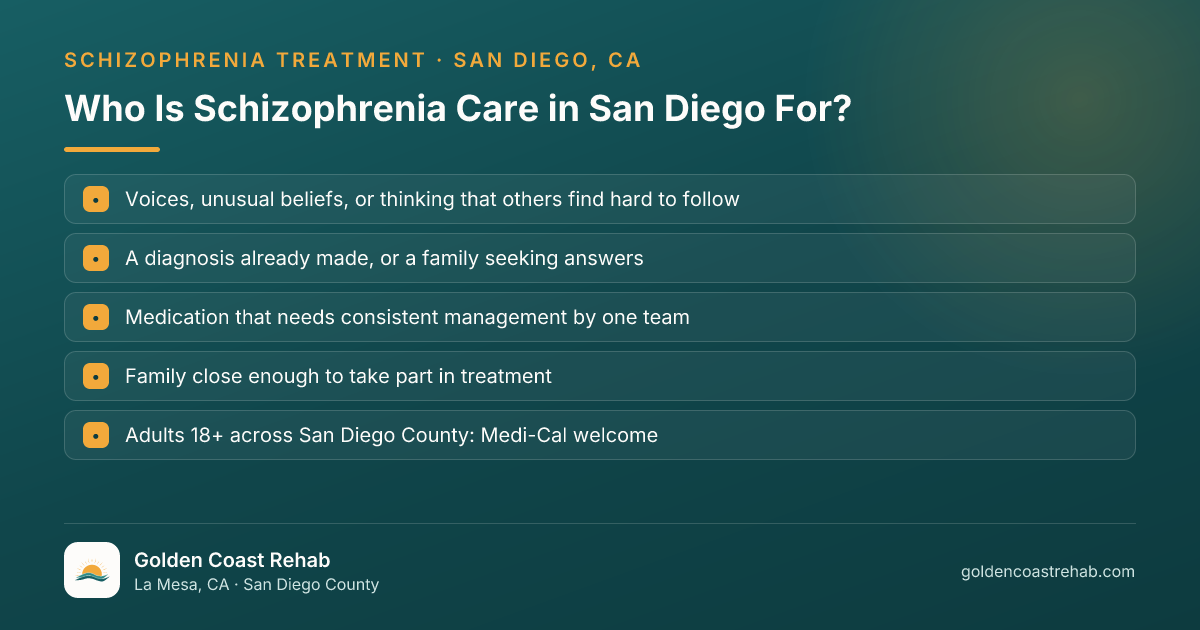
Schizophrenia treatment in San Diego at Golden Coast Rehab is structured outpatient care for adults who are psychiatrically stable. Medication management, therapy, and family work held together by one team, under San Diego County's specialty mental health system. In active psychosis or crisis, call 988 or the county Access and Crisis Line first; treatment here begins after stabilization. Medi-Cal covers this care as a Specialty Mental Health Service under County Contract 575462, at no cost to San Diego County members when clinical criteria are met.
- Reviews medication history, side effects, housing, and support at intake with equal weight
- Medication consistency with the psychiatric provider comes first in the first two weeks
- Family education included where family is involved, shown to reduce relapse
- Groups focus on symptom management, daily living, stress, and social connection
- Relapse plan names early signs like sleep changes, withdrawal, and suspicion
- Every day, 8am – 8pm
- 100% confidential (HIPAA & 42 CFR Part 2)
- Adults 18+ · dual-diagnosis welcome
Book an assessment
Takes about 60 seconds. Eligible Medi-Cal members can pick an assessment time right away; everyone else hears from our admissions team, usually within the hour.
Key Takeaways for Schizophrenia Treatment
- Outpatient schizophrenia care for stable adults 18+, at our one La Mesa facility. We are not a crisis service and do not treat active psychosis
- Provided as Specialty Mental Health Services under County of San Diego Contract 575462
- Medication managed alongside therapy and family sessions by one team, with continuity over time as the organizing principle
- Family involvement is built in. The clinical literature links psychoeducation to lower relapse risk
- Medi-Cal covers treatment at no cost on any of the county's four plans when clinical criteria are met
- In active psychosis or immediate danger: 911; crisis support: 988, or the San Diego Access and Crisis Line at 1-888-724-7240
Schizophrenia is a brain condition that affects perception, thinking, motivation, and the ability to tell internal experience from external reality. It is not a split personality and it is not a life sentence of institutions. Most people with schizophrenia live in the community, and treatment is what makes that stable rather than precarious.
Golden Coast Rehab provides outpatient specialty mental health treatment for adults with schizophrenia, schizoaffective disorder, and related psychotic disorders across San Diego County.
Our programs commonly serve people stepping down from a hospitalization and people whose symptoms are stable enough for outpatient care but who need more structure than a monthly medication check, a position easier to place alongside severe mental health treatment in San Diego.
Programs Available for Schizophrenia Treatment in San Diego
Golden Coast Rehab is a contracted provider of Specialty Mental Health Services (Partial Hospitalization Program and Intensive Outpatient Program) for the County of San Diego, Behavioral Health Services, under County Contract 575462. Both programs serve adults 18 and older whose primary condition is a mental health condition, and both are delivered at our La Mesa facility. For the neighborhood view, see schizophrenia treatment in La Mesa.
Partial Hospitalization Program (PHP)
Day treatment provides daily structure and close monitoring. Typically after an inpatient psychiatric stay, or when symptoms have increased and the alternative would be an admission. PHP runs during the day, several days a week, and you go home each evening. It is the most structured level of care we offer.
Intensive Outpatient Program (IOP)
IOP maintains several sessions a week for people who are stable but need consistent support to stay that way. IOP is several sessions a week rather than full days, so it fits around work, school, and family. Many people step down into IOP from PHP; others start here.
We do not provide residential or inpatient treatment. If your assessment shows you need a higher level of care than we offer, we will tell you plainly and help you find it.
What Does Schizophrenia Treatment Involve at Golden Coast?
Schizophrenia treatment at Golden Coast follows a defined sequence. Intake and assessment, the first two weeks, active treatment, and step-down. Nobody walks in already knowing how this works, so here it is in full, start to finish.
Intake and assessment
We review symptom history, hospitalizations, current medications and how you have responded to them, side effects, substance use, housing, and support. Practical circumstances get equal weight to symptoms here, because housing and support are what most often determine whether treatment holds. Symptoms are tracked with standardized measures, including the PHQ-9 and the GAD-7 where clinically indicated, completed at intake and repeated during treatment so that change is measured rather than assumed. Where housing itself is unstable, our mental health housing support page covers the options.
The first two weeks
Medication consistency comes first, working with our Medical Director, Dr. Sanjai Mathew Thankachen, MD, a board-certified psychiatrist on what you are taking, what it is doing, and what it is costing you in side effects. Side effects are a leading reason people stop medication, and the answer is adjusting the regimen rather than pretending they are not happening.
Active treatment
Medication management, individual therapy, and groups focused on symptom management, daily living, stress, and social connection. Where family is involved, family education is included. It has some of the best evidence of anything in schizophrenia care for reducing relapse.
Stepping down and aftercare
Step-down means continued psychiatric follow-up plus a relapse plan naming your early warning signs, which for most people are consistent and recognizable: sleep changes, withdrawal, and suspicion tend to arrive before symptoms return in full. A full course of care runs up to twelve weeks across PHP and IOP, but length is a clinical decision made by your treatment team based on how you are actually doing, not a fixed schedule.
How Does Schizophrenia Treatment at Golden Coast Work?
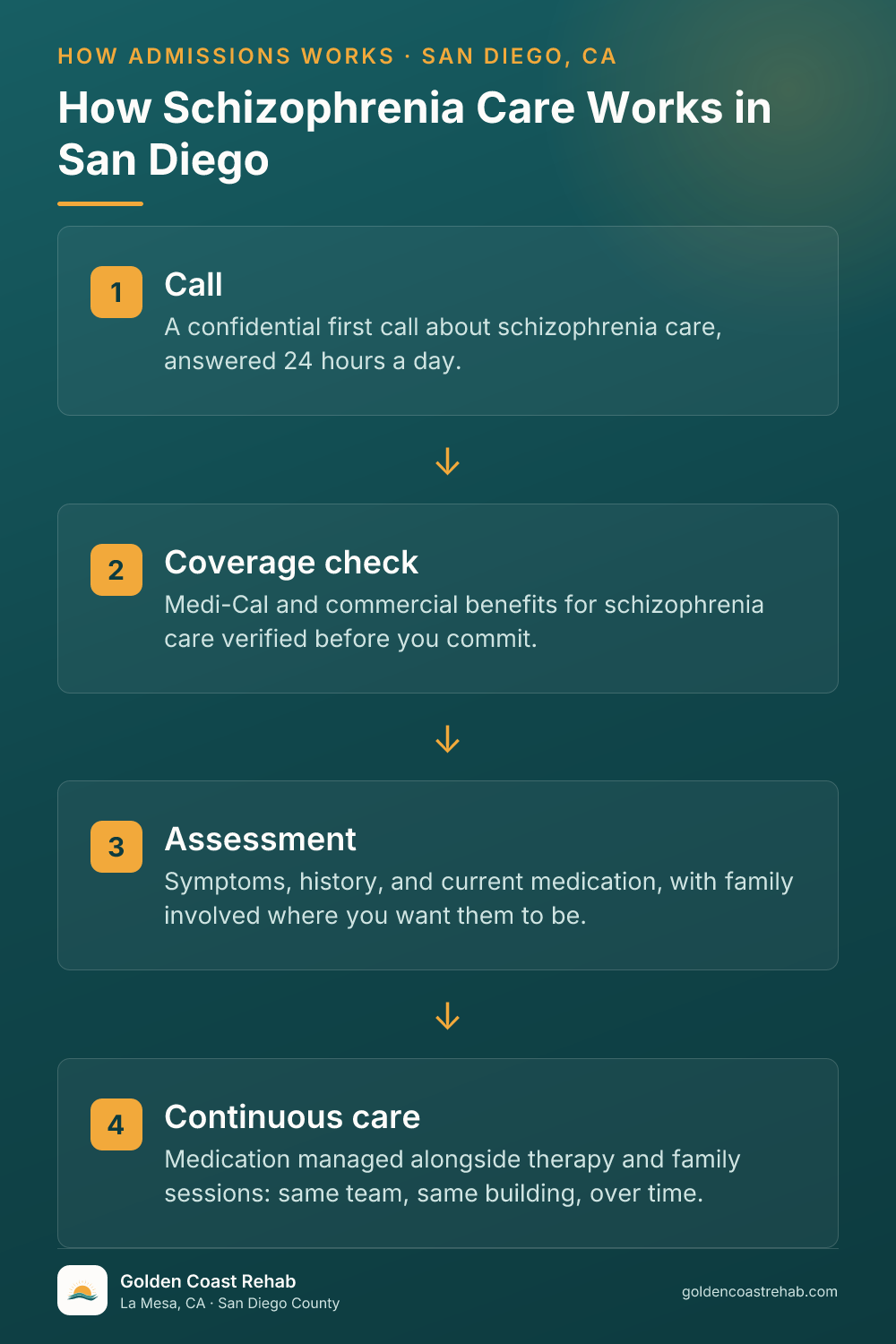
Schizophrenia treatment at Golden Coast works in four phases, paced by your progress rather than a fixed calendar.
1. Assessment confirms stability and maps the history
Symptoms, medication history, and what previous stretches of stability looked like, with family involved where you want them.
2. Anchoring the medication routine
Early treatment stabilizes the regimen and the practical machinery around it. Pharmacy, side-effect management, the daily structure adherence depends on.
3. Active treatment rebuilds the day
Therapy and group work on social connection, routine, and self-management; family psychoeducation runs alongside, because families carry relapse-prevention work too.
4. Continuity, indefinitely
Schizophrenia care is measured in years, not programs. The same team, the same building, and a written early-warning plan naming the signals that precede an episode.
Ready to take the first step?
Speak with our admissions team: free, confidential, and no obligation.
Common Signs of Schizophrenia
What Are the Common Signs of Schizophrenia?
The common signs of schizophrenia fall into two categories. Positive symptoms such as hallucinations, and negative symptoms such as withdrawal and loss of drive. Both matter.
01.highHearing or seeing things others do not
Voices are the most common form. They may comment, criticize, or instruct, and they are experienced as genuinely external.
Health Risks: Command hallucinations that direct harm require urgent clinical attention.
02.highFixed beliefs that others do not share
Convictions about being watched, followed, targeted, or controlled, held firmly despite evidence.
Health Risks: Persecutory beliefs can lead to dangerous decisions and to cutting off the people trying to help.
03.moderateDisorganized speech or thinking
Conversation that jumps between unconnected ideas, or becomes difficult for others to follow.
Health Risks: Disorganization interferes with work, appointments, and self-care.
04.moderateWithdrawal, flat affect, and loss of drive
Reduced emotional expression, speaking little, and a loss of motivation for activity that is not laziness and not depression.
Health Risks: These negative symptoms often affect long-term functioning more than hallucinations do, and are frequently misread by families.
05.moderateStopping medication
Discontinuing antipsychotics because of side effects, cost, or the sense of being well and no longer needing them.
Health Risks: Discontinuation is the single most common precursor to relapse and rehospitalization.
Why Golden Coast for Schizophrenia Treatment in San Diego
1. One facility, all of San Diego County
We are a single facility in La Mesa serving the whole county, so your treatment team stays consistent from intake through step-down instead of handing you between locations.
2. County-contracted specialty mental health care
Golden Coast Rehab is a contracted provider of Specialty Mental Health Services for the County of San Diego, which is why care here can be covered at no cost on any Medi-Cal plan in the county.
3. Progress you can see, not just feel
Schizophrenia symptoms are tracked with standardized tools like the GAD-7 and PHQ-9 at intake and throughout your course of care, so your care team adjusts the plan based on evidence rather than impression.
4. Psychiatric care from a board-certified physician
Where medication is part of your plan, it is managed by our Medical Director, Dr. Sanjai Mathew Thankachen, MD, a board-certified psychiatrist.
5. Small enough to notice a bad week
As of July 2026 our programs are staffed at two clinicians for every five clients, which keeps groups small enough that a clinician notices when you are struggling.
6. Reachable when it matters
Our phones are answered 24 hours a day, and our offices are open 8am to 8pm, so starting care does not depend on catching us during a narrow window.
Check your coverage
Medi-Cal welcome. Find out what your coverage includes.
How Does Golden Coast Support Family During Schizophrenia Treatment?
Golden Coast supports family during schizophrenia treatment with education, an element the clinical literature links to lower relapse rates: learning which behaviors are negative symptoms rather than choices, keeping expectations realistic without giving up on them, lowering the temperature of criticism and conflict at home, and knowing the early warning signs. Families also need support of their own, and that is legitimate.
With your consent, family members can be included in treatment planning and family sessions. Without your consent, they cannot. Your privacy is protected by law, and we will explain to your family what we can and cannot share. More for the people who love you: For Families.
Does Medi-Cal Cover Schizophrenia Treatment in San Diego?
Yes. Schizophrenia treatment at Golden Coast is covered by Medi-Cal in San Diego County, including any of the four managed care plans, at no cost to you, because specialty mental health services are administered by San Diego County Behavioral Health Services rather than by your plan. Full detail on how Medi-Cal works here.
Call (858) 925-8589 to check your eligibility. Our line is answered 24 hours a day. If you are in crisis, the San Diego County Access and Crisis Line is available around the clock at 1-888-724-7240.
Understanding Schizophrenia
Understanding schizophrenia, what it is clinically, how common it is, and what it responds to, puts the treatment decisions on this page in context.
What is schizophrenia?
Schizophrenia is a chronic psychotic disorder affecting perception, thinking, motivation, and social function. Hallucinations and fixed false beliefs on one side, and flattened expression and withdrawal on the other. With sustained treatment, many people live stable, meaningful lives.
How common is schizophrenia?
Schizophrenia and related psychotic disorders affect an estimated 0.25% to 0.64% of the U.S. population, according to NIMH's schizophrenia statistics page. Locally, psychotic disorders were the most common primary diagnosis, at 45%, among adults in San Diego County's public behavioral health system, per County HHSA FY 2020-21 system-of-care data.
Why is medication consistency the center of schizophrenia treatment?
Medication consistency is the center because discontinuation is the strongest predictor of relapse, and stopping usually follows feeling better or side effects nobody addressed. Treatment here manages both, in the same building as everything else.
What role does family play in schizophrenia treatment?
Family plays a measurable clinical role: structured family psychoeducation reduces relapse rates, because families who know the early warning signs and how to respond become part of the treatment system rather than bystanders to it.
Can people with schizophrenia live full lives?
Yes. With sustained treatment, many people with schizophrenia work, maintain relationships, and live independently. The strongest predictors are continuity of care and medication stability, which is exactly what an outpatient program built on one team is for.
Next Steps
Related Care for Schizophrenia
Levels of care for schizophrenia step up and down around your progress. Start where you are, and we'll adjust together.
Partial Hospitalization Program (PHP)
Our most structured outpatient level of care, offered as a specialty mental health service.
Learn moreIntensive Outpatient Program (IOP)
Evidence-based group and individual therapy with the flexibility to keep working, studying, and living at home.
Learn moreMedication-Assisted Treatment (MAT)
FDA-approved medication for opioid and alcohol use disorder, managed by our medical team.
Learn moreDual Diagnosis Treatment
Integrated care for substance use and co-occurring mental health conditions, treated together, not separately.
Learn moreVerify Your Insurance
Check your coverage in minutes: free, confidential, and with no obligation to enroll.
Learn moreAdmissions Process
See exactly what happens from your first call to your start date, step by step.
Learn moreServing members of every San Diego Medi-Cal plan
Credentialed through Optum, administrator of behavioral health services for the County of San Diego.




 Optum, a UnitedHealth Group companyAdministrative Services Organization for County of San Diego behavioral health. We are credentialed with Optum.
 County of San Diego Behavioral Health ServicesContracted provider of Specialty Mental Health Services under County Contract 575462.
Not sure if you're covered? Verify your benefits in minutes, free & confidential.
Admissions
Our Schizophrenia Admission Process
Starting treatment at Golden Coast Rehab takes one phone call. Here's exactly what happens from your first call.
Call or Reach Out
Speak with an admissions specialist: no pressure, completely confidential.
Verify Your Coverage
We confirm what your plan covers, Medi-Cal welcome, usually the same day.
Phone Assessment
A 10–15 minute ASAM-based assessment helps us understand your history and recommend the right level of care.
Clinical Review & Intake
Our team reviews your assessment, builds an individualized plan, and schedules your start date.
Questions, Answered
Schizophrenia Treatment FAQs
Can schizophrenia be treated outside a hospital?
Is medication required?
Does therapy help schizophrenia?
Do you treat schizoaffective disorder?
What if there is also substance use?
Can therapy really help if medication manages the main symptoms?
What if I've been hospitalized for psychosis before?
Can loved ones stay involved as I move through treatment for schizophrenia?
What if my symptoms include both psychosis and substance use?
How do I know if I need a schizophrenia treatment program instead of weekly therapy?
How is progress measured in schizophrenia treatment?
Does Golden Coast Rehab take Medi-Cal for schizophrenia treatment?
What does a day in the schizophrenia treatment program look like?
Can adults self-refer for schizophrenia treatment in San Diego County?
Sources
- San Diego County HHSA: schizophrenia and other psychotic disorders were the most common diagnosis (45%) among adult/older-adult behavioral health clients in FY 2020-21https://www.sandiegocounty.gov/content/dam/sdc/hhsa/programs/bhs/TRL/AOA%20Annual%20System%20of%20Care%20Report%20FY%2020-21.pdf
- NIMH: schizophrenia and related psychotic disorders prevalence range in the U.S. (0.25%-0.64%)https://www.nimh.nih.gov/health/statistics/schizophrenia
About this page
Prepared by the Golden Coast Rehab team. Everything described here is delivered under two public, verifiable authorities: specialty mental health services (PHP and IOP) contracted by the County of San Diego, and substance use treatment certified by DHCS. We do not operate residential or inpatient beds; partner housing and coordinated referrals cover what we do not deliver on site, and we say so plainly when an assessment points that way.
This content is general educational information, not medical advice. Decisions about your care belong in a conversation with a clinician, which is what the first phone call starts.
Chat with us.
We're here to help you or your loved one, whether the need is mental health, sobriety, or both. Free, confidential.
Structure, support, and a team that knows your name, starting this week.
One call, answered by a person, 24 hours a day. We will tell you plainly whether this is the right fit, and where to go if it is not.
Every day, 8am – 8pm · Free & confidential · HIPAA & 42 CFR Part 2 protected