
Anxiety Treatment Program in San Diego for Medi-Cal Adults
Anxiety treatment in San Diego at Golden Coast Rehab is structured outpatient care, PHP and IOP levels, for adults whose generalized anxiety, panic, social anxiety, or health anxiety has outgrown weekly therapy. We are a contracted Specialty Mental Health Services provider for the County of San Diego, treatment is measured with the GAD-7 from intake onward, and Medi-Cal covers care here at no cost when criteria are met.
- Treats generalized anxiety, panic disorder, social anxiety, and health anxiety
- Builds a personal exposure hierarchy before any exposure work begins
- Core work pairs cognitive behavioral therapy with graded exposure to feared situations
- Teaches families to support without accommodating avoidance
- Relapse plan targets the early return of avoidance as the first warning sign
- Every day, 8am – 8pm
- 100% confidential (HIPAA & 42 CFR Part 2)
- Adults 18+ · dual-diagnosis welcome
Book an assessment
Takes about 60 seconds. Eligible Medi-Cal members can pick an assessment time right away; everyone else hears from our admissions team, usually within the hour.
Key Takeaways for Anxiety Treatment
- Two levels of care for anxiety, partial hospitalization (PHP) and intensive outpatient (IOP), for adults 18+, delivered at our one La Mesa facility
- Provided as Specialty Mental Health Services under County of San Diego Contract 575462; a substance use diagnosis is not required for admission
- Treats generalized anxiety, panic disorder, social anxiety, and health anxiety; CBT and exposure-based therapy are the core of the work
- Progress is measured with the GAD-7 from intake onward, not guessed at
- Medi-Cal covers treatment at no cost on any of the county's four plans when clinical criteria are met
- We do not operate inpatient or hospital beds; in a crisis, call 988, or the San Diego Access and Crisis Line at 1-888-724-7240
Anxiety disorders are the most common mental health conditions in adults, and among the most responsive to treatment. That combination matters: a great many people spend years managing something that has a well-established, evidence-based fix.
Golden Coast Rehab treats generalized anxiety, panic disorder, social anxiety, and health anxiety in adults across San Diego County, alongside specific phobia treatment. Anxiety becomes a clinical problem not when it is intense but when it starts making decisions for you, which invitations you decline, which roads you avoid, which appointments you cancel.
The goal of treatment is not a life without anxiety. It is anxiety that no longer runs the schedule.
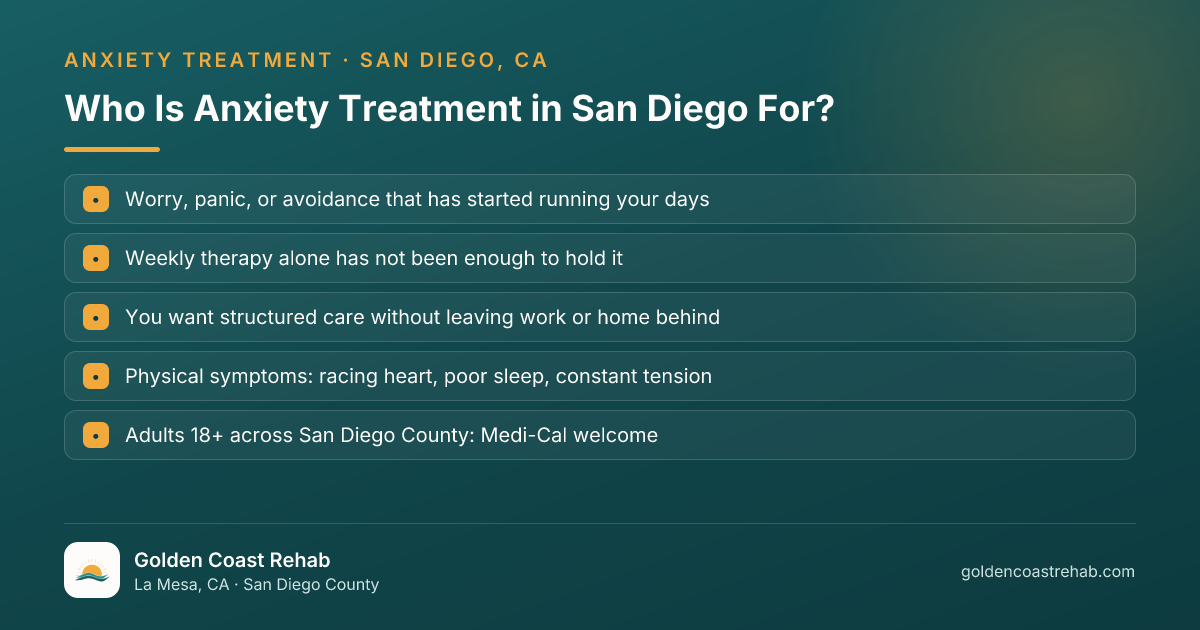
Programs Available for Anxiety Treatment in San Diego
Golden Coast Rehab is a contracted provider of Specialty Mental Health Services (Partial Hospitalization Program and Intensive Outpatient Program) for the County of San Diego, Behavioral Health Services, under County Contract 575462. Both programs serve adults 18 and older whose primary condition is a mental health condition, and both are delivered at our La Mesa facility. If you are close by, our anxiety treatment in La Mesa page covers the local details.
Partial Hospitalization Program (PHP)
Day treatment is for anxiety that has become disabling. Panic attacks frequent enough to stop you leaving home, avoidance that has shut down work and relationships, or anxiety severe enough that outpatient therapy alone has not held. Acceptance-based work such as acceptance and commitment therapy targets exactly that avoidance. PHP runs during the day, several days a week, and you go home each evening. It is the most structured level of care we offer.
Intensive Outpatient Program (IOP)
IOP gives several structured sessions a week, which is usually enough to do real exposure work while you keep your commitments. IOP is several sessions a week rather than full days, so it fits around work, school, and family. Many people step down into IOP from PHP; others start here.
We do not provide residential or inpatient treatment. If your assessment shows you need a higher level of care than we offer, we will tell you plainly and help you find it.
What Does Anxiety Treatment Involve at Golden Coast?
Anxiety treatment at Golden Coast follows a defined sequence. Intake and assessment, the first two weeks, active treatment, and step-down. Nobody walks in already knowing how this works, so here it is in full, start to finish.
Intake and assessment
We map what you avoid and what triggers it, take a history of panic, worry, and physical symptoms, screen for depression and substance use, and rule in or out medical contributors. Anxiety is often tangled with caffeine, sleep debt, and thyroid or cardiac symptoms, so those get asked about too.
The first two weeks
You learn the mechanics first. How the fear response works in the body, why avoidance provides relief and then makes anxiety worse, and what a panic attack actually is physiologically. Alongside that, breathing and grounding skills, sleep repair, and the beginning of a personal exposure hierarchy.
Active treatment
The core work is cognitive behavioral therapy plus graded exposure: approaching feared situations deliberately, in a planned order, with support, until your nervous system updates its prediction. Groups add practice and the considerable relief of hearing other people describe your exact experience. Medication is available where it helps.
How progress is measured
Anxiety symptoms are tracked with the GAD-7, a seven-item questionnaire covering worry, restlessness, irritability, and the physical side of anxiety. You complete it at intake and repeat it during treatment, so change is measured rather than assumed. Useful in a condition where avoidance shrinks so gradually that people miss their own progress. Because depression so often travels with an anxiety disorder, the PHQ-9 is used alongside it. Your scores are reviewed with you rather than kept in a chart.
Stepping down and aftercare
You step down as avoidance shrinks and you can run exposures on your own. Relapse prevention focuses on the early return of avoidance, which is the first thing to reappear under stress, and on a written plan for what to do when it does. A full course of care runs up to twelve weeks across PHP and IOP, but length is a clinical decision made by your treatment team based on how you are actually doing, not a fixed schedule.
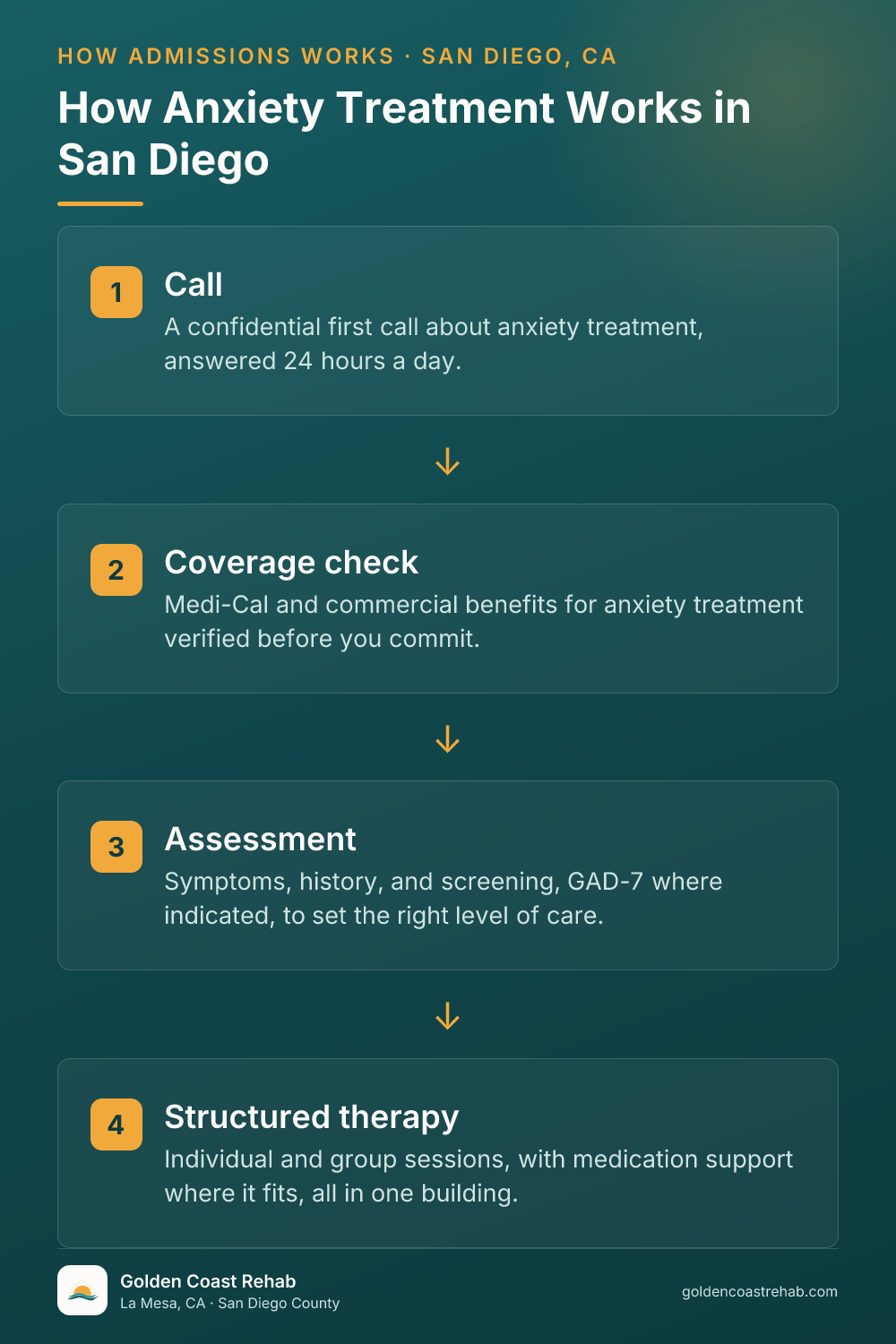
How Does Anxiety Treatment at Golden Coast Work?
Anxiety treatment at Golden Coast works in four phases, each with a clear job, moving at the pace your progress actually supports rather than a fixed calendar.
1. Assessment sets the GAD-7 baseline and the level of care
A clinician takes your symptom history, screens for co-occurring conditions, and administers the GAD-7. A validated seven-item anxiety measure scored 0 to 21. That score, not a sales conversation, is what the rest of treatment is measured against, and it determines whether PHP or IOP is the right starting level.
2. Early treatment builds the skills exposure work depends on
The first weeks teach the CBT foundations: how to catch a catastrophic prediction, how to test it against evidence, how panic physiology actually works. Medication support is arranged in the same building where it fits.
3. Active treatment applies the skills to the feared situations themselves
Graded exposure is where anxiety treatment earns its results. Approaching the avoided freeway, meeting, or grocery store in planned steps, with the group and your therapist debriefing each one. GAD-7 scores are re-checked as you go.
4. Step-down keeps the same team as the schedule lightens
PHP steps down to IOP and IOP to weekly outpatient care with the same clinicians, on a written relapse-prevention plan for what to do when stress brings symptoms back.
Ready to take the first step?
Speak with our admissions team: free, confidential, and no obligation.
Common Signs of Anxiety
What Are the Common Signs of Anxiety?
The common signs of anxiety show up once it starts making your decisions instead of you. These are the signs that it has crossed that line.
01.highPanic attacks
Sudden surges of fear with pounding heart, shortness of breath, chest tightness, dizziness, or a sense of unreality. They frequently get mistaken for a heart attack.
Health Risks: Fear of the next attack often drives people to stop leaving the house entirely.
02.moderateAvoidance that keeps expanding
Skipping the freeway, the grocery store, the meeting, the party. Each avoidance brings relief and makes the next one more likely.
Health Risks: Avoidance is the mechanism by which a manageable anxiety becomes a disabling one.
03.moderateWorry you cannot switch off
Hours a day of anticipating what could go wrong, often about health, money, or the people you love, with no ability to set it down.
Health Risks: Chronic worry disrupts sleep and concentration and commonly leads into depression.
04.moderatePhysical symptoms with no medical cause found
Stomach problems, headaches, muscle tension, jaw clenching, and fatigue that repeatedly come back clean on medical workup.
Health Risks: People often cycle through specialists and emergency rooms for years before anxiety is identified.
05.lowDrinking or using to take the edge off
Alcohol, cannabis, or benzodiazepines used to get through social situations or to sleep.
Health Risks: Substances reduce anxiety briefly and increase it on the rebound, which is how dependence starts.
Why Golden Coast for Anxiety Treatment in San Diego
1. One facility, all of San Diego County
We are a single facility in La Mesa serving the whole county, so your treatment team stays consistent from intake through step-down instead of handing you between locations.
2. County-contracted specialty mental health care
Golden Coast Rehab is a contracted provider of Specialty Mental Health Services for the County of San Diego, which is why care here can be covered at no cost on any Medi-Cal plan in the county.
3. Progress you can see, not just feel
Anxiety symptoms are tracked with standardized tools like the GAD-7 and PHQ-9 at intake and throughout your course of care, so your care team adjusts the plan based on evidence rather than impression.
4. Psychiatric care from a board-certified physician
Where medication is part of your plan, it is managed by our Medical Director, Dr. Sanjai Mathew Thankachen, MD, a board-certified psychiatrist.
5. Small enough to notice a bad week
As of July 2026 our programs are staffed at two clinicians for every five clients, which keeps groups small enough that a clinician notices when you are struggling.
6. Reachable when it matters
Our phones are answered 24 hours a day, and our offices are open 8am to 8pm, so starting care does not depend on catching us during a narrow window.
Check your coverage
Medi-Cal welcome. Find out what your coverage includes.
How Does Golden Coast Support Family During Anxiety Treatment?
Golden Coast supports family during anxiety treatment by teaching them how to support without accommodating, in a way that does not feel like abandonment. Families usually try to help by providing reassurance and by taking over the things the anxious person avoids. Both loving responses that accidentally strengthen the anxiety.
With your consent, family members can be included in treatment planning and family sessions. Without your consent, they cannot. Your privacy is protected by law, and we will explain to your family what we can and cannot share. More for the people who love you: For Families.
Does Medi-Cal Cover Anxiety Treatment in San Diego?
Yes. Anxiety treatment at Golden Coast is covered by Medi-Cal in San Diego County, including any of the four managed care plans, at no cost to you, because specialty mental health services are administered by San Diego County Behavioral Health Services rather than by your plan; our PHP and IOP are delivered under County of San Diego Contract 575462, a public record you can verify. Full detail on how Medi-Cal works here.
Call (858) 925-8589 to check your eligibility. Our line is answered 24 hours a day. If you are in crisis, the San Diego County Access and Crisis Line is available around the clock at 1-888-724-7240.
Understanding Anxiety
Understanding anxiety, what it is clinically, how common it is, and what it responds to, makes the treatment decisions on this page easier to weigh. These are the questions we answer most often.
What is an anxiety disorder?
An anxiety disorder is fear machinery firing without a proportionate threat. Worry, panic, or avoidance that is intense, persistent, and interferes with daily life. That last part is the clinical line: feeling anxious before a real stressor is normal biology; reorganizing your week around avoiding it is a disorder.
How common are anxiety disorders?
Anxiety disorders are the most common mental health conditions in the United States: the National Institute of Mental Health, on its Any Anxiety Disorder statistics page, estimates that 19.1% of U.S. adults experience one in any given year. Commonness cuts both ways. It means nothing about your situation is strange, and it means treatment for it is unusually well developed.
What is the difference between generalized anxiety and panic disorder?
Generalized anxiety is chronic, roaming worry, health, money, family, work, running most days for months. Panic disorder is built around discrete panic attacks: sudden surges of terror with pounding heart and shortness of breath, followed by fear of the next attack. Both respond to CBT; the exposure work is simply aimed differently.
Can anxiety be treated without medication?
Yes. Anxiety can be treated without medication, and CBT with exposure is a first-line treatment on its own. Medication is a tool, not a requirement: at assessment the question is what combination gives you the best odds, and clients decide medication questions with the prescriber, never by default.
What happens if anxiety goes untreated?
Untreated anxiety tends to grow by avoidance: each skipped situation brings relief, and relief teaches the brain the situation really was dangerous. Over years that can compound into shrinking work life, strained relationships, depression, and substance use as self-medication, which is why treating it earlier is genuinely easier.
What is the GAD-7, and why do we use it?
The GAD-7 is a seven-item screening instrument, scored 0 to 21, validated for detecting and tracking generalized anxiety in Spitzer and colleagues' 2006 study in the Archives of Internal Medicine. We use it because anxiety improves in increments you can miss from the inside; a falling score across weeks is evidence that treatment is working, and a flat one is a prompt to change the plan.
Next Steps
Related Care for Anxiety
Levels of care for anxiety step up and down around your progress. Start where you are, and we'll adjust together.
Partial Hospitalization Program (PHP)
Our most structured outpatient level of care, offered as a specialty mental health service.
Learn moreIntensive Outpatient Program (IOP)
Evidence-based group and individual therapy with the flexibility to keep working, studying, and living at home.
Learn moreMedication-Assisted Treatment (MAT)
FDA-approved medication for opioid and alcohol use disorder, managed by our medical team.
Learn moreDual Diagnosis Treatment
Integrated care for substance use and co-occurring mental health conditions, treated together, not separately.
Learn moreVerify Your Insurance
Check your coverage in minutes: free, confidential, and with no obligation to enroll.
Learn moreAdmissions Process
See exactly what happens from your first call to your start date, step by step.
Learn moreServing members of every San Diego Medi-Cal plan
Credentialed through Optum, administrator of behavioral health services for the County of San Diego.




 Optum, a UnitedHealth Group companyAdministrative Services Organization for County of San Diego behavioral health. We are credentialed with Optum.
 County of San Diego Behavioral Health ServicesContracted provider of Specialty Mental Health Services under County Contract 575462.
Not sure if you're covered? Verify your benefits in minutes, free & confidential.
Admissions
Our Anxiety Admission Process
Starting treatment at Golden Coast Rehab takes one phone call. Here's exactly what happens from your first call.
Call or Reach Out
Speak with an admissions specialist: no pressure, completely confidential.
Verify Your Coverage
We confirm what your plan covers, Medi-Cal welcome, usually the same day.
Phone Assessment
A 10–15 minute ASAM-based assessment helps us understand your history and recommend the right level of care.
Clinical Review & Intake
Our team reviews your assessment, builds an individualized plan, and schedules your start date.
Questions, Answered
Anxiety Treatment FAQs
What is exposure therapy, and is it as bad as it sounds?
Can anxiety be treated without medication?
Do you treat panic attacks specifically?
How do you screen for anxiety severity?
Can anxiety treatment help with physical symptoms like a racing heart or nausea?
What if my anxiety is tied to a specific phobia?
Can I keep seeing my own therapist while in anxiety treatment here?
Does anxiety treatment address sleep problems?
How do I know if I need an anxiety treatment program instead of weekly therapy?
How is progress measured in anxiety treatment?
Does Golden Coast Rehab take Medi-Cal for anxiety treatment?
What does a day in the anxiety treatment program look like?
Can adults self-refer for anxiety treatment in San Diego County?
Sources
- NIMH, Any Anxiety Disorder statistics page: past-year prevalence in U.S. adults (19.1%)https://www.nimh.nih.gov/health/statistics/any-anxiety-disorder
- Spitzer RL et al. (2006), Archives of Internal Medicine. Validation of the GAD-7 brief measure for assessing generalized anxiety disorderhttps://pubmed.ncbi.nlm.nih.gov/16717171/
About this page
Prepared by the Golden Coast Rehab team. Everything described here is delivered under two public, verifiable authorities: specialty mental health services (PHP and IOP) contracted by the County of San Diego, and substance use treatment certified by DHCS. We do not operate residential or inpatient beds; partner housing and coordinated referrals cover what we do not deliver on site, and we say so plainly when an assessment points that way.
This content is general educational information, not medical advice. Decisions about your care belong in a conversation with a clinician, which is what the first phone call starts.
Chat with us.
We're here to help you or your loved one, whether the need is mental health, sobriety, or both. Free, confidential.
Structure, support, and a team that knows your name, starting this week.
One call, answered by a person, 24 hours a day. We will tell you plainly whether this is the right fit, and where to go if it is not.
Every day, 8am – 8pm · Free & confidential · HIPAA & 42 CFR Part 2 protected