
Opioid Addiction Treatment in San Diego for Medi-Cal Adults
Opioid addiction treatment in San Diego at Golden Coast Rehab combines medication and counseling, the strongest evidence base in addiction medicine, delivered outpatient under DHCS certification 370254AP. Assessment determines when medication can safely start, and with Medi-Cal in San Diego County, treatment can be covered at no cost to you.
- Nearly every illicit opioid in California now carries fentanyl risk, including pills that look pharmaceutical
- Medication relieves withdrawal and craving without producing a high at therapeutic doses
- Very few people get through opioid withdrawal unaided, which is why unsupported attempts often end in relapse
- Medication is delivered alongside counseling, never as a prescription on its own
- Every day, 8am – 8pm
- 100% confidential (HIPAA & 42 CFR Part 2)
- Adults 18+ · dual-diagnosis welcome
Book an assessment
Takes about 60 seconds. Eligible Medi-Cal members can pick an assessment time right away; everyone else hears from our admissions team, usually within the hour.
Key Takeaways for Opioid Addiction Treatment
- Outpatient opioid treatment for adults 18+ under DHCS certification 370254AP. Withdrawal management, IOP, and medication-assisted treatment
- Medication for opioid use disorder is prescribed and managed here, alongside counseling, by the same team
- Fentanyl contamination now applies to nearly every illicit opioid. Carry naloxone, and avoid using alone while arranging treatment
- Depression, anxiety, and trauma alongside the opioid use are treated together, not sequenced
- Medi-Cal covers treatment through Drug Medi-Cal at no cost on any plan in San Diego County when criteria are met
- We do not operate inpatient detox or residential beds; in a crisis, call 988, or the San Diego Access and Crisis Line at 1-888-724-7240
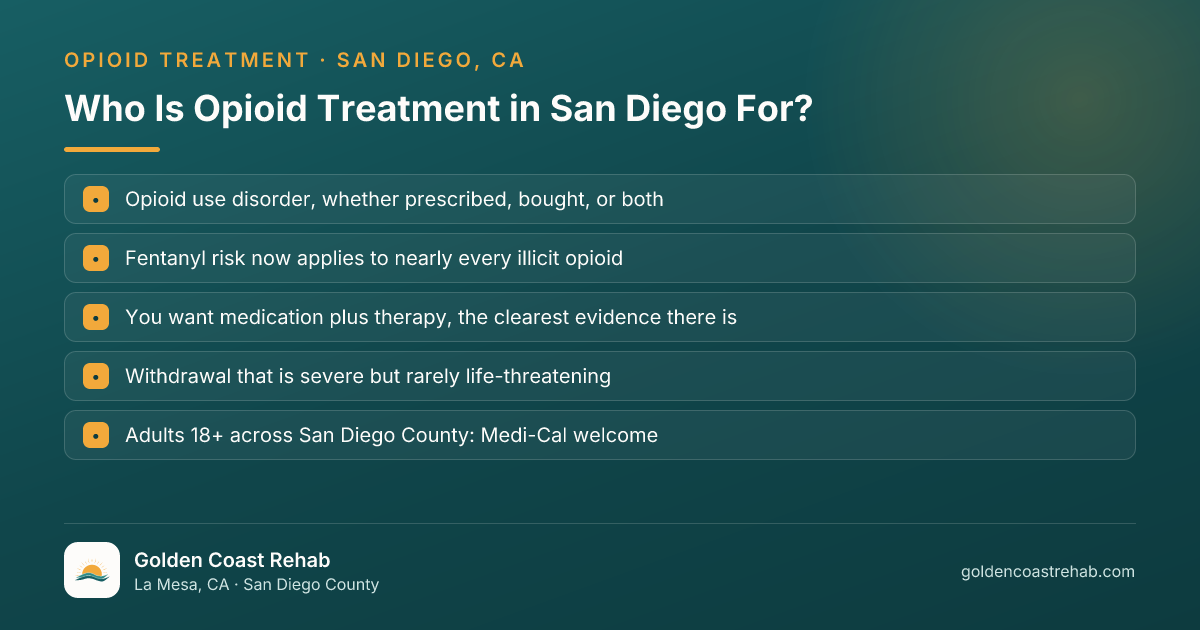
Opioid use disorder is a medical condition with an unusually clear treatment answer: medication plus therapy, sustained over time, which reduces relapse and reduces death. If you are searching near our clinic, our opioid addiction treatment in La Mesa page covers the local details. Whether someone gets that combination is the single biggest variable in how this goes.
Golden Coast Rehab treats opioid use disorder in adults across San Diego County on an outpatient basis, whether the opioid was prescribed, bought, or both, and our guide to outpatient detox providers taking Medi-Cal shows how withdrawal management fits in.
Nearly every illicit opioid in California now carries fentanyl risk, including pills that look pharmaceutical. That changes the overdose math for everyone using, regardless of tolerance or experience.
How Is Opioid Use Disorder Treated at Golden Coast?
Opioid addiction treatment at Golden Coast Rehab is delivered on an outpatient basis, under our California DHCS substance use disorder certification (370254AP) covering outpatient detoxification, outpatient, intensive outpatient, and medication-assisted treatment. We do not provide residential or inpatient treatment, and the substance use partial hospitalization track, while licensed, is not yet enrolling. Partial hospitalization at Golden Coast Rehab is a specialty mental health service under our County of San Diego contract.
Outpatient detox
Opioid withdrawal is rarely life-threatening but is severe. Muscle and bone pain, vomiting, diarrhea, insomnia, and profound restlessness. Very few people get through it unaided, which is why unsupported attempts so often end in relapse, and relapse after a period of abstinence is when overdose risk is highest because tolerance has dropped.
Medication-assisted treatment
This is the central treatment for opioid use disorder, not an optional extra. Medication relieves withdrawal and craving without producing a high at therapeutic doses, and it substantially reduces overdose death. It is delivered here alongside counseling, never as a prescription in isolation.
Intensive outpatient program
The core of treatment: several sessions a week of group and individual therapy while you live at home and, in most cases, keep working. This is where the actual work on triggers, craving, and the life around the using happens.
Outpatient program
A lighter weekly schedule that follows intensive outpatient and keeps the clinical relationship intact through the first year, when relapse risk is highest.
How Does Opioid Addiction Treatment at Golden Coast Work?
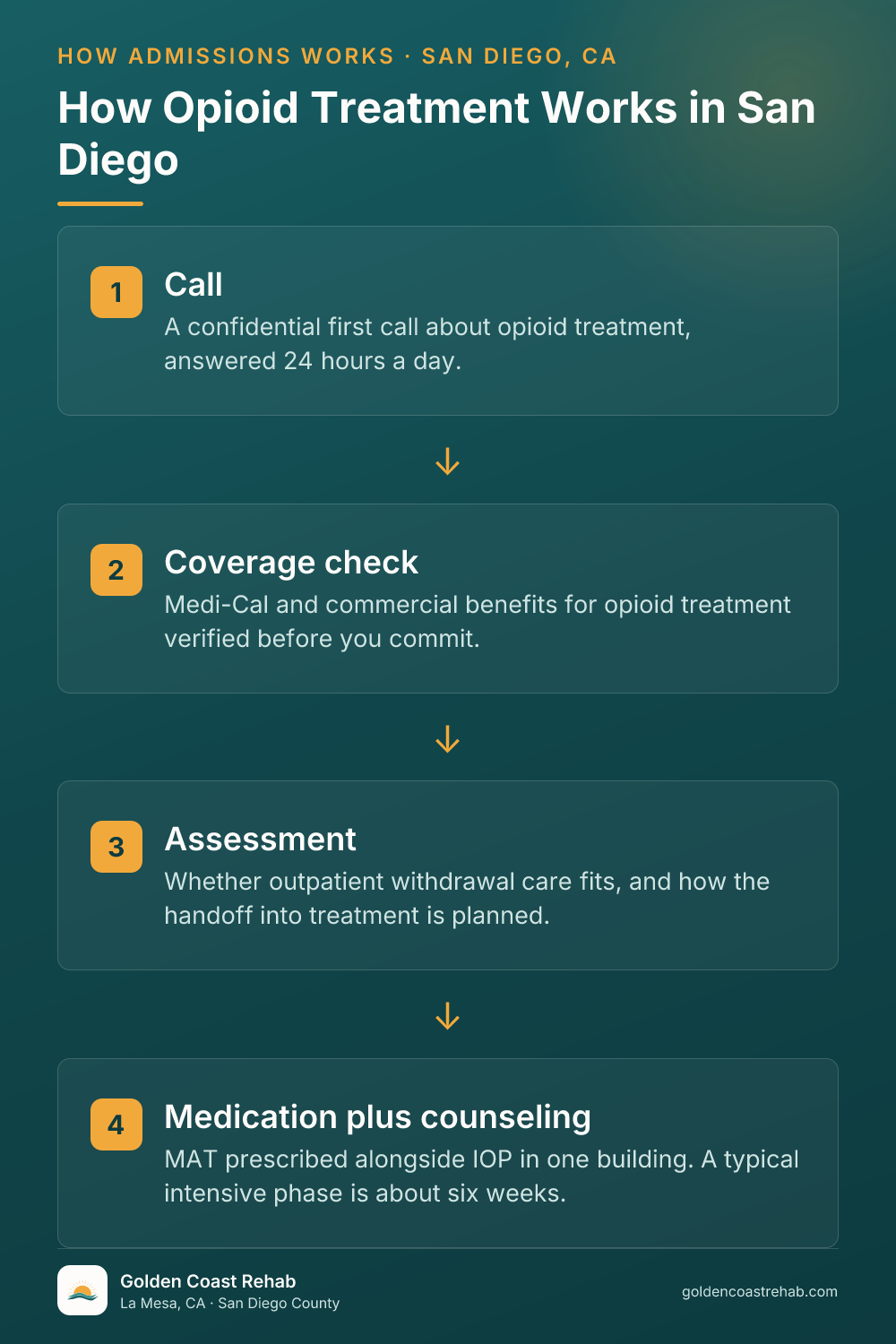
Opioid Addiction Treatment treatment at Golden Coast works in four phases, matched to how this substance actually behaves.
1. Assessment, including when medication can start
Use history, withdrawal status, and timing, because starting medication at the wrong moment can trigger precipitated withdrawal, the assessment sets the schedule.
2. Stabilization on medication
Medication begins under medical supervision with close early follow-up. The phase where craving quiets and the nervous system stops running emergencies.
3. Intensive outpatient alongside
Group and individual work several days a week on the patterns, triggers, and repairs. The life rebuilt around not using. A typical intensive phase runs six to twelve weeks, decided clinically.
4. Continuing care, medication included
Step-down to weekly care with the same team; medication continues as long as it is helping, a clinical decision rather than a deadline.

Common Signs of Opioid Use Disorder
What Are the Common Signs of Opioid Use Disorder?
The common signs of opioid use disorder are the patterns that mark it, and the ones most associated with overdose risk.
01.highUsing to avoid withdrawal rather than to get high
The point of using has shifted from feeling good to feeling normal, and the day gets organized around not being sick.
Health Risks: This marks physical dependence and a sharp escalation in overdose and health risk.
02.highUsing alone
Using where nobody could respond if something went wrong.
Health Risks: Using alone is the single most common circumstance in fatal overdose. Naloxone and never using alone save lives.
03.moderateEscalating amounts or switching to stronger sources
Tolerance rising, or moving from pills to something cheaper or stronger.
Health Risks: Fentanyl contamination makes every unknown source potentially lethal, regardless of tolerance.
04.moderateDoctor shopping or buying outside a prescription
Running out early, seeking multiple prescribers, or purchasing pills from other sources.
Health Risks: Counterfeit pills are frequently pressed with fentanyl at inconsistent doses.
05.moderateEverything else falling away
Work, relationships, money, and health deteriorating while use continues.
Health Risks: The accumulating losses raise the risk of both overdose and suicide.
Ready to take the first step?
Speak with our admissions team: free, confidential, and no obligation.
Can Co-Occurring Mental Health Conditions Be Treated Alongside Opioid Use Disorder?
Yes. Depression, anxiety, trauma, and bipolar disorder frequently sit alongside opioid use disorder, and treating only one of them is the most reliable way to end up back where you started. Both are treated here by one clinical team. See dual diagnosis, or the same care framed from the mental health side on co-occurring disorders.
Why Golden Coast for Opioid Use Disorder Treatment in San Diego
DHCS-Certified Opioid Use Disorder Treatment You Can Verify
Golden Coast Rehab holds California DHCS substance use disorder certification 370254AP, so the credential behind your opioid use disorder care is a matter of public record, not a claim on a website.
Medication-Assisted Treatment for Opioid Use Disorder, Prescribed by a Board-Certified Physician
Where medication fits your treatment plan, FDA-approved medications are prescribed by Dr. Sanjai Mathew Thankachen, MD, a board-certified physician, alongside counseling rather than in place of it.
Close Clinician Attention for Opioid Use Disorder Care
Golden Coast Rehab maintains a ratio of 2 clinicians per 5 clients (as of July 2026), so treatment is not delivered in a crowded room.
One Team for Opioid Use Disorder and Any Co-Occurring Condition
Depression, anxiety, trauma, and bipolar disorder are screened alongside opioid use disorder using the GAD-7 and PHQ-9, and where specialty mental health care is warranted, our county-contracted PHP and IOP programs are part of the same clinical team.
Medi-Cal Welcome for Opioid Use Disorder Treatment, County-Wide
Our single facility in La Mesa serves adults across all of San Diego County, and Medi-Cal is welcome for members who meet criteria, so you can compare county-contracted outpatient programs before choosing.
Care for Opioid Use Disorder That Fits Around Your Life
Telehealth is available, phones are answered 24 hours a day, and our offices are open 8am to 8pm, so treatment does not require putting the rest of your life on hold.
Check your coverage
Medi-Cal welcome. Find out what your coverage includes.
Does Medi-Cal Cover Opioid Use Disorder Treatment in San Diego?
Yes. Opioid use disorder treatment is covered for San Diego County Medi-Cal beneficiaries through the Drug Medi-Cal Organized Delivery System, administered by San Diego County Behavioral Health Services rather than by your managed care plan. If you have Medi-Cal in the county, any of the four plans, and you meet criteria, care here can be covered at no cost to you. See how Medi-Cal works here.
Call (858) 925-8589, answered 24 hours a day. In a crisis, the San Diego County Access and Crisis Line is available around the clock at 1-888-724-7240.
Understanding Opioid Use Disorder
Understanding opioid use disorder, how dependence forms, why medication works, and what the fentanyl era changed, explains why opioid addiction treatment here is built the way it is.
What is opioid use disorder?
Opioid use disorder is a pattern of opioid use you cannot reliably control. Craving, tolerance, withdrawal, and continued use despite mounting damage. It reshapes brain circuitry that medication directly addresses, which is why treatment here is medical as well as therapeutic.
How dangerous is the current opioid supply?
The current illicit opioid supply is the most dangerous on record: opioid-involved overdose deaths in the U.S. reached 79,358 in 2023, according to NIDA's drug overdose deaths data page, driven overwhelmingly by fentanyl in the supply. This is why we treat naloxone access and not using alone as immediate priorities, before treatment even starts.
Why is medication the first-line treatment for opioid use disorder?
Medication is first-line because it works on the biology craving runs on: it stabilizes the system, cuts overdose risk, and roughly doubles the odds of staying in recovery compared with counseling alone. Here it is always paired with counseling, never a substitute for it.
Is opioid withdrawal dangerous?
Opioid withdrawal is severe but rarely life-threatening. Days of aching, restless, flu-like misery. The real danger comes after: tolerance falls fast, and a return to a previous dose becomes an overdose. That is exactly the window treatment and medication are built to protect.
Can someone recover from opioid addiction?
Yes. People recover from opioid addiction every day, and recovery odds rise sharply with medication and time in care. The path is not willpower; it is stabilizing the biology, then rebuilding the life, with a team that stays.
Next Steps
Related Care for Opioid Addiction
Levels of care for opioid addiction step up and down around your progress. Start where you are, and we'll adjust together.
Partial Hospitalization Program (PHP)
Our most structured outpatient level of care, offered as a specialty mental health service.
Learn moreIntensive Outpatient Program (IOP)
Evidence-based group and individual therapy with the flexibility to keep working, studying, and living at home.
Learn moreMedication-Assisted Treatment (MAT)
FDA-approved medication for opioid and alcohol use disorder, managed by our medical team.
Learn moreDual Diagnosis Treatment
Integrated care for substance use and co-occurring mental health conditions, treated together, not separately.
Learn moreVerify Your Insurance
Check your coverage in minutes: free, confidential, and with no obligation to enroll.
Learn moreAdmissions Process
See exactly what happens from your first call to your start date, step by step.
Learn moreServing members of every San Diego Medi-Cal plan
Credentialed through Optum, administrator of behavioral health services for the County of San Diego.




 Optum, a UnitedHealth Group companyAdministrative Services Organization for County of San Diego behavioral health. We are credentialed with Optum.
 County of San Diego Behavioral Health ServicesContracted provider of Specialty Mental Health Services under County Contract 575462.
Not sure if you're covered? Verify your benefits in minutes, free & confidential.
Admissions
Our Opioid Addiction Admission Process
Starting treatment at Golden Coast Rehab takes one phone call. Here's exactly what happens from your first call.
Call or Reach Out
Speak with an admissions specialist: no pressure, completely confidential.
Verify Your Coverage
We confirm what your plan covers, Medi-Cal welcome, usually the same day.
Phone Assessment
A 10–15 minute ASAM-based assessment helps us understand your history and recommend the right level of care.
Clinical Review & Intake
Our team reviews your assessment, builds an individualized plan, and schedules your start date.
Questions, Answered
Opioid Addiction Treatment FAQs
Is medication-assisted treatment just trading one drug for another?
Can I detox from opioids as an outpatient?
Do you provide residential treatment for opioid addiction?
Does Medi-Cal cover opioid treatment?
Does Golden Coast Rehab offer MAT for opioid addiction?
How long is opioid addiction treatment?
Can I detox from opioids without staying overnight?
What if I have depression or anxiety along with an opioid problem?
What makes Golden Coast Rehab different from other San Diego rehabs?
Will my family be involved in opioid treatment?
Sources
- NIDA: opioid-involved overdose deaths in the U.S., 2023 (79,358)https://nida.nih.gov/research-topics/trends-statistics/overdose-death-rates
- California Department of Public Health. California Overdose Surveillance Dashboard, San Diego County (2024 data)https://skylab.cdph.ca.gov/ODdash/?tab=CTY
About this page
Prepared by the Golden Coast Rehab team. Everything described here is delivered under two public, verifiable authorities: specialty mental health services (PHP and IOP) contracted by the County of San Diego, and substance use treatment certified by DHCS. We do not operate residential or inpatient beds; partner housing and coordinated referrals cover what we do not deliver on site, and we say so plainly when an assessment points that way.
This content is general educational information, not medical advice. Decisions about your care belong in a conversation with a clinician, which is what the first phone call starts.
Chat with us.
We're here to help you or your loved one, whether the need is mental health, sobriety, or both. Free, confidential.
Structure, support, and a team that knows your name, starting this week.
One call, answered by a person, 24 hours a day. We will tell you plainly whether this is the right fit, and where to go if it is not.
Every day, 8am – 8pm · Free & confidential · HIPAA & 42 CFR Part 2 protected