
Alcohol Addiction Treatment in San Diego for Medi-Cal Adults
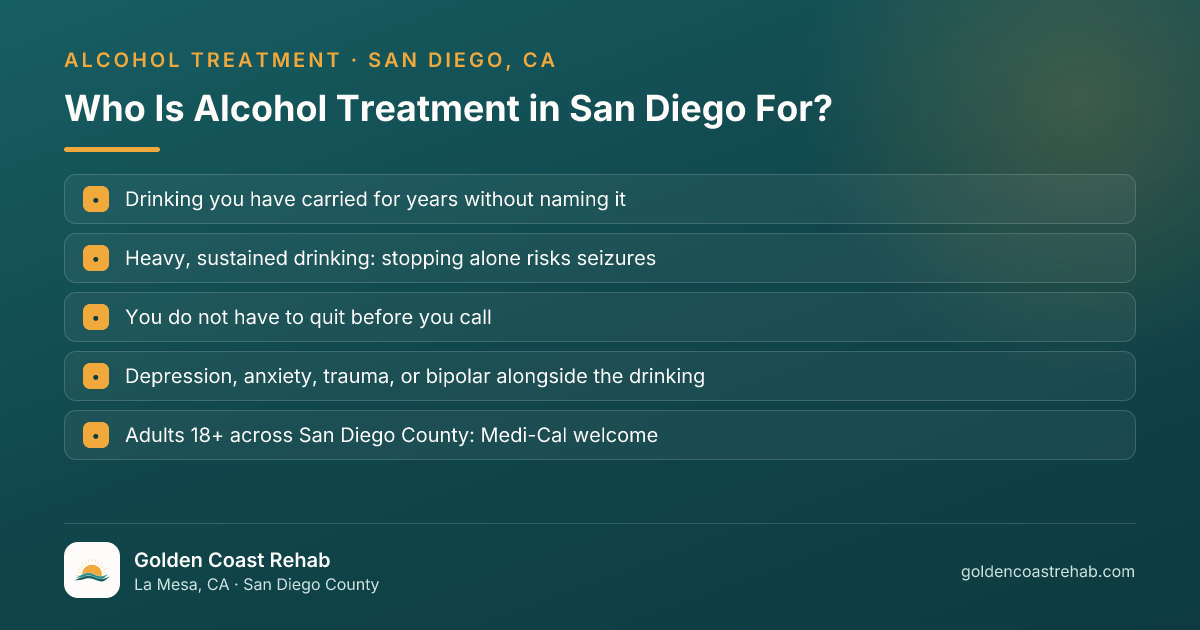
Alcohol addiction treatment in San Diego at Golden Coast Rehab is outpatient care for adults. Assessment-gated withdrawal management, intensive outpatient, and medication where it fits, under DHCS certification 370254AP. You do not have to stop drinking before you call: the assessment decides what is safe, and with Medi-Cal in San Diego County, treatment can be covered at no cost to you.
- Assessment first, because how you stop depends on how much and how long you've been drinking
- Alcohol withdrawal can bring seizures and delirium tremens, so stopping abruptly alone is dangerous
- Medication can reduce craving and reduce the reward from drinking, prescribed alongside therapy
- Outpatient program keeps the clinical relationship intact through the highest-risk first year
- Every day, 8am – 8pm
- 100% confidential (HIPAA & 42 CFR Part 2)
- Adults 18+ · dual-diagnosis welcome
Book an assessment
Takes about 60 seconds. Eligible Medi-Cal members can pick an assessment time right away; everyone else hears from our admissions team, usually within the hour.
Key Takeaways for Alcohol Addiction Treatment
- Outpatient alcohol treatment for adults 18+ under DHCS certification 370254AP: withdrawal management where safe, IOP as the core of the work, then outpatient care
- Alcohol withdrawal can be dangerous. Assessment before you stop drinking determines whether outpatient detox is safe for you
- Medication for alcohol use disorder can be prescribed and managed here, alongside counseling, by the same team
- Depression, anxiety, and trauma alongside the drinking are treated together, not sequenced
- Medi-Cal covers treatment through Drug Medi-Cal at no cost on any plan in San Diego County when criteria are met
- We do not operate inpatient detox or residential beds; in a crisis, call 988, or the San Diego Access and Crisis Line at 1-888-724-7240
Alcohol is legal, social, and everywhere, which is exactly why alcohol use disorder is so easy to carry for years without naming it. It is also the substance whose withdrawal is most likely to be medically dangerous, and that fact should shape how anyone stops.
Golden Coast Rehab treats alcohol use disorder in adults across San Diego County on an outpatient basis. Treatment starts with an assessment rather than a schedule, because how you stop drinking depends on how much, how long, and what your body has already been through.
How Is Alcohol Use Disorder Treated at Golden Coast?
Alcohol addiction treatment at Golden Coast Rehab is delivered on an outpatient basis, under our California DHCS substance use disorder certification (370254AP) covering outpatient detoxification, outpatient, intensive outpatient, and medication-assisted treatment. When comparing options, our guide to the best detox centers in San Diego lists the outpatient and residential providers by level. We do not provide residential or inpatient treatment, and the substance use partial hospitalization track, while licensed, is not yet enrolling. Partial hospitalization at Golden Coast Rehab is a specialty mental health service under our County of San Diego contract.
Outpatient detox
Alcohol withdrawal can produce tremor, sweating, agitation, high blood pressure, seizures, and in severe cases delirium tremens, which can be fatal. That is why stopping abruptly on your own after heavy, sustained drinking is genuinely dangerous. Outpatient withdrawal management is appropriate for many people and not for everyone; the assessment determines which, and if you need a hospital or residential setting we will tell you and help arrange it.
Medication-assisted treatment
Medication for alcohol use disorder can reduce craving or reduce the reward from drinking, and it is underused. Where it fits your clinical picture, it is prescribed alongside therapy rather than on its own.
Intensive outpatient program
The core of treatment: several sessions a week of group and individual therapy while you live at home and, in most cases, keep working. This is where the actual work on triggers, craving, and the life around the using happens.
Outpatient program
A lighter weekly schedule that follows intensive outpatient and keeps the clinical relationship intact through the first year, when relapse risk is highest.
How Does Alcohol Treatment at Golden Coast Work?
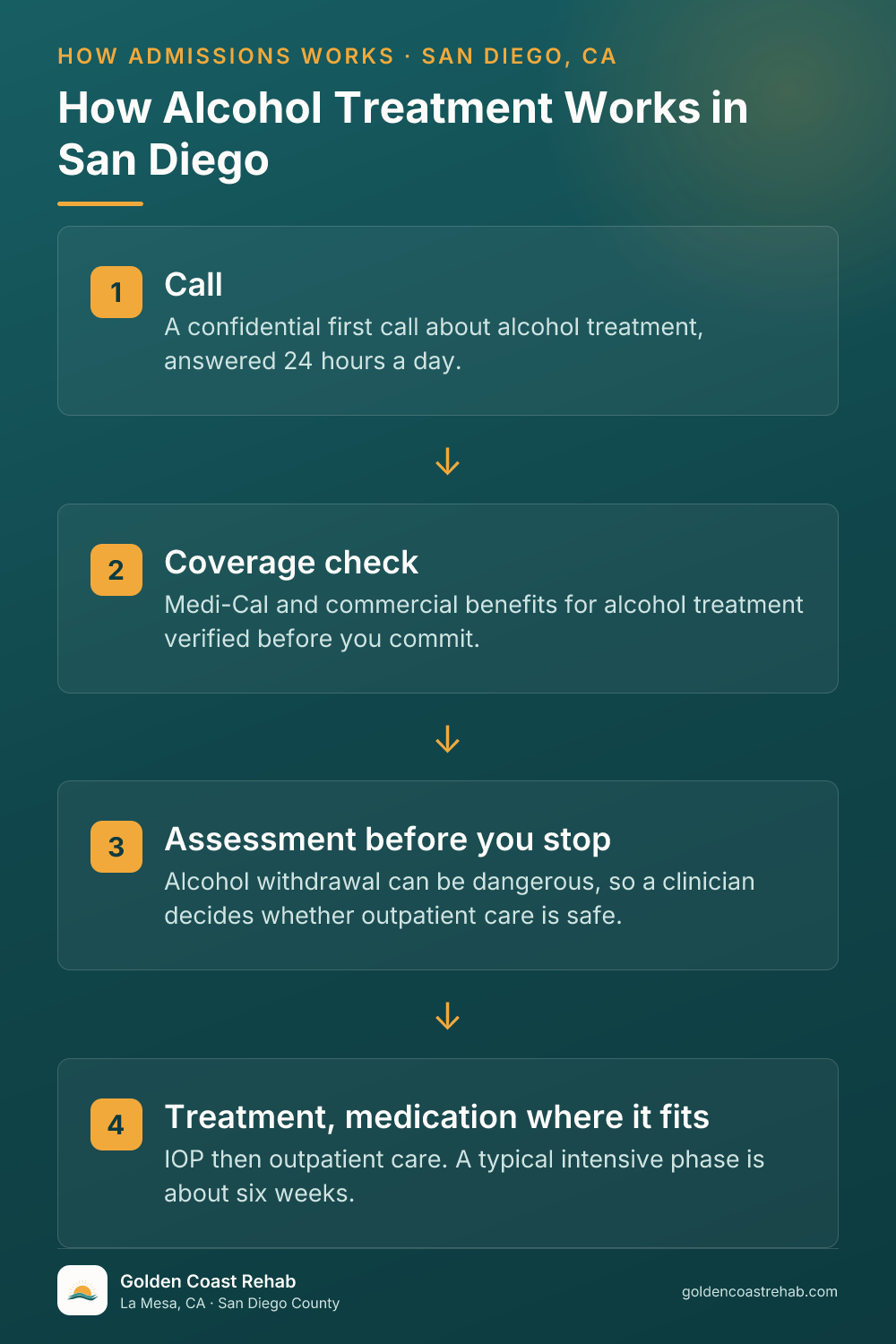
Alcohol addiction treatment at Golden Coast works in four phases, and the first one matters more for alcohol than for almost any other substance, because stopping abruptly on your own can be dangerous.
1. Assessment before you stop drinking
A clinician takes your drinking history, amount, duration, past withdrawals, and determines whether outpatient withdrawal management is safe or whether you need a medically monitored setting first. This is a medical decision, made before anything else happens.
2. Withdrawal management, where it is needed
Outpatient detox means scheduled monitoring visits with nights at home, medication to keep withdrawal safe and tolerable, and a low threshold for escalating care if symptoms demand it. The handoff into treatment is arranged before detox ends, because detox alone treats nothing.
3. Intensive outpatient does the core of the work
Group and individual sessions several days a week. The thinking patterns around drinking, the situations that trigger it, the life that gets rebuilt around not drinking. Anti-craving medication runs alongside where it fits, and a typical intensive phase runs six to twelve weeks, decided clinically.
4. Outpatient care holds the first year
A lighter weekly schedule with the same team through the months when relapse risk is highest, on a written plan for the moments the plan was made for.

Common Signs of Alcohol Use Disorder
What Are the Common Signs of Alcohol Use Disorder?
The common signs of alcohol use disorder are behavioral and physical, and they are diagnosed on a pattern rather than a quantity. These are the signals that matter most clinically.
01.highWithdrawal symptoms when you stop
Shaking, sweating, nausea, racing heart, or anxiety hours after the last drink. Often relieved by drinking again, which is how morning drinking starts.
Health Risks: Physical withdrawal from alcohol can escalate to seizures. Do not stop abruptly without medical guidance.
02.highDrinking in situations that are not safe
Driving, at work, while caring for children, or on top of medications that interact with alcohol.
Health Risks: Alcohol-involved driving and falls cause a large share of preventable injury and death.
03.moderateNeeding more for the same effect
Tolerance climbing, so the amount that once did the job no longer touches it.
Health Risks: Rising tolerance means rising organ exposure: liver, pancreas, heart, and brain.
04.moderateRepeatedly drinking more than you meant to
Deciding on two, having eight. The intention is genuine and the outcome keeps not matching it.
Health Risks: Loss of control over quantity is a core diagnostic feature, not a willpower problem.
05.moderateLife reorganizing around drinking
Choosing plans by whether alcohol will be there, hiding how much, or cutting back on things you used to care about.
Health Risks: The narrowing of life is often what family notices long before anyone uses the word addiction.
Ready to take the first step?
Speak with our admissions team: free, confidential, and no obligation.
Can Co-Occurring Mental Health Conditions Be Treated Alongside Alcohol Use Disorder?
Yes. Depression, anxiety, trauma, and bipolar disorder frequently sit alongside alcohol use disorder, and treating only one of them is the most reliable way to end up back where you started. Both are treated here by one clinical team. See dual diagnosis, or the same care framed from the mental health side on co-occurring disorders.
Why Golden Coast for Alcohol Use Disorder Treatment in San Diego
DHCS-Certified Alcohol Use Disorder Treatment You Can Verify
Golden Coast Rehab holds California DHCS substance use disorder certification 370254AP, so the credential behind your alcohol use disorder care is a matter of public record, not a claim on a website.
Medication-Assisted Treatment for Alcohol Use Disorder, Prescribed by a Board-Certified Physician
Where medication fits your treatment plan, FDA-approved medications are prescribed by Dr. Sanjai Mathew Thankachen, MD, a board-certified physician, alongside counseling rather than in place of it.
Close Clinician Attention for Alcohol Use Disorder Care
Golden Coast Rehab maintains a ratio of 2 clinicians per 5 clients (as of July 2026), so treatment is not delivered in a crowded room.
One Team for Alcohol Use Disorder and Any Co-Occurring Condition
Depression, anxiety, trauma, and bipolar disorder are screened alongside alcohol use disorder using the GAD-7 and PHQ-9, and where specialty mental health care is warranted, our county-contracted PHP and IOP programs are part of the same clinical team, which is the standard we apply in our guide to dual diagnosis treatment for Medi-Cal members.
Medi-Cal Welcome for Alcohol Use Disorder Treatment, County-Wide
Our single facility in La Mesa serves adults across all of San Diego County, and Medi-Cal is welcome for members who meet criteria. Living nearby? Start with alcohol addiction care in La Mesa.
Care for Alcohol Use Disorder That Fits Around Your Life
Telehealth is available, phones are answered 24 hours a day, and our offices are open 8am to 8pm, so treatment does not require putting the rest of your life on hold.
Check your coverage
Medi-Cal welcome. Find out what your coverage includes.
Does Medi-Cal Cover Alcohol Use Disorder Treatment in San Diego?
Yes. Alcohol use disorder treatment is covered for San Diego County Medi-Cal beneficiaries through the Drug Medi-Cal Organized Delivery System, administered by San Diego County Behavioral Health Services rather than by your managed care plan. If you have Medi-Cal in the county, any of the four plans, and you meet criteria, care here can be covered at no cost to you. See how Medi-Cal works here.
Call (858) 925-8589, answered 24 hours a day. In a crisis, the San Diego County Access and Crisis Line is available around the clock at 1-888-724-7240.
How to Help Someone With Alcohol Addiction
Many of the calls we take are not from the person drinking; they are from a spouse, a parent, or an adult child looking for help for alcohol addiction on someone else's behalf. Three things actually help. First, name what you see without an ultimatum, when they are sober, once. Second, have a concrete next step ready: our admissions team can check coverage and hold an assessment slot before the conversation happens. Third, look after your own footing; family therapy exists for exactly this, and our guides on family roles in addiction and what to do when a family member refuses treatment cover the harder cases.
Understanding Alcohol Use Disorder
Understanding alcohol use disorder, what it is clinically, how common it is, and why stopping alone can be dangerous, explains why alcohol addiction treatment here is structured the way it is.
What is alcohol use disorder?
Alcohol use disorder is a pattern, not a quantity: drinking more or longer than intended, failed attempts to cut down, craving, tolerance, withdrawal, and continued use despite the damage. Clinicians diagnose it on how drinking behaves in your life, which is why people with jobs and families have it in large numbers, and why you do not need to hit a stereotype to qualify for help.
How common is alcohol use disorder?
Alcohol use disorder is among the most common substance use disorders in the country. Federal survey data (NSDUH 2019) put it at 5.3% of Americans aged 12 and older, about 14.5 million people. Locally, one county health brief found 20.5% of San Diego County adults reported binge drinking in the past 30 days. Most people with the disorder never receive alcohol addiction treatment, which is the statistic we are most interested in changing.
Why is alcohol withdrawal dangerous?
Alcohol withdrawal is dangerous because alcohol suppresses the nervous system, and the brain compensates by running hotter. Remove the alcohol abruptly and that compensation fires unopposed. In heavy, sustained drinkers this can mean seizures or delirium tremens, which is why the assessment before you stop is not a formality: it is the safety decision the whole plan hangs on.
Does medication help with alcohol use disorder?
Yes. Medication helps with alcohol use disorder, and it is underused. Naltrexone and acamprosate reduce craving and support abstinence, prescribed here alongside counseling by our medical team rather than instead of it. Medication is a clinical decision made at evaluation, never a requirement and never a substitute for the work.
Can someone recover from alcohol use disorder?
Yes. People recover from alcohol use disorder every day, including people who had stopped believing they would. Recovery rates improve with treatment intensity and time in care, which is exactly why our levels of care are built as a sequence: the structure holds while the drinking loosens, and the same team stays through the first year, when relapse risk is highest.
Next Steps
Related Care for Alcohol Addiction
Levels of care for alcohol addiction step up and down around your progress. Start where you are, and we'll adjust together.
Partial Hospitalization Program (PHP)
Our most structured outpatient level of care, offered as a specialty mental health service.
Learn moreIntensive Outpatient Program (IOP)
Evidence-based group and individual therapy with the flexibility to keep working, studying, and living at home.
Learn moreMedication-Assisted Treatment (MAT)
FDA-approved medication for opioid and alcohol use disorder, managed by our medical team.
Learn moreDual Diagnosis Treatment
Integrated care for substance use and co-occurring mental health conditions, treated together, not separately.
Learn moreVerify Your Insurance
Check your coverage in minutes: free, confidential, and with no obligation to enroll.
Learn moreAdmissions Process
See exactly what happens from your first call to your start date, step by step.
Learn moreServing members of every San Diego Medi-Cal plan
Credentialed through Optum, administrator of behavioral health services for the County of San Diego.




 Optum, a UnitedHealth Group companyAdministrative Services Organization for County of San Diego behavioral health. We are credentialed with Optum.
 County of San Diego Behavioral Health ServicesContracted provider of Specialty Mental Health Services under County Contract 575462.
Not sure if you're covered? Verify your benefits in minutes, free & confidential.
Admissions
Our Alcohol Addiction Admission Process
Starting treatment at Golden Coast Rehab takes one phone call. Here's exactly what happens from your first call.
Call or Reach Out
Speak with an admissions specialist: no pressure, completely confidential.
Verify Your Coverage
We confirm what your plan covers, Medi-Cal welcome, usually the same day.
Phone Assessment
A 10–15 minute ASAM-based assessment helps us understand your history and recommend the right level of care.
Clinical Review & Intake
Our team reviews your assessment, builds an individualized plan, and schedules your start date.
Questions, Answered
Alcohol Addiction Treatment FAQs
Is it dangerous to stop drinking on my own?
Do I have to quit completely to get treatment here?
Do you offer residential alcohol rehab?
Does Medi-Cal cover alcohol treatment?
Does Golden Coast Rehab offer MAT for alcohol addiction?
How long is alcohol addiction treatment?
Can I detox from alcohol without staying overnight?
What if I have depression or anxiety along with my drinking?
What makes Golden Coast Rehab different from other San Diego rehabs?
Will my family be involved in alcohol treatment?
Sources
- San Diego County HHSA Health Brief. 20.5% of adults countywide reported binge drinking in the past 30 dayshttps://www.sandiegocounty.gov/content/dam/sdc/hhsa/programs/phs/CHS/Health%20Briefs/2021%20Health%20Briefs_North%20Inland.pdf
- SAMHSA 2019 NSDUH: 5.3% (14.5 million people aged 12+) had a past-year alcohol use disorderhttps://www.samhsa.gov/data/sites/default/files/reports/rpt29393/2019NSDUHFFRPDFWHTML/2019NSDUHFFR090120.htm
- NIAAA: medications for alcohol use disorder (naltrexone, acamprosate) overviewhttps://www.niaaa.nih.gov/health-professionals-communities/core-resource-on-alcohol/medications-alcohol-use-disorder
About this page
Prepared by the Golden Coast Rehab team. Everything described here is delivered under two public, verifiable authorities: specialty mental health services (PHP and IOP) contracted by the County of San Diego, and substance use treatment certified by DHCS. We do not operate residential or inpatient beds; partner housing and coordinated referrals cover what we do not deliver on site, and we say so plainly when an assessment points that way.
This content is general educational information, not medical advice. Decisions about your care belong in a conversation with a clinician, which is what the first phone call starts.
Chat with us.
We're here to help you or your loved one, whether the need is mental health, sobriety, or both. Free, confidential.
Structure, support, and a team that knows your name, starting this week.
One call, answered by a person, 24 hours a day. We will tell you plainly whether this is the right fit, and where to go if it is not.
Every day, 8am – 8pm · Free & confidential · HIPAA & 42 CFR Part 2 protected