Prescription Drug Addiction Treatment in San Diego for Medi-Cal Adults
Prescription drug addiction treatment in San Diego at Golden Coast Rehab treats dependence that started somewhere reasonable, surgery, injury, anxiety, ADHD, with a plan matched to the medication class, under DHCS certification 370254AP. Coordination with your existing prescriber happens with your consent, and Medi-Cal can cover treatment at no cost.
- Usually starts somewhere reasonable, surgery, an injury, an anxiety or ADHD prescription
- Covers three classes: opioid pain medication, benzodiazepines, and prescription stimulants
- What withdrawal looks like depends entirely on the class, from severe to a slow supervised taper
- Focus is on what you're taking now and what stopping safely requires, not how it began
- Every day, 8am – 8pm
- 100% confidential (HIPAA & 42 CFR Part 2)
- Adults 18+ · dual-diagnosis welcome
Book an assessment
Takes about 60 seconds. Eligible Medi-Cal members can pick an assessment time right away; everyone else hears from our admissions team, usually within the hour.
Key Takeaways for Prescription Drug Addiction Treatment
- Outpatient treatment for prescription opioid, benzodiazepine, and stimulant dependence in adults 18+ under DHCS certification 370254AP
- Treatment matches the class: MAT for prescription opioids, a supervised taper for benzodiazepines, structured behavioral care for stimulants
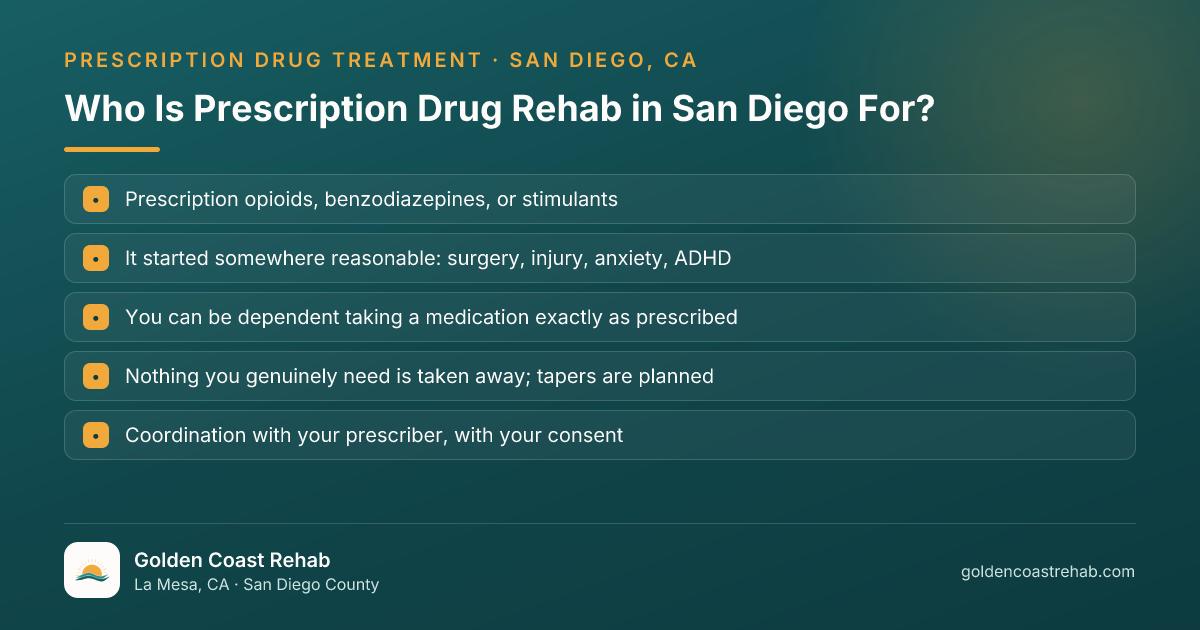
- You can be dependent taking a medication exactly as prescribed: that is pharmacology, not misuse
- Nothing you genuinely need is taken away; tapers are planned, and prescriber coordination happens with your consent
- Medi-Cal covers treatment through Drug Medi-Cal at no cost on any plan in San Diego County when criteria are met
- We do not operate inpatient detox or residential beds; in a crisis, call 988, or the San Diego Access and Crisis Line at 1-888-724-7240
Prescription drug dependence usually starts somewhere entirely reasonable: surgery, an injury, an anxiety diagnosis, an ADHD prescription. There is no moment where someone decides to become dependent, which is part of why it takes people so long to name it.
Golden Coast Rehab treats prescription medication dependence in adults across San Diego County on an outpatient basis, across the three classes it usually involves. Opioid pain medication, benzodiazepines, and prescription stimulants.
We do not spend time on how it began. What matters clinically is what you are taking now, how much, and what stopping safely requires.
How Is Prescription Drug Dependence Treated at Golden Coast?
Prescription drug addiction treatment at Golden Coast Rehab is delivered on an outpatient basis, under our California DHCS substance use disorder certification (370254AP) covering outpatient detoxification, outpatient, intensive outpatient, and medication-assisted treatment. We do not provide residential or inpatient treatment, and the substance use partial hospitalization track, while licensed, is not yet enrolling. Partial hospitalization at Golden Coast Rehab is a specialty mental health service under our County of San Diego contract.
Outpatient detox
What withdrawal looks like depends entirely on the class. Opioid withdrawal is severe but rarely dangerous. Benzodiazepine withdrawal can cause seizures and requires a slow supervised taper. Never an abrupt stop. Stimulant withdrawal is mainly exhaustion and depression. The assessment establishes which applies to you and what is safe.
Medication-assisted treatment
For dependence on prescription opioids, medication-assisted treatment applies exactly as it does for any other opioid use disorder, and it is the most effective option available.
Intensive outpatient program
The core of treatment: several sessions a week of group and individual therapy while you live at home and, in most cases, keep working. This is where the actual work on triggers, craving, and the life around the using happens.
Outpatient program
A lighter weekly schedule that follows intensive outpatient and keeps the clinical relationship intact through the first year, when relapse risk is highest.
How Does Prescription Drug Treatment at Golden Coast Work?
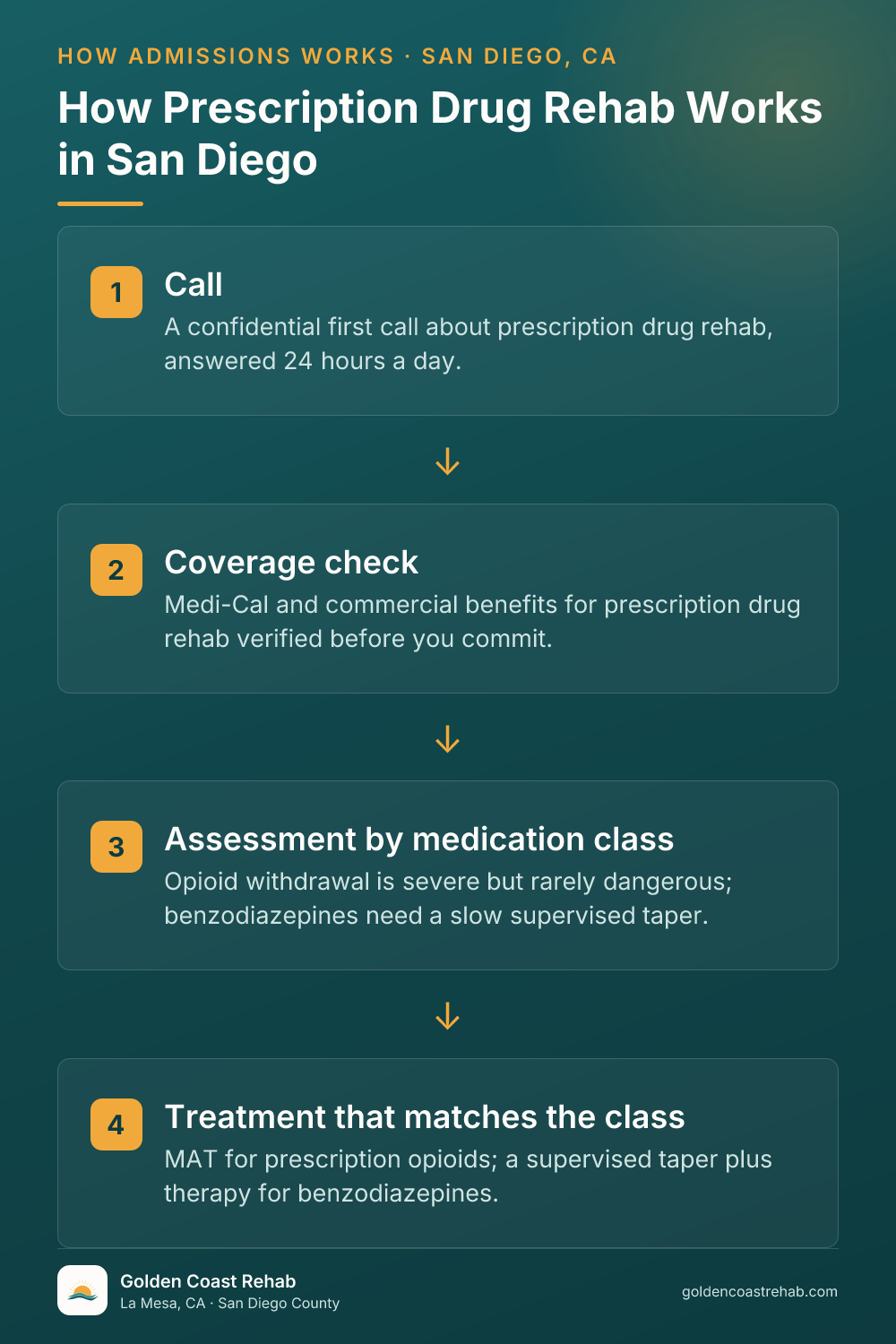
Prescription Drug Addiction Treatment treatment at Golden Coast works in four phases, matched to how this substance actually behaves.
1. Assessment by medication class
What you take, how much, and for how long, because opioids, benzodiazepines, and stimulants each need a different exit.
2. The safe exit begins
MAT induction for opioids, a supervised taper for benzodiazepines, structured scheduling for stimulants. Matched, not generic.
3. Treatment for the reason it started
Therapy for the pain, anxiety, or attention problem underneath, so the original prescription's job is being done by something sustainable.
4. Step-down and prescriber handoff
Weekly care with the same team, and a coordinated plan with your prescriber for whatever medication remains genuinely needed.
Common Signs of Prescription Drug Dependence
What Are the Common Signs of Prescription Drug Dependence?
The common signs of prescription drug dependence are rarely obvious from inside, since the line between taking a medication and depending on it is easy to miss. These are the markers.
01.highRunning out early, consistently
Finishing a prescription before the refill and managing the gap somehow.
Health Risks: The gap is where either withdrawal or an unsafe outside supply enters the picture.
02.highBuying pills outside a pharmacy
Obtaining medication from friends, online, or the street to maintain supply.
Health Risks: Counterfeit pills commonly contain fentanyl at unpredictable doses and look identical to the real thing.
03.moderateTaking it for something other than the original problem
Using it for sleep, stress, mood, or energy rather than the condition it was prescribed for.
Health Risks: The shift in purpose usually precedes escalation.
04.moderateMultiple prescribers
Seeing several doctors or pharmacies to keep a supply going.
Health Risks: Fragmented prescribing removes the safety checks that catch dangerous combinations.
05.moderateFear of being without it
Anxiety about running out that is disproportionate to the underlying medical need.
Health Risks: That fear is usually the first clear sign of dependence rather than treatment.
Ready to take the first step?
Speak with our admissions team: free, confidential, and no obligation.
Can Co-Occurring Mental Health Conditions Be Treated Alongside Prescription Drug Dependence?
Yes. Depression, anxiety, trauma, and bipolar disorder frequently sit alongside prescription drug dependence, and treating only one of them is the most reliable way to end up back where you started. Both are treated here by one clinical team. See dual diagnosis, or the same care framed from the mental health side on co-occurring disorders.
Why Golden Coast for Prescription Drug Dependence Treatment in San Diego
DHCS-Certified Prescription Drug Dependence Treatment You Can Verify
Golden Coast Rehab holds California DHCS substance use disorder certification 370254AP, so the credential behind your prescription drug dependence care is a matter of public record, not a claim on a website.
Medication-Assisted Treatment for Prescription Drug Dependence, Prescribed by a Board-Certified Physician
Where medication fits your treatment plan, FDA-approved medications are prescribed by Dr. Sanjai Mathew Thankachen, MD, a board-certified physician, alongside counseling rather than in place of it.
Close Clinician Attention for Prescription Drug Dependence Care
Golden Coast Rehab maintains a ratio of 2 clinicians per 5 clients (as of July 2026), so treatment is not delivered in a crowded room.
One Team for Prescription Drug Dependence and Any Co-Occurring Condition
Depression, anxiety, trauma, and bipolar disorder are screened alongside prescription drug dependence using the GAD-7 and PHQ-9, and where specialty mental health care is warranted, our county-contracted PHP and IOP programs are part of the same clinical team.
Medi-Cal Welcome for Prescription Drug Dependence Treatment, County-Wide
Our single facility in La Mesa serves adults across all of San Diego County, and Medi-Cal is welcome for members who meet criteria. For the neighborhood view, see prescription drug addiction treatment in La Mesa.
Care for Prescription Drug Dependence That Fits Around Your Life
Telehealth is available, phones are answered 24 hours a day, and our offices are open 8am to 8pm, so treatment does not require putting the rest of your life on hold.
Check your coverage
Medi-Cal welcome. Find out what your coverage includes.
Does Medi-Cal Cover Prescription Drug Dependence Treatment in San Diego?
Yes. Prescription drug dependence treatment is covered for San Diego County Medi-Cal beneficiaries through the Drug Medi-Cal Organized Delivery System, administered by San Diego County Behavioral Health Services rather than by your managed care plan. If you have Medi-Cal in the county, any of the four plans, and you meet criteria, care here can be covered at no cost to you. See how Medi-Cal works here.
Call (858) 925-8589, answered 24 hours a day. In a crisis, the San Diego County Access and Crisis Line is available around the clock at 1-888-724-7240.
Understanding Prescription Drug Dependence
Understanding prescription drug dependence, how it forms inside legitimate care and why prescription drug addiction treatment differs by class, frames everything above.
How does prescription drug dependence start?
Prescription drug dependence starts inside legitimate medicine: a post-surgical opioid, a benzodiazepine for panic, a stimulant for ADHD. The body adapts exactly as pharmacology predicts, and the line into dependence is crossed quietly, often while following the label.
Can I be dependent if I take my medication as prescribed?
Yes. You can be dependent taking medication exactly as prescribed. Dependence is a physiological adaptation, not a moral category; what matters clinically is whether stopping is now dangerous or unmanageable, and what the medication is still doing for you.
Why does treatment differ by medication class?
Treatment differs by class because the exits differ: prescription opioids respond to medication-assisted treatment, benzodiazepines require a slow supervised taper (abrupt stopping is dangerous), and stimulants call for structured behavioral care. One assessment sorts your situation into the right lane.
How risky is prescription opioid misuse?
Prescription opioid misuse carries a documented escalation path: an estimated 4-6% of people who misuse prescription opioids transition to heroin, according to NIDA's prescription opioids and heroin research report (NIDA), and the pills themselves, especially counterfeits, increasingly carry fentanyl risk. Early treatment interrupts the path while it is still short.
Will you work with my current prescriber?
Yes. We coordinate with your existing prescriber, with your consent and never behind your back. If a medication is genuinely needed, that is respected; if a taper is the right move, it is planned together rather than imposed.
Next Steps
Related Care for Prescription Drug Addiction
Levels of care for prescription drug addiction step up and down around your progress. Start where you are, and we'll adjust together.
Partial Hospitalization Program (PHP)
Our most structured outpatient level of care, offered as a specialty mental health service.
Learn moreIntensive Outpatient Program (IOP)
Evidence-based group and individual therapy with the flexibility to keep working, studying, and living at home.
Learn moreMedication-Assisted Treatment (MAT)
FDA-approved medication for opioid and alcohol use disorder, managed by our medical team.
Learn moreDual Diagnosis Treatment
Integrated care for substance use and co-occurring mental health conditions, treated together, not separately.
Learn moreVerify Your Insurance
Check your coverage in minutes: free, confidential, and with no obligation to enroll.
Learn moreAdmissions Process
See exactly what happens from your first call to your start date, step by step.
Learn moreServing members of every San Diego Medi-Cal plan
Credentialed through Optum, administrator of behavioral health services for the County of San Diego.


 Optum, a UnitedHealth Group companyAdministrative Services Organization for County of San Diego behavioral health. We are credentialed with Optum.
 County of San Diego Behavioral Health ServicesContracted provider of Specialty Mental Health Services under County Contract 575462.
Not sure if you're covered? Verify your benefits in minutes, free & confidential.
Admissions
Our Prescription Drug Addiction Admission Process
Starting treatment at Golden Coast Rehab takes one phone call. Here's exactly what happens from your first call.
Call or Reach Out
Speak with an admissions specialist: no pressure, completely confidential.
Verify Your Coverage
We confirm what your plan covers, Medi-Cal welcome, usually the same day.
Phone Assessment
A 10–15 minute ASAM-based assessment helps us understand your history and recommend the right level of care.
Clinical Review & Intake
Our team reviews your assessment, builds an individualized plan, and schedules your start date.
Questions, Answered
Prescription Drug Addiction Treatment FAQs
I take my medication as prescribed. Can I still be dependent?
Will you take away medication I actually need?
Do you treat prescription stimulant misuse?
Does Medi-Cal cover prescription drug treatment?
Does Golden Coast Rehab offer MAT for prescription drug addiction?
How long is prescription drug addiction treatment?
Can I detox from prescription drugs without staying overnight?
What if I have depression or anxiety along with prescription drug dependence?
What makes Golden Coast Rehab different from other San Diego rehabs?
Will my family be involved in prescription drug treatment?
Sources
- NIDA: an estimated 4-6% of people who misuse prescription opioids transition to heroinhttps://nida.nih.gov/publications/drugfacts/prescription-opioids
- California Department of Public Health. California Overdose Surveillance Dashboard, San Diego County (2024 data)https://skylab.cdph.ca.gov/ODdash/?tab=CTY
About this page
Prepared by the Golden Coast Rehab team. Everything described here is delivered under two public, verifiable authorities: specialty mental health services (PHP and IOP) contracted by the County of San Diego, and substance use treatment certified by DHCS. We do not operate residential or inpatient beds; partner housing and coordinated referrals cover what we do not deliver on site, and we say so plainly when an assessment points that way.
This content is general educational information, not medical advice. Decisions about your care belong in a conversation with a clinician, which is what the first phone call starts.
Chat with us.
We're here to help you or your loved one, whether the need is mental health, sobriety, or both. Free, confidential.
Structure, support, and a team that knows your name, starting this week.
One call, answered by a person, 24 hours a day. We will tell you plainly whether this is the right fit, and where to go if it is not.
Every day, 8am – 8pm · Free & confidential · HIPAA & 42 CFR Part 2 protected